What To Expect From Hudson Yards’ Restaurant And Food Options

Anya Fernald is bringing Belcampo's burgers, bowls and

“(…) The majority of new restaurants are slated to open this Friday, an almost unfathomable feat in a city where opening day can be synonymous with delays and postponement.

“We have an absolutely incredible construction and tenant coordination team,” Stuessi says with a laugh when asked how they’re pulling off the large batch of openings. “They’re working with us to bring them all to life in one moment.”

Already, there’s a sense of community in the new neighborhood.

“You see people from different restaurants walking in each other’s spots, grabbing a coffee,” Stuessi says.

The benefit of proximity has also helped the restaurants work together on staffing and supply needs; Stuessi recounts that the hospitality businesses were able to share applicants with their neighbors when good candidates presented themselves but job openings were already filled. “There is a sense of camaraderie with everyone opening a restaurant in Hudson Yards at the same time,” says Sam Gelman, vice president of operations at Fuku, Momofuku’s fast-casual fried chicken sandwich mini-chain.

The Hudson Yards outpost will feature Fuku’s new bone-in fried chicken program and menu of sides, along with its signature spicy fried chicken sandwiches and chicken fingers.

Opening day eats

More than 25 restaurant and food concepts are planned for Hudson Yards, with a majority making their debut this week. (Some, like Sweetgreen, have already opened, while others, like new concepts from Danny Meyer in The Shed and Stephen Starr in the Equinox Hotel, as well as a Maison Kayser, will follow.) Here’s a look at everything on the food front that’s slated to open on Friday:

The Shops & Restaurants at Hudson Yards

  • Teak Tearoom at The Conservatory: Choose from a variety of teas, as well as bites and baked goods, at this all-day cafe. Level 1
  • Blue Bottle Coffee: Get your java fix from the specialty coffee roasters. Level 2
  • Citarella Hudson Yards: Shop a selection of seafood, meat, cheese and produce, as well as wine and spirits, at the gourmet market. Level 2
  • The Drug Store: Try new beverages from Dirty Lemon at this cocktail bar. Level 2
  • Fuku: Find the latest location for the Momofuku fried chicken spot. Level 2
  • Kith Treats at Snark Park: The ice cream and cereal bar adds an outpost in this exhibition space. Level 2
  • Bluestone Lane: Another spot to get your coffee fix. Level 3
  • Van Leeuwen Artisan Ice Cream: The fancy ice cream shop continues its rapid NYC expansion. Level 3
  • William Greenberg Desserts: Pick up some black and whites from the kosher bakery. Level 3
  • Belcampo: Sustainably-sourced meats are the focus of this California chain. Level 4
  • Dylan’s Candy Bar: Fill up on boutique candy. Level 4
  • Hudson Yards Grill: The latest from chef Michael Lomonaco. Level 4
  • Jack’s Stir Brew: More in coffee. Level 4
  • Li-Lac Chocolates: The chocolate institution opens its newest chocolate bar and new flagship. Level 4
  • Queensyard: A restaurant and bar from the UK’s D&D London. Level 4
  • Shake Shack: Get the chain’s signature burgers and milkshakes. Level 4
  • Bouchon Bakery: Find a selection of French pastries and freshly-baked breads. Level 5
  • Kāwi: Chef Eunjo Park helms this new restaurant from Momofuku. Level 5
  • Milos Wine Bar: Get yogurt to go during the day, sip on Greek wines at night. Level 5
  • Neiman Marcus: The department store will feature a cafe (Cook & Merchants, level 5), bar (Bar Stanley, level 6) and restaurant (The Zodiac Room, level 7).
  • Peach Mart: Momofuku’s new to-go concept specializes in kimbap and sandwiches. Level 5
  • Wild Ink: Chef Peter Jin helms this new restaurant from the UK hospitality group rhubarb. Level 5
  • TAK Room: Chef Thomas Keller debuts a new concept in NYC. Levels 5 and 6
  • Estiatorio Milos: Chef Costas Spiliadis opens a second NYC location of his acclaimed Greek restaurant. Level 6

View more here.

Fishing for Transparency: Farmed Fish Gains Market Share

fishing boats in bay

“Farm fishing, or aquaculture has been on the rise since the 1990’s. Globally, we have become more reliant on farm fishing as the demand for fish increases. While these trends correlate through a simple supply and demand relationship, it’s important to note just how much aquaculture will play a part in satisfying our need for fish.”

Screen Shot 2019-03-05 at 9.21.43 AM.png

“Food trends. Millennials are the largest population on planet Earth in 2017, and restaurant industry trends point to the fact that their food preferences are different than that of boomers. Because of that, they are very aware and knowledgeable about the food that they eat. Many are conscious of eating higher amounts of protein – enter, the rise of fish. Consuming fish has many benefits: it’s high in protein and omega 3s, helping to improve cognitive abilities and lowering the risks of heart disease.

Fresher fish. When you go out and catch fish in the ocean there are a variety of issues. First, many parts of the ocean are overfished. Second, to get these fish to market requires one to first send a crew out there for weeks, pick up the fish, package it, board it on a truck and distribute it. Just because you live in New York, does not mean that your fish is coming from the Atlantic, it could be coming from Europe or Asia, so the commute is much longer. Farm fish, however, typically come from areas closer to home. The farms are built closer to the demand and require less transportation and travel. (…)”

Read more here.


West Village Favorite Gabe Stulman Is Eyeing the Iconic Great Jones Cafe Space

“Looks like prolific West Village restaurateur Gabriel Stulman is trying to get in on the former space of Noho icon Great Jones Cafe. Stulman’s name is on the Manhattan Community Board 2 agenda, applying for a liquor license at the 54 Great Jones St. restaurant, as EV Grieve first pointed out.

He’s the second person to try and open a new business there; in the fall, a crew including a Tao vet applied to reopen Great Jones as a “modern American” restaurant. The Cajun restaurant closed in August after 35 years, a shutter that happened shortly after owner Jim Moffett’s death. It was known for being a lively neighborhood hang, a stand-by for locals and a late-night fixture.

Knowing that history, the last people to try and open a restaurant in the space told neighbors that it would maintain “the spirit” of the original Great Jones. What Stulman plans to do with it is to-be-announced; he declined to comment on the liquor license application.”

Read more here.


Murray’s Opens a Mac-and-Cheese Restaurant in the West Village

Murray’s has a cheese store that also sells charcuterie and condiments on this busy West Village block, and, a few doors down, Murray’s Cheese Bar, serving wine and a cheese-friendly menu. Now, in an empty storefront, formerly Amy’s Bread, on the same block, the company has opened a macaroni and cheese restaurant. It’s a counter-service spot, with 20 seats, featuring a build-your-own menu. Start with a bowl of pasta cooked with cheese and other ingredients, then add other cheeses, vegetables, meats, sauces and toppings, all in four possible portion sizes (snack to family). Classic, barbecue, French onion and Buffalo chicken are among the style and flavor options. The pastas — all radiatori — are made by Sfoglini, a pasta company in upstate New York. There’s also a breakfast mac and cheese made with sausage, bacon, egg and Cheddar that’s served only on Saturdays and Sundays.

254 Bleecker Street (Leroy Street), 212-243-3289, ext. 350, murrayscheese.com.

See more Openings here.

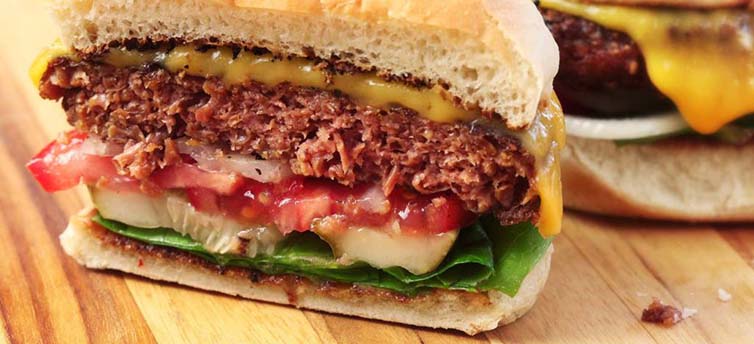
Billionaires Are Betting Big on Alternative Meat

Image result for Billionaires Are Betting Big on Alternative Meat

Creating designer protein that can make your veggie burger taste like the real thing is as easy as brewing beer. Or at least that’s what a new subsidiary of Boston-based bio-manufacturing startup, Ginkgo Bioworks Inc., says.

Ginkgo’s Motif Ingredients, which aims to replicate animal protein for meatless alternatives, is getting $90 million from investors including Breakthrough Energy Ventures, whose board includes tech billionaires Jeff Bezos, Bill Gates and Jack Ma. Commodity powerhouse Louis Dreyfus Co. and Fonterra Co-operative Group Ltd, New Zealand’s dairy-exporting giant, are also backing the company.

The goal at Ginkgo is to get alternative products to market faster, chief executive officer Jason Kelly said in an interview. In a statement announcing the funding, the company likened making alternative foods to the beer-brewing process, because vital ingredients such as vitamins, amino acids, enzymes, and flavors are made through fermentation with genetically engineered yeasts and bacteria. Eliminating extra time in the lab can streamline the process and make it go faster, Kelly said.

Read more here.

Hardee’s, Carl’s Jr. are bringing back Froot Loops Mini Donuts

Froot Loops Mini Donuts return to Carl's Jr. and Hardee's restaurants for a limited time.

“Hardee’s and Carl’s Jr. are bringing back their popular Froot Loops Mini Donuts.

The miniature doughnuts, inspired by the Kellogg’s cereal, will be available for a limited time starting Feb. 25 at participating Hardee’s and Feb. 27 at Carl’s Jr. restaurants, parent company CKE Restaurants announced Tuesday. They come in five colors – red, yellow, purple, green and blue – and taste like their smaller cereal counterparts. A five-pack starts at $1.99 and they will be available all day, not just for breakfast.

“Froot Loops Mini Donuts are the perfect anytime snack and will bring any consumer back to their childhood,” Owen Klein, CKE Restaurants vice president global culinary innovation, said in a statement. “We know our fans craved these nostalgic treats, and we’re thrilled to bring this fun innovation back to our menu this spring.”

Read more here.

In New York City, Restaurants Welcome Tables for One

Customers dine at Boqueria for lunch. The Spanish restaurant’s tapas, or grazing-style menu, appeals to solo patrons.

In New York City restaurants, the party-of-one is becoming a cause for celebration.

OpenTable, the online reservation platform, said that bookings by solo diners at restaurants in the city jumped by 80% from 2014 to 2018. And while OpenTable said those parties-of-one represent a very small slice of overall bookings, some restaurants said that business from solo diners can now account for up to 10% of their sales.

Even on Valentine’s Day, the most couple-oriented dining occasion of the year, New York restaurants are making room for patrons dining alone. OpenTable said that Valentine’s Day solo reservations in 2018 increased by 33% over the previous year. And perhaps for good reason: Restaurants said solo customers represent the ideal, as they are truly there for the food and experience rather than the social occasion.

“The way we approach it is that when we have a solo diner, it’s more of an honor than anyone else,” said Andrew Kuhl, the dining-room manager at Eleven Madison Park, the Michelin-starred restaurant in Manhattan’s Flatiron District.

Restaurants are doing their part to encourage such business. At such establishments as L’Artusi, an Italian restaurant in the West Village, and Odo, a Japanese spot in the Flatiron District, solo diners are given a free offering—say, a small serving of an off-menu item or a glass of sparkling wine. And on Valentine’s Day, some restaurants said they make an extra effort to welcome the solo crowd. For example, at Jones Wood Foundry, a food-driven pub on the Upper East Side, a communal table is set aside for party-of-one diners.

View more here.

DoorDash Closes $400 Million Funding Round

Image result for doordash funding round

“In the last month, a pair of food delivery startups were battling complaints about their tipping policies. Customers and workers chastised the companies for unfairly using tips to subsidize worker pay. As the furor grew, one of the companies, Instacart Inc., changed its compensation policies to match some of workers’ demands.

Meanwhile, the other company, DoorDash Inc., stood firm. It still uses tips from customers to offset some of the minimum payment that a worker gets for each delivery job, in which “Dashers” travel to restaurants or stores and bring food to customers. That decision apparently hasn’t harmed DoorDash’s reputation in the eyes of investors. The company said on Thursday that it received a new round of funding that values it at $7.1 billion.

In an interview Thursday to promote the investment, DoorDash Chief Executive Officer Tony Xu defended the tipping practice, which has been in use since 2017. Xu said internal data show that under the current pay model, Dashers stay on the platform longer, are more satisfied with their jobs and make deliveries in a more timely manner. He blamed recent backlash on Instacart’s implementation of its own policy.”

See more here.

Fluffy Japanese Pancake in Chinatown

People are going wild for these Japanese souffle pancakes

“Chinatown Japanese dessert shop Taiyaki is drawing wildly long lines with a new menu item: fluffy souffle pancakes. People waited in a two-hour line to grab the pancakes last weekend, which come topped with sugar, butter, whipped cream, and syrup, or with matcha cream. The Chinatown restaurant at 119 Baxter St., between Canal and Hester Streets, is selling a stack for $7 from 11 a.m. to 2 p.m. on Fridays, Saturdays, and Sundays.”

See more here.

How Urban Development Shaped the Way 19th-century New Yorkers Ate

“New York City is famous for its food culture, whether it’s a $500 tasting menu at a Michelin-starred restaurant or a bodega bacon, egg, and cheese. It’s possible to find food from every corner of the world, no matter how obscure. Restaurants make, and sometimes unmake, entire neighborhoods.

This is a city that eats out. But that wasn’t always the case. Rewind just over 200 years, when New York was caught between being a Dutch colony and a city, and dining out was a rarity. As the city urbanized, how its residents ate profoundly changed.

An oyster cart, circa 1885

“Food serves as a nice medium to take a step back and look at the bigger picture of New York City history,” says Victoria Flexner, the founder of Edible History, a supper club that creates dinners themed around specific historical moments. Recently Flexner and chef Jay Reifel hosted a meal at the James Beard House that told the story of New York City’s urban development in the 19th century through how its residents dined out.

As the city became rapidly industrialized in the 19th century, a new system emerged to feed these workers: the mobile food cart.

While politicians, businessmen, and other white-collar workers went to oyster cellars and restaurants for their midday meals, lunch came to the working class. Vendors would park outside of factories and docks and, for a few pennies, would sell items like gingerbread, yams, oysters, and corn.”

Read more here.