How Urban Development Shaped the Way 19th-century New Yorkers Ate

“New York City is famous for its food culture, whether it’s a $500 tasting menu at a Michelin-starred restaurant or a bodega bacon, egg, and cheese. It’s possible to find food from every corner of the world, no matter how obscure. Restaurants make, and sometimes unmake, entire neighborhoods.

This is a city that eats out. But that wasn’t always the case. Rewind just over 200 years, when New York was caught between being a Dutch colony and a city, and dining out was a rarity. As the city urbanized, how its residents ate profoundly changed.

An oyster cart, circa 1885

“Food serves as a nice medium to take a step back and look at the bigger picture of New York City history,” says Victoria Flexner, the founder of Edible History, a supper club that creates dinners themed around specific historical moments. Recently Flexner and chef Jay Reifel hosted a meal at the James Beard House that told the story of New York City’s urban development in the 19th century through how its residents dined out.

As the city became rapidly industrialized in the 19th century, a new system emerged to feed these workers: the mobile food cart.

While politicians, businessmen, and other white-collar workers went to oyster cellars and restaurants for their midday meals, lunch came to the working class. Vendors would park outside of factories and docks and, for a few pennies, would sell items like gingerbread, yams, oysters, and corn.”

Read more here.

Refined British Restaurant Found Hiding in a Brooklyn Bar

Image result for Cherry Point new york

“Cherry Point sits on Manhattan Avenue in Greenpoint, a few steps from the corner where Bedford Avenue, having flowed all the way across Brooklyn from the shores of Sheepshead Bay, suddenly comes to an end. The area is marked by a cluster of restaurants. Some have a washed-up feeling, as if they’d all been drifting along in Bedford’s currents and had been stranded there. A few stand out in the landscape.

In the fall, Cherry Point took a decisive turn into the second category when a new chef took over, but not everyone in the neighborhood seems to realize it yet. People still tumble in for happy hour, when servers whose hairstyles take a minute to adjust to will pour three-gulp martinis, manhattans and Rob Roys (due for a revival) in little Nick & Nora glasses for $8 each, and then after happy hour ends at 7 p.m. most of the crowd generally drifts out to find somewhere else for dinner. The space, with its old-timey wainscoting and its central bar, is easy to mistake for a tavern.”

Read more here.

A New Bill Proposes Foie Gras Ban for NYC

Foie gras could soon be illegal to eat in NYC. A new bill from lower Manhattan councilwoman Carlina Rivera is proposing that the sale of the fatty duck liver be illegal, on the basis of animal cruelty. The bill proposes that violators would be guilty of a misdemeanor, with the potential for $1,000 in fines and one year in jail for each offense. The bills follows the Supreme Court rejecting a challenge on California’s foie gras ban. Brooklyn councilman Justin Brannan backs the bill, telling the Post, “Don’t tell me you’re a fan of the Central Park Mandarin duck but you think foie gras is ok.”

Read more here.

One of West Africa’s Most Accomplished Chefs Opens an NYC Restaurant Soon

“Former Le Grand Dakar chef Pierre Thiam — who strives to be an ambassador of Africa’s culinary history — will open a Pan-African restaurant in Harlem’s Africa Center next month, where he’ll showcase his native cuisine in fast-casual format.

Teranga, which translates roughly to “hospitality” in Wolof, a language spoken in Senegal, will focus on Senegalese cuisine, as well as foods from Nigeria, Mali, the Ivory Coast, and Guinea in bowl-like formats.

The menu is molded by West African ingredients like sorghum and millet paired with dried fruits for breakfast, as well as fonio, a grain that’ll be served within salads and bowls during lunch and dinner, Thiam told the Times in August.

Vegetable and protein bowls like grilled chicken and caramelized onions over Liberian red rice will also be available, plus other vegetarian options like a sweet potato and black-eyed pea stew. Drinks range from hot and cold African coffees, teas, and juices. The menu is gluten-free; see it in full below.

The location of Thiam’s new restaurant within the cultural center makes sense, as he is a vocal advocate for Africa’s culinary history and even appeared in a 2016 episode of the late Anthony Bourdain’s Parts Unknown in his native Senegal. The restaurant will take up a 2,000-square-foot space in the center, overlooking Central Park.”

Read more here.

New NYC restaurants: Danish bakery Ole & Steen’s stateside debut, and more

Screen Shot 2019-01-28 at 7.05.09 PM.png

“Ole & Steen

“NYC’s Nordic offerings continue to grow beyond destinations such as the Great Northern Food Hall with the stateside debut of this 28-year-old Danish bakery. Find Danish rye breads, pastries and tarts, as well as sweet or savory porridges, open-faced sandwiches, salads and more on the all-day menu. Now open Mon.-Fri. from 6:30 a.m.-10 p.m., Sat.-Sun. from 7:30 a.m.-10 p.m.; 873 Broadway, 929-209-1020”

View more here.

Request for Proposals for the Sale of Food and Beverages from Mobile Food Units at Flatbush Ave & Plaza St, 9th St & Prospect Park West, Dog Beach, 10th Ave Ballfields and the Vanderbilt Playground Loop in Prospect Park, Brooklyn, NY

Screen Shot 2019-01-23 at 5.49.47 PM.png

See more here.

Bangladeshi Food Is a Rarity Around New York

““I love feeding people,” said Nur-E Gulshan, who began cooking as a 16-year-old newlywed in the Bangladeshi city of Bogra. “Since my kids’ friends come over, they always said: ‘Auntie, why don’t you open a restaurant? Your food is so good!’ Always, I thought they are just telling me as courtesy. Then they grew up, and they’re still telling me to do the same.”

“There is a long, often-unexplored history of Bangladeshi immigrants’ owning nominally Indian restaurants in the United States. But the food isn’t Bangladeshi, nor does it reflect the varied regional cuisines of India, one of the largest and most populous countries in the world.

Nur-E Farhana is steadfast in distinguishing her mother’s Bangladeshi food from the Indian food typically encountered in restaurants in America: “Chicken tikka masala, butter chicken, paneer,” she said with a sigh.”

See more here.

Flatiron Plaza Food & Beverage Kiosk RFPs

Screen Shot 2019-01-22 at 1.00.23 PM.png

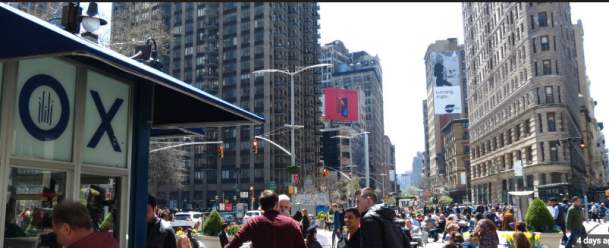
The Flatiron/23rd Street Partnership (BID) is seeking proposals from qualified firms to manage and operate an outdoor food or beverage kiosk (“Kiosk”) in the Flatiron North Public Plaza, located at 23rd Street, Broadway, and Fifth Avenue, and the Flatiron South Public Plaza, located on Broadway between 22nd and 23rd Streets, adjacent the famed Flatiron Building.

Created by the by the New York City Department of Transportation (DOT) in 2008, the Flatiron Public Plazas have become town squares, where countless residents, employees in the neighborhood, and visitors from around the world converge each day. The BID has a concession license agreement with DOT for the operation, management, and maintenance of the Plazas which allows for the operation and management of subconcession(s).

It is the goal of the BID to draw customers to a successfully-branded food or beverage kiosk that is successful and enhances the atmosphere and experience of the Flatiron Public Plazas and this vibrant neighborhood.

A nonmandatory pre-bid conference will be held on Thursday, January 24th at 10 am at the office of the Flatiron BID (27 West 24th Street, Suite 800B). The pre-bid conference will include a site visit to the Flatiron Public Plazas. Questions related to the RFPs should be submitted in writing to the BID no later than Friday, February 1st at 5 pm. All proposals are due by 5 pm on Friday, February 22, 2019.

See more here.

Benno, Proudly Out of Step With the Age

Image result for Benno, Proudly Out of Step With the Age

“Dated was the word one friend used after going to Benno, and if you’ve eaten there, too, you’ll know why. It’s as if the past 15 years in food never happened. The menu seems to be stuck in some time between 1994, when Thomas Keller bought the French Laundry, and 2004, when he opened Per Se with a young Jonathan Benno leading the kitchen.

The restaurant will probably be a tough sell to those diners who expect all restaurants to fall on a continuum between Noma and the Salt Bae place. But I prefer it to any number of newer, self-consciously modern restaurants, some of which are so determined to be of the moment that they might as well have a time stamp. Benno is not trying to be contemporary. It’s trying to be delicious. And it is, from start to finish, almost without exception.”

Read more here.

U.S. FDA Says It Will Try to Resume Some Food Inspections

Related image

“The U.S. Food and Drug Administration will be restarting high-risk food inspections as early as Tuesday — a process many Americans may not have even known was halted.

FDA Commissioner Scott Gottlieb announced via Twitter the plan to resume high-risk probes on Monday afternoon, adding that “we started sampling high-risk imported produce in the northeast region today. We’ll expand our footprint as the week progresses. Our teams are working.”

The work is “being done by an inspectorate that’s largely going unpaid,” during the government shutdown, he added.”

See more here.