The Lucky Bee Promises Both Flash and Substance in LES

12289662_1688514854697882_4618353828013842184_n.jpg

Photo via The Lucky Bee’s Facebook page

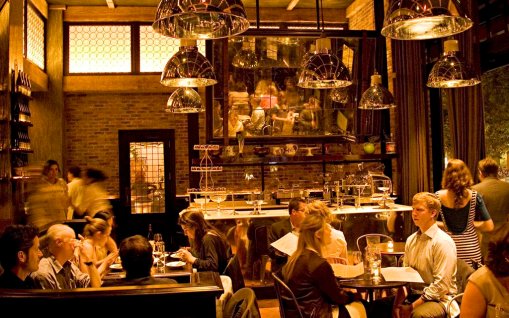
Although they have no set opening date (Facebook messages promise “about two weeks”), The Lucky Bee on Broome street is already generating  exciting press for their Thai street-food/Asian-fusion concept. Conceived by Rupert Noffs and chef Matty Bennett (formerly of the Fat Radish), the Lucky Bee looks to be a brightly colored, design-heavy confection of a restaurant; the interior, menu and website are all splashed with neon pink, and in some cases they literally flash. But Noffs and Bennett have a more serious mission beyond the aesthetic, with a mission to provide original Thai-influenced cuisine not available anywhere else in Manhattan, and a major locavore bent.

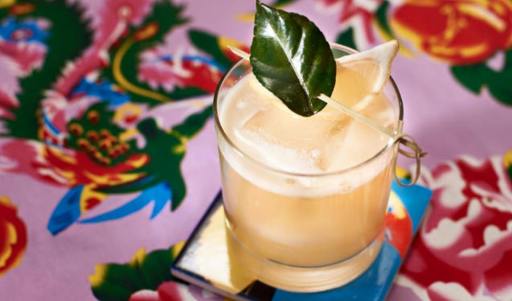
And while the term “locavore” (or “farm-to-table”) might seem like more of an empty prerequisite than a real statement these days, The Lucky Bee is at least serious about respecting their namesake. The cocktail list features drinks made with local honey, and a dollar from each drink sold goes to the New York Beekeeper’s Association. They even hope to keep their own hive on the roof soon. With the troubling free fall of honey bee populations in the past few years, the pollinators could certainly use some PR men with as much design sense and culinary chops as Noffs and Bennett. Hopefully their momentum continues well past opening.

To read more, click here.

UPDATE: The Lucky Bee is now open! They began serving dinner January 21st.

David Chang’s Maple Expands Delivery Zone

As of today, workers in midtown now have the option to order there lunch from Maple – the streamlined food delivery competitor of Seamless and Grubhub backed by Momofuku’s David Chang. The Maple app launched last spring, and has since then allowed users downtown to order lunch or dinner from a rotating selection of menus (roughly 5 a day) to be delivered to their work or home. What separates Maple from other delivery apps is that there is no restaurant or selection of restaurants you are ordering from; instead, their small staff operates out of a commissary kitchen testing, preparing, and packaging the recipes each day (although Chang describes the operation as a “real restaurant,” with the app and delivery logistics taking the place of typical front of house operations).

Maple is a favorite of downtown 9-to-5’ers for it’s focus on presentation, affordability, and simple, healthy options. Chang originally invested in the project because he believed that “no one [had] ever taken the time to really do delivery food well.” They are expanding slowly for now, and still have all the trappings of a service-focused start-up: they have a small team of well-paid employees with a high attention to detail, and if you contact them with any problems (like a food order that arrives after 30 minutes), you’re likely to get emails back from a real person whose top priority is keeping you as a customer. Orders even include a free sugar cookie to set them apart. So far all thi has worked to Maple’s advantage, and press has been consistently good. We’ll know soon whether they can build the momentum necessary to compete with top delivery apps on a larger scale.

To read more, click here.

The $100 Donut You Probably Don’t Need

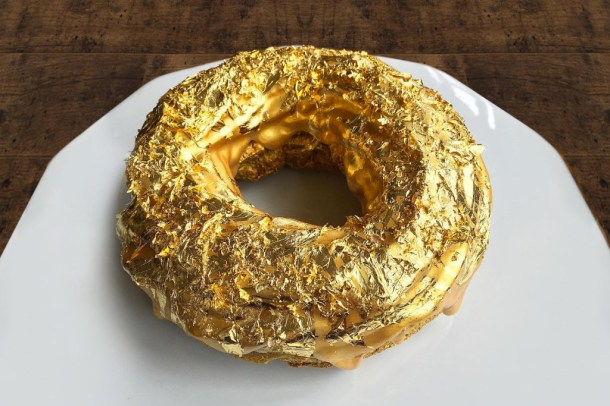
manila-social-club-100-dollar-donut-101.jpgThe New York Lottery has been running subway ads recently which feature allegedly true stories of egregious displays of wealth – thousands of dollars spent on dead bats or caviar that never gets eaten, for example – with the tagline “You’d make a much better rich person.” The idea is a catchy one, and it’s easy to find examples of people who will pay a little (or a lot) more to get the most luxe versions of everyday items, and businesses willing to provide them. The latest example is Williamsburg’s Manila Social Club, where you can now buy a $100 donut coated in 24-karat gold and Cristal champagne icing.
The donut was originally conceived by chef Björn DelaCruz to pair with Braven Brewery‘s IPA. The recipe has morphed over time, although Manila was already known for other donuts featuring the same ube filling. So far the steep price tag and over-the-top execution have generated plenty of publicity, and according to Business Insider some guests have even paid 1,200 and gotten a full dozen. All of which raises the question – can any of us really be sure we would make better rich people than the dead-bat collectors and caviar-forgetters of the world?

To read more, click here.

France Is Getting Aggressive with Food Waste

We wrote recently about tackling food waste, a major contributor to climate change causing emissions, by embracing ugly food. Although the ugly food movement has footholds worldwide, some of it’s strongest proponents are in France, including Nicholas Chabanne of Gueules Cassées. But as wonderful as the idea is to get “imperfect” produce out of landfills and onto our plates, it requires reversing a lot of momentum and decades of habits for both consumers and suppliers. Since the French government has stated that they intend to cut food waste in half by 2025, they are pulling out all the stops necessary to do so.

In May, the French National Assembly passed legislation requiring grocery stores to have formal contracts with food banks and implementing hefty fines for throwing out food or deliberately spoiling it (an apparently common practice to prevent dumpster diving). Now the French government has made it illegal for large restaurants (generally those seating over 150) not to offer doggy bags to all guests. Since the French do not have a native word for the concept, it could be slow to catch on, but every bit counts in a nation where restaurants are such a vital part of the national economy.

To read more, click here.

Andrew Carmellini Comes to Brooklyn

Andrew Carmellini’s NoHo Hospitality Group, which brought Manhattan border-hopping concepts ranging from the French bistro (Lafayette) to the Italian cafe (Bar Primi) to the American oyster-house (The Dutch), not to mention a few hotel restaurants (Locanda Verde and Little Park), will finally come to Brooklyn this summer. The NoHo group, which includes Carmellini and partners Luke Ostrom and Josh Pickard,  will be taking over food and beverage operations at The William Vale hotel: a 21 story building with 183 rooms, a ballroom, indoor-outdoor bar, and an elevated 15,000 square ft. public green space. They will be responsible for the hotel’s dedicated restaurants, as well as the bar, room service, and any events catering. Fortunately their CVs are up to the task and they have the enthusiasm to match. In a statement to BKMagazine, they said “We love Williamsburg and know this property will be an anchor for the neighborhood. The timing is just right.”

To read more, click here.


Farm-to-Table, Even in Alaska

OLYMPUS DIGITAL CAMERA

Photo via verticalharvesthydroponics.com

The expression “farm-to-table” (and it’s variants in the retail world like “bean-to-bar,” which recently got the Mast Brothers in hot water) has been around for some time; with sustainability and health on everyone’s minds in 2016, it shows no signs of going away. Even in Alaska, a state where chefs of all kinds lament the flavorlessness and cost of produce picked before its time and shipped thousands of miles, a farm-fresh movement is starting to take root.

Two new startups, Alaska Natural Organics and Vertical Harvest Hydroponics, are attempting to bring sustainable farming closer to the residents of Alaska using (relatively) new agricultural technology. The two companies rely on different solutions to the problem of climate – the former operates a small farm out of an old warehouse in downtown Anchorage, with LED lights set up to allow hydroponic vegetables to grow year round, and the latter makes portable growing pods out of repurposed cargo containers. These containers are designed to be climate-proof and easily installed as close to the consumer as possible – in the basement of restaurants or grocery stores, for example.

If successful, more start-ups could follow suit in Alaska and other harsh climates. The benefits are easy to see, as produce grown nearby saves on shipping costs, reduces emissions, keeps money in the local economy, and can be picked when ripe for better taste and nutrition.

To read more, click here.

Chick-Fil-A Rings in New Year by Getting Shut Down

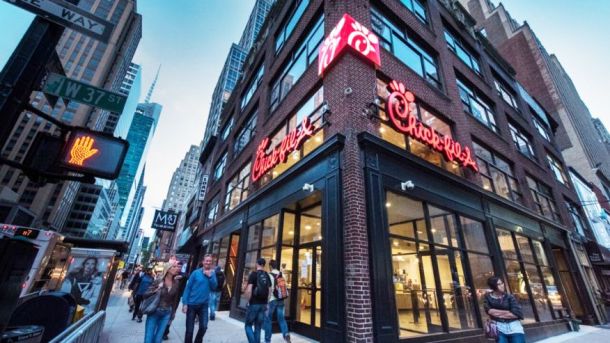
wrewr435345fdssdfsd.jpgAfter a December Health Inspection that earned the fried chicken chain a damning C grade, the midtown Manhattan Chick-Fil-A has closed for five days in order to make improvements to operations and hopefully earn a higher grade on re-inspection. “Grade Pending” currently hangs in their window until the update is complete.

This New York branch of the controversy-ridden chain earned a total of 59 violation points on their December 24th inspection, and 39 on an earlier December inspection. Those include a number of “critical” violations for things like the presence of filth flies and improper food storage. They are allowed to leave the “Grade Pending” sign up until their appeal is heard at an Office of Administrative Trials and Hearing Health Tribunal.

To read more, click here.