Reducing Carbon Emissions with Ugly Food

imperfect-fruit.jpg

The recent United Nations climate conference in Paris drew to a close with a historic deal, but there is still a long uphill battle ahead to reduce emissions and reach the target CO2 levels most climate scientists agree are safe. One creative solution has emerged from the farming industry, where food waste (and the decomposition of edible food in landfills) is responsible for over a billion tons of carbon emissions every year.

Nicholas Chabanne is an entrepreneur encouraging consumers to “eat ugly” through his campaign Gueules Cassées, which translates into Ugly Mugs. He is part of a growing international movement to encourage people to buy and consume more produce that would ordinarily be deemed too visually unappealing for supermarkets – and as a consequence end up in landfills. Often the fruits and vegetables which are discarded by major producers simply do not meet size criteria, or have minor superficial blemishes from the farm.

Chabanne is joined by like-minded entrepreneurs around the globe, including the San Francisco startup Imperfect Produce and the Portuguese cooperative Fruta Feia (or Ugly Fruit). With logistics in place, consumers can buy this produce at significant discounts, but most conventional grocery stores refuse to sell anything that doesn’t meet the strictest visual criteria.

So far, the movement to “eat ugly” has gained a foothold largely with home consumers, but restaurants buying directly from wholesale producers can do their part to increase demand as well. Meeting the climate goals established in Paris will take commitment and creative solutions across the board – hopefully this is one idea that diners can stomach just fine.

To read more, click here.

Tipping Lawsuit Against Danny Meyer’s Gramercy Tavern

Recently we wrote about the new trend among US restaurants – largely spearheaded by Danny Meyer himself – toward the more European style of removing tipping altogether and increasing wages across the board (paid for by corresponding price increases). Now a new lawsuit has emerged against Danny Meyer’s Union Square Hospitality Group by two former employees, who allege minimum wage and tipping violations by Gramercy Tavern during their time their.

The two plaintiffs claim that they were paid the tipped minimum wage (currently $5/hour in New York) when they should have received the full minimum of $8.75 because their tips were pooled and shared with non-service employees. The suit also claim that Gramercy unlawfully withheld all or part of a 20% service charge from special events. They are seeking class action status to recoup the lost tips for all service employees, which likely brings the number to over 100.

In an emailed statement, a spokesperson for Meyers said that “Union Square Hospitality Group has systems in place to comply with all employment regulations. We have always cared deeply about cultivating a strong employee-first culture, and we will review this matter thoroughly.” By 2016, when all USHG restaurants move to a non-tipping system, they will effectively remove the possibility of these types of lawsuits.

To read more, click here.

The Chocolate-Bone Broth No One Saw Coming

BrodoChoc.jpg

Photo via Grubstreet.com

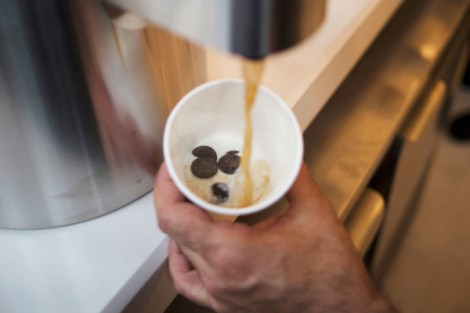
Trends have a way of folding in on themselves – stretching their own limits and testing their customers taste buds in the process. Bone broth, the trendy hot health drink which took off last winter with Marco Canoro’s Brodo is the latest example. This year, Canoro is teaming up with Morgenstern’s Finest Ice Cream on Rivington (which also opened last year) to open a pop-up window shop with some unexpected new mashups.

In addition to the full Brodo broth menu, the shop will offer the “What Came First” (organic egg yolk, freshly grated nutmeg, organic chicken broth), a savory take on eggnog, and the “St. Nick” (bitter chocolate, beef broth, coconut milk). Canoro calls the savory-broth-cocoa “fucking outrageous,” which is a bargain at $7.75 for ten ounces. TBD on whether New Yorkers will take to this combo the way they did to the original broths, but who knows what’s possible in this post-chocolate-and-bacon-trend world. At least customers can still tout the health benefits of the broth, with the added kick of dark chocolate.

To read more, click here.

St. Nick.jpg

Photo via Grubstreet.com

Port Authority to Get an Upscale Food Court

Few people think of going to Port Authority unless they absolutely have to, let alone hosting a business lunch or out of town guests there. That may not change in the near future, but the bus terminal is trying to make your Greyhound layovers a little more swanky by adding an upscale food court with three “diverse, high-end dining options,” according to a recent press release.

The Board approved OHM Concession, which operates airport food courts all over the country, will be renting space near the ticketing entrance on a 10 year lease totaling just over $15 million. This price is a good deal higher than any existing vendors pay for the same area.They plan to start construction in February, but there is no word yet on exactly what restaurants will go into the space.

This particular lease is part of the Port Authority’s “Quality of Commute” program, which includes more general plans to improve the space over the coming years by adding more cell phone service, WiFi, and new restrooms. The program should run around $90 million overall.

To read more, click here.


Apres-Ski Themed Bar on Eataly’s Roof

Baita.jpg

Photo via eataly.com

Eataly, the Italian food mecca on 5th avenue, has opened the pop-up Baita bar on their roof with an “Italian Alps” theme. According to their website, they’ve “replaced the stone walls and nearby hills of grazing sheep with a retractable glass roof and views of the neighboring Flatiron building, but the food and drink will make you think you’re in the Italian Alps, right in the middle of Manhattan.”

Holiday shoppers, tourists and Eataly regulars can all enjoy tasty seasonal fare, like polenta and homemade sausage, while sipping on the sort of drinks you might crave after a long day on the slopes. Eataly’s brewery Birreria is running the pop-up, and pints of their cask ales will be available alongside a full wine list and house cocktails. Featured among those are mulled wine and Bombardino – a cream based Italian cocktail reminiscent of eggnog – but if the ski lodge aesthetic isn’t enough to make you forget the unseasonable warm weather we’ve been having, there are plenty of original cold cocktails as well. Other classic Italian goodies like fresh pasta and charcuterie from the market below will also be available.

If you visit and fall in love with the festive atmosphere, Eataly is also renting out Baita for parties of up to 175. But get there soon – the pop-up will only be around through March of 2016.

To read more, click here
.


A New Fast Casual from the Eleven Madison Park Team

Daniel Humm and Will Guidara, the current co-owners of Eleven Madison Park, recently announced plans for a new fast casual concept to open next year on West 28th. Made Nice will be a counter-service spot featuring veggie- and grain-heavy meals with seasonal ingredients for the health conscious crowd. They hope to join the current wave of healthier quick service restaurants with a greener tinge popping up all over the city, and provide flavor-forward meals meals running between $10 and $15.

Early hints from the team indicate that the new restaurant will still be strongly design-focused. They are working with the architecture and design firm Stonehill & Taylor on the interior and artist Jono Pandolfi on stoneware, both of whom worked with the team previously on NoMad.

The EMP team also has other plans in the works, including a new NoMad in Los Angeles due in fall of 2017, and a mysterious fine-dining project on Park avenue described as a “Four Seasons on steroids for the 21st Century.”

To read more, click here.

Another Chipotle Connects to E.Coli

Chipotle has been under a lot of fire these past few months because of its connection to multiple E.Coli outbreaks. This past week a number of Boston College athletes were reported sick with the norovirus after eating at Chipotle. The BC students were brought to the university’s health services because of their “gastrointestinal symptoms.”

Boston College emailed a public health warning to the whole student body that called the Chipotle near campus “the common denominator of all affected students.” The men’s basketball team is among the 30 sick students.

Chipotle spokesman Chris Arnold said “We do not have any evidence to suggest that this incident is related to the previous E.coli incident.” The Department of Public Health is working to determine if the students have E.coli.

To read more, click here.

Keurig sold for $14 Billion

keurig-logoKeurig Green Mountain has shown recent decrease in their sales, because of consumer demands of variety in the K-Cups, their high prices, and their lack of adaptability for other branded K-Cups. Their Kold soda-maker had disappointing results despite long term investment. However, the maker of single-serving coffee pod machines has been sold to an investment group for $13.9 billion.

The purchasing group, led by private-equity firm JAB Holdings, also owns Oreo-maker Mondelez. The sale of Keurig has shot up stocks 76 percent. The deal has become a crucial step for the group’s “global coffee platform.”

To read more, click here.

Tipping is Going Extinct

Over the past week weeks, a storm of debate has surged over the news that Danny Meyer has opted to eliminate tipping in his fine dining restaurants over the course of the next year. It’s a monumental decision and the change has its advocates and skeptics. In this month’s Enterprise Insight, we’re cutting through the opinion to talk specifically about the benefits and challenges of implementing such a system.

Specifically, we will review what operators need to consider when thinking about this: why, how, and the possible pitfalls.

Why Would You Eliminate Tipping

With our clients, we’ve discussed three key reasons for implementing a more-European system: pay disparity, retention, and rising wages.

The back of house has always been under-compensated in comparison to the dining room. Due to the legal classifications of wages, back of house employees cannot be tipped. Under a tip-included system, the real cost of the meal—menu price plus tip—is built into a single number, and the revenue from that number is accessible to the owner to distribute as he or she sees fit.

This, in turn, can help with retention. Low-wage jobs are historically high-turnover jobs. However, with access to the tip ‘revenue,’ an owner can increase wages accordingly to alleviate this issue.

Lastly, rising wages are driving up labor costs and in some instances, driving away skilled labor. With the minimum wage in New York changing on a industry-by-industry basis, it will only become more difficult to find and retain great team members. Again, a tip-included system allows the operator to offer competitive wage rates.

Additionally, in the front of house, the tipped-minimum is also going up. Come January 1, NYC restaurateurs will be required to pay their servers $7.50 per hour–a 50% increase. However, if the restaurant eliminates tipping, then the team can be paid a salary, or a greater hourly wage plus a bonus drawn from the ‘tipped revenue’, thus alleviating this jump in labor costs.

How Would You Eliminate Tipping

Currently, there are only two viable options: increase prices, or apply an “administrative fee.” Be mindful with an applied “fee:” if you charge a “Service Fee” rather than “administrative,” you cannot disburse that revenue to any one not in a service position.

Neither feels good right now, but we believe that price increases will become the new normal. Here’s why: with an “administrative fee,” tipping isn’t eliminated, it’s removed from the diner’s control. With price increases, it’s truly taken off the table. The diner does not know and cannot argue with the prices because they give no allusion to the portion going to the team.

Pitfalls

Increasing pricing will always cause a certain degree of pushback from guests. Until they’re fully on board with tip-included system, the sticker shock will cause a reaction. However, as more and more of NYC s fine-dining enterprises move to this style, the less resistance operators will face. Whether your establishment plans on keeping or eliminating tipping, it’s important to understand the mechanics, because “tip-included” is bound to become the new normal for a significant portion of the dining scene.

Blu on Park Opens in New York City

blu-on-park09.w600.h400Blu on Park is New York’s newest luxury steakhouse. It is located on Park, 116 East 60th St. Blu on Park is uptown, housed on the first three floors of a renovated 1920s residential brownstone. The restaurant seats 132, and NH Designs has included opulent details like gold-tinted exposed brick, abstract landscape paintings, and antique mirrors. The first floor is devoted to the bar and the lounge. The mezzanine and third floors are large-scale dining rooms.

Blu on Park’s Chef Russell Rosenberg created a more traditional steakhouse menu. They offer seven different types of steaks ranging from $42 to $120. There are lobster and shrimp cocktails, jumbo crab cake, sautéed black sea bass, and sour-cream cheesecake for dessert. The more affordable bar menu includes truffled arancini, caviar with roasted marble potatoes and creme fraiche, and veal meatballs.

To read more, click here.