What does 2016 Hold for Meal Kits?

f482d9a047cffbed4fc45904bffc824992dcbc63_christmas-4.jpgMeal kits and recipe delivery services exploded in 2015, with promises of convenience and easy access to all the joys of cooking. Services like Blue Apron, Plated and Hello Fresh (all available nationally), along with a number of more local startups, offer customers customizable subscription services to bring pre-portioned ingredients to your door, along with a (hopefully) easy to follow recipe selected from the frequently updated options on their sites. Many of these companies tailor their recipes to focus on specific health concerns or responsible ingredient sourcing, with the goal of providing subscribers with all the pride of a fully home-cooked meal. One plant-based version of the model even attracted the legendary Mark Bittman to their team.

Understandably, these companies have already seen some blowback from their surge in popularity, on both the environmental side (the extra packaging used to deliver a single meal’s worth of 5 spices may not be the best thing for mother earth) to the cultural (is some part of the joy of cooking lost for the sake of convenience?) But that hasn’t stopped the venture funding from flowing in. Even if the bubble doesn’t burst, some meal kit companies may face growing pains in the coming year, as competition increases and newcomers try to expand quickly. Good Eggs, a grocery delivery service with over $50 million in funding, recently laid off nearly half their employees and closed operations in all cities but San Francisco.

One important test will be how these companies take advantage of the holiday season, and increase their reach through either gift subscriptions or holiday offerings. Most sites already sell gift cards, and some offer holiday meal kits to make party-hosting easy. Blue Apron, for example, wants you to “Host a Blue Apron Christmas!” and Atlanta-based PeachDish sold out of their Christmas dinner for four, but are offering it for New Years as well. According to their website, “You provide the champagne and we’ll provide everything else for your New Year’s Eve party!” Of course, you could always get the champagne delivered too and call it a night.

To read more, click here.
Minibar, Drizly, and Amazon Want to Keep your Champagne Popping

minibar-delivery-app.png

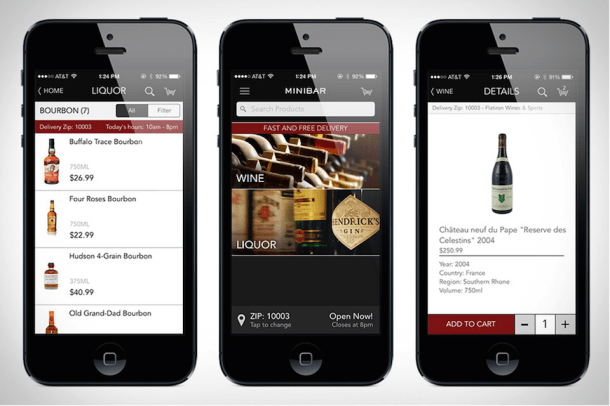
If you’ve taken the New York subway recently, you may have noticed the seasonal ads for Minibar, the alcohol delivery service that has been expanding rapidly the past few months, first by acquiring competitor Booze Carriage in March, and then by launching a subscription service for recurring orders in October. Minibar claims to have the largest share of the New York market, but that’s difficult to confirm. They certainly have plenty of competitors out there who are looking for a piece of the alcohol-delivery pie.

Most notably, and perhaps most threateningly to Minibar, is Amazon. Until early this month, Amazon only offered 1-hour booze delivery in Seattle, but as of December 9th New Yorkers with a Prime subscription can take advantage of the service as well.  Amazon is billing it as part of their Prime Pantry, so you can stock your party with other necessities like paper towels and Swiffers as well.

A third option is Drizly, which has a larger share of the Boston market, but is also available in parts of Manhattan, Brooklyn and Queens. Both Drizly and Minibar work by partnering with local liquor stores, listing their offerings via their app and website by zipcode, and taking a percentage of sales. Which service emerges as the market leader in New York may come down to who snatches up those local partners the fastest, but Minibar is also bolstering their business by providing other services – their website includes a party-planning feature to make sure you’re well stocked for any event, and if you feel intimidated by all those bottles you can even rent a bartender through their site.

To read more, click here.


NASA Engineer Makes Your New Robo-Barista

IMG_2267-1200x900.jpg

Most coffee shop regulars are willing to sacrifice at least some quality for speed, and the time-consuming process of  making pour-over coffee usually just isn’t feasible when there’s a line of customers out the door, even if the end product is a superior brew. In July, Cafe Grumpy introduced their solution to this problem at the Chelsea branch: a robotic pour-over machine capable of brewing 5 cups at a time. The Poursteady was engineered by Mark Sibenac and Stuart Heys, whose CVs include building parts for NASA’s Mars Rover, but who have now turned their attention towards quintupling the production of pour-over coffee.

Far from becoming our caffeinated robot overlord, the Poursteady actually puts as much control as possible in the hands of the barista, who can change the water temperature to within a degree, the water volume to within a gram, the timing to within a second, and the size of the drizzle pattern, all from a custom app. Outsourcing all those controls to an app keeps the machine itself clean and simple. So far, it seems to be working well for Cafe Grumpy, who originally installed the Poursteady for a trial run but bought it only a month later. Several more are currently in production, and you can even buy your own through their website.

To read more, click here.


Correction: an earlier version of this article listed Stephan von Muehlen, the product designer, as chief engineer.

Enterprise Insight: Employee Tips get boost from POS systems

It’s not news that your Point of Sale can drastically affect operations. However, we’re seeing a new trend—the POS boosting employee tips. In this month’s Enterprise Insight, we will discuss the different types of point of sale systems, the effect mobile terminals have on tipping, and the concurrent changes in minimum wages.

Type of Systems

Point of Sales systems can largely by classified into either legacy-based or tablet-based systems. Legacy systems are those that run on proprietary hardware that hasn’t caught up technologically to what is available to consumers. These terminals operate on touch screens that are linked to an in-house server. These systems are good for keeping data on site, but that is largely no longer necessary. Aloha and Micros are great examples.

Tablet systems use hardware such has iPads to run a cloud-based point of sale software. These tablets process orders locally and push the data into the cloud, which is then accessible from anywhere. One of the biggest selling points of these systems—namely Square, Revel, Shopkeep, and Lavu—is the ease of use and mobility of these systems. The graphical user interfaces are friendly, editing the menu doesn’t require using a Windows-based database software, and the back of house reporting is more visual than legacy systems.

Furthermore, these terminal do not need to be tied to a centrally-located server, which let’s users take orders from just about anywhere. Lastly, these systems all allow guests to sign for checks on the screen—which driving major changes in tipping practices.

iPad POS Systems Driving Up Employee Tips

Software research company Software Advice recently surveyed customers familiar with iPad point of sale systems and found compelling results: quick-tip buttons improve gratuity. Software Advice’s research found that the proximity to the server, the automatically-calculated tip amounts, and the presence of “no tip” buttons all create more frequent, more likely, and higher-value tipping.

Meanwhile, this tip creep in the industry comes at a time when two other significant changes are taking hold: an increasing minimum wage and a trend towards abolishing tips in favor of “service charges.”

New York State just passed legislation that increases the minimum wage of foodservice employees of chains with 22 or more locations to $15 per hour (by 2021.) Unfortunately for these employees, though, these operators are now less likely than ever to use iPad terminals with suggested tipping—with the increased cost of labor passed on to customers, the guests certainly won’t feel so willing to tip.

Furthermore, this comes just as the City passed legislation increasing the tipped minimum wage to $7.50. And given the recent unrest surrounding the difference in pay between service and kitchen staff, more and more full-service restaurants are prohibiting tipping and instead applying the gratuity automatically as a charge on the bill. This charge is then equally distributed amongst the entire staff, not just servers.

However, full-service restaurants will soon be operating in a more quick-service fashion once EMV payments are required, and the guests must process their cards themselves; the guest will come face-to-face with the POS terminal, just as in a quick-service setting. Perhaps the “service charge” will become preset buttons just as in the current quick-serve template, creating “service charge” creep at this end of the spectrum, as well.

To read more about Software Advice’s research, click here.

To read more about the increase in minimum wages, click here.

Restaurant Tech: From Sourcing to Reservations

Technology is a major factor in growing businesses now, and is especially transforming the restaurant industry. Many start-ups are developing applications and resources to improve restaurant operations and optimize dining experiences. On July 22nd presenters of these start-up companies will share what makes their technologies and business models unique and their lessons learned from growing their companies.

There will be a networking event, wine from Taste Wine Company, catering from Ox Verte, Salsa Pistolero, Digg In and Wandering Bear Coffee Co. Presenters include Krystle Mobayeni, Co-founder of Bento Box, Konstantin Zvereff, Co-founder & CEO of Improvonia, Greg Hong, CEO & Co-founder & Board Director of Reserve, and Adam Eskin, Founder of Digg Inn.

The event is from 7 PM- 9:30 PM at LMHQ (150 Broadway, 20th Floor, Manhattan, NY). Price is $20.00 per person.

To learn more about the event, click here 

Opportunities: CohnReznick Presents 2015 Hospitality Webinar Series

8c1d533d77cb811b09c0b47c64360fa9

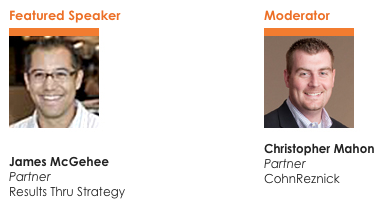
CohnReznick LLP, one of the top accounting, tax, and advisory firms in the United States, will hold the second session in their Hospitality Webinar Series on May 21st titled The Technology Landscape: Understanding What You Need and What Works. This webinar will cover the past, present and future of hospitality industry technology and identify the best platforms based on a company’s technological need. The webinar will be moderated by Christopher Mahon, Partner at CohenReznick and will feature James McGhee, Partner at Results Thru Strategy. Screen Shot 2015-04-28 at 12.39.44 PM

The series goal is to present webinars focused on the financial and operational issues that face hospitality companies. Other upcoming topics for the series include Public Relations and Social Media Strategies, The ABCs of Lending: The Finance Market for Restaurants, Both Big and Small and Legal Issues for the Hospitality Industry.

CohnReznick, headquartered in New York, offers specialized services for middle market, Fortune 1000 companies, private equity and financial services firms, government contractors, government agencies, and not-for-profit organizations. Founded in 1919, they have over 300 partners, 2700 plus employees and bring in an annual revenue of more than $500 million dollars.

To register for this webinar, please click here

Venture Capital Is Hungry for the Food Business

The food business is “ripe for disruption,” according to Steve Case, who cofounded America Online 30 years ago.  Case, who recently started his Washington-based venture capital firm Revolution, has made several high-profile bests on food: Sweetgreen, OrderUp, and Revolution Foods, a school-lunch company serving 1.5 million student meals per week.

“There are opportunities to improve the way things are done at every level: How food is produced, exported, processed, consumed,” Case said in an interview this week. “Our focus … is on investing in people and ideas that can change the world, and it’s harder to imagine anything that changes the world as much as food.”  To Case, the opportunity is, like in tech, in scalability: “It’s one thing to create one product in one particular restaurant,” Case said. “It’s another thing to roll it out to 5,000 restaurants, where the chefs are 16-year-old kids who have worked there for a few hours.”

Case thinks that the low barriers to entry and potentially high profit margins are partially why so many successful food companies have rested on their laurels, and this is where tech will come in to disrupt–especially given that eaters are embracing dining out more often and using apps for payment.  Sweetgreen, one of Case’s investments, is a salad shop that receives more than 20% of its orders through the chain’s mobile app.

“We’re in the first days, the early innings of this food revolution,” he said. “Nothing’s more important than what you put in your mouth three, four, five times a day.”

To read more, click here.

Developing A Restaurant Tech Strategy

Food Tech Connect will be hosting a series of classes on June 28th in NYC on how to save money on technology in a restaurant. The first class in the series will touch upon how to choose the POS system best suited for your restaurant, how to budget for your restaurant IT and how to drive more traffic and keep customers coming back. Overall the class will teach how to create a tech strategy that is straight forward and that will save you time and money. Mike Dulle, who leads the Restaurant & Bar Initiative at ShopKeep POS, will be leading this first 90 minute class.

Here are a few of the steps that will be covered in the class:

  1. Operational Setup: tech to purchase (Hardware & Network), website creation, POS
  2. Workforce Management: employee scheduling, payroll
  3. Demand Generation: reservations, local business listings, menu management, yelp
  4. Customer Retention: loyalty, email marketing, social media

The second class in the series is taught by Felicia Stingone, former Senior Managing Director of Brand and Marketing for Danny Meyer’s Union Square Hospitality Group. The class focuses on different marketing strategies and how to really leverage and build your brand.

Here are a few takeaways from the class:

  • Learn about the marketing strategies restaurant powerhouses use to grow their business
  • Get an inside look at how to start to leverage “brand” to scale a business, from opening more doors or new concepts to publishing books and launching products
  • Walk away with insights and practical tactics that you can use to shape a brand strategy and develop a marketing plan to help grow your business.

The last part of the series is a panel led by the founders of Culintro, Easy Pairings and Culinary Agents. The panel discussion will focus on how to streamline hiring processes and which technologies can help make this process easier. It will also share tips on how to empower employees to succeed and give an insight into how these three startups are working to improve and simplify the hiring process.

The series welcomes already established brands as well as startups and anything in between. The course will take place on June 28th in NYC but will also become available online on Aug 6. To read more about the event click here

Advancement of Mobile Payments in the Restaurant Industry

Starbucks was the first to adopt mobile payments back in 2011, and now other brands are quickly getting on board. As mobile payments become increasingly more available, customers will begin to expect the service, so brands are now navigating through their options on how to launch their own mobile payment systems. At a panel held last week by the National Restaurant Association, brand representatives stated that mobile payments are moving toward the mass adoption stage and are no longer in the early stages.

Mobile payments offer the benefit of providing an insight into consumer’s purchasing behaviors and this information in turn can be used to influence such behaviors in order to better engage with the customer. Mobile payments also mean lower interchange rates and more secure payments. Restaurant brands will need to explore different technologies that can help facilitate payments at the point-of-sale and decide which will be a good fit.

Here are just a few of these types of technologies:

  • NFC
  • QR code presentment
  • QR code scan
  • Single use number
  • iBeacon technology

To read more about the benefits of mobile and the technologies, click here


9th Annual Fast Casual Executive Summit in Denver

The 9th Annual Fast Casual Executive Summit will be held in Denver, Co from October 12-15 at the Four Seasons Hotel. Lon Southerland, senior director, global food and beverage for Marriott International, will be the keynote speakers. The event is designed to bring together the movers and shakers of the of the fast casual industry.

See the agenda and more information here.