Uber Eats has Steep Costs for Restaurants

The food delivery market, once handled primarily by restaurants themselves, has gotten more and more crowded lately as both start-ups and established companies muscle their way into the fray. As the field grows, the importance of differentiating oneself is obvious – whether it’s by offering more options or fewer, a shorter delivery time or a cheaper surcharge. But one factor that’s largely invisible to the end user is the percentage these companies charge to the restaurant themselves.

A typical rate for standbys like GrubHub and Seamless falls in between 10 and 15 percent, while others (like Caviar), charge nothing to the restaurant and make their profit entirely from delivery fees paid by the customer. Uber Eats, on the other hand, will be rolling out services in major cities this month at a 30% rate – even worse than the current high of 25% charged by Amazon.

It’s worth noting that, unlike GrubHub and Seamless (who do not supply their own delivery people), Uber and Amazon offer a more complete service to restaurants. Beyond the interface they offer, the delivery itself is taken care of, not to mention promotional assistance and photographers. To some, these services and the exposure they provide more than justify the cost. But to others – particularly those with lower profit margins per-item to begin with – Uber Eats is simply out of reach.

To read more, click here.

How Bad was Jonas for New York Restaurants?

Storm-Jonas-deadly-blizzard-snow-storm-403909.jpg

In preparation for the blizzard this weekend, residents up and down the East Coast cleared out grocery stores and prepared to hunker down for the weekend. Many restaurateurs followed Mayor De Blasio’s urging and shut down operations on Saturday, although there were notable exceptions (including Mario Batali and Andrew Carmellini). It’s no surprise that restaurants took a financial hit; according to restaurant reservation app Resy, same-day reservations were down 88% on Saturday and 38% on Sunday, decreasing weekly reservations by 25% from the previous week.

Food delivery also suffered, and GrubHub reported to Bloomberg that they were dealing with a record number of refunds for undelivered orders. They did not offer any exact numbers, but considering they were also offering a 10% discount during the storm, it’s likely the weekend was particularly hard on their bottom line.

New York is cleaning up this week, and most restaurants are open for business once again. If you’ve burned through all the milk and bread you purchased last week, considering heading out and giving your neighborhood spot some love. Just make sure to wear your snow-boots.

To read more, click here.

UberEats Launches in Ten Cities

uber-eats-new-york-los-angeles-denver-spain-chicago.png

New York, along with 9 other major American cities, can soon benefit from Uber’s extensive network of drivers to satisfy their lunchtime munchies in record time. The company is finally launching UberEats, which they hope will ultimately compete with Grubhub and Seamless, although their existing ten-minute lunch delivery still has a very small user base. New York, Chicago, L.A., San Francisco, Austin, Houston, Dallas, Atlanta, and Washington, D.C. should all be able to use UberEats by March.

Drivers will be able to opt in to or out of the new program if they prefer not to mix hot foods and New York gridlock, but Uber is charging a flat delivery fee of $5 to encourage more drivers to participate. And true to the sharing-economy, there will also be an UberPool version which allows users to pay only $1 and have their food delivered with other orders in the area. With more and more food delivery companies joining the fray, each will have to work harder to stand out – the promised shorter delivery times Uber offers could go a long way towards doing that, especially with Grubhub and Seamless averaging over 45 minutes.

To read more, click here.

David Chang’s Maple Expands Delivery Zone

As of today, workers in midtown now have the option to order there lunch from Maple – the streamlined food delivery competitor of Seamless and Grubhub backed by Momofuku’s David Chang. The Maple app launched last spring, and has since then allowed users downtown to order lunch or dinner from a rotating selection of menus (roughly 5 a day) to be delivered to their work or home. What separates Maple from other delivery apps is that there is no restaurant or selection of restaurants you are ordering from; instead, their small staff operates out of a commissary kitchen testing, preparing, and packaging the recipes each day (although Chang describes the operation as a “real restaurant,” with the app and delivery logistics taking the place of typical front of house operations).

Maple is a favorite of downtown 9-to-5’ers for it’s focus on presentation, affordability, and simple, healthy options. Chang originally invested in the project because he believed that “no one [had] ever taken the time to really do delivery food well.” They are expanding slowly for now, and still have all the trappings of a service-focused start-up: they have a small team of well-paid employees with a high attention to detail, and if you contact them with any problems (like a food order that arrives after 30 minutes), you’re likely to get emails back from a real person whose top priority is keeping you as a customer. Orders even include a free sugar cookie to set them apart. So far all thi has worked to Maple’s advantage, and press has been consistently good. We’ll know soon whether they can build the momentum necessary to compete with top delivery apps on a larger scale.

To read more, click here.

What does 2016 Hold for Meal Kits?

f482d9a047cffbed4fc45904bffc824992dcbc63_christmas-4.jpgMeal kits and recipe delivery services exploded in 2015, with promises of convenience and easy access to all the joys of cooking. Services like Blue Apron, Plated and Hello Fresh (all available nationally), along with a number of more local startups, offer customers customizable subscription services to bring pre-portioned ingredients to your door, along with a (hopefully) easy to follow recipe selected from the frequently updated options on their sites. Many of these companies tailor their recipes to focus on specific health concerns or responsible ingredient sourcing, with the goal of providing subscribers with all the pride of a fully home-cooked meal. One plant-based version of the model even attracted the legendary Mark Bittman to their team.
Understandably, these companies have already seen some blowback from their surge in popularity, on both the environmental side (the extra packaging used to deliver a single meal’s worth of 5 spices may not be the best thing for mother earth) to the cultural (is some part of the joy of cooking lost for the sake of convenience?) But that hasn’t stopped the venture funding from flowing in. Even if the bubble doesn’t burst, some meal kit companies may face growing pains in the coming year, as competition increases and newcomers try to expand quickly. Good Eggs, a grocery delivery service with over $50 million in funding, recently laid off nearly half their employees and closed operations in all cities but San Francisco.

One important test will be how these companies take advantage of the holiday season, and increase their reach through either gift subscriptions or holiday offerings. Most sites already sell gift cards, and some offer holiday meal kits to make party-hosting easy. Blue Apron, for example, wants you to “Host a Blue Apron Christmas!” and Atlanta-based PeachDish sold out of their Christmas dinner for four, but are offering it for New Years as well. According to their website, “You provide the champagne and we’ll provide everything else for your New Year’s Eve party!” Of course, you could always get the champagne delivered too and call it a night.

To read more, click here.

Minibar, Drizly, and Amazon Want to Keep your Champagne Popping

minibar-delivery-app.png

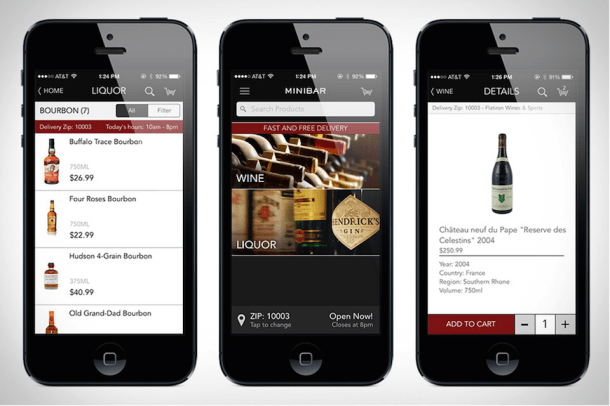
If you’ve taken the New York subway recently, you may have noticed the seasonal ads for Minibar, the alcohol delivery service that has been expanding rapidly the past few months, first by acquiring competitor Booze Carriage in March, and then by launching a subscription service for recurring orders in October. Minibar claims to have the largest share of the New York market, but that’s difficult to confirm. They certainly have plenty of competitors out there who are looking for a piece of the alcohol-delivery pie.

Most notably, and perhaps most threateningly to Minibar, is Amazon. Until early this month, Amazon only offered 1-hour booze delivery in Seattle, but as of December 9th New Yorkers with a Prime subscription can take advantage of the service as well.  Amazon is billing it as part of their Prime Pantry, so you can stock your party with other necessities like paper towels and Swiffers as well.

A third option is Drizly, which has a larger share of the Boston market, but is also available in parts of Manhattan, Brooklyn and Queens. Both Drizly and Minibar work by partnering with local liquor stores, listing their offerings via their app and website by zipcode, and taking a percentage of sales. Which service emerges as the market leader in New York may come down to who snatches up those local partners the fastest, but Minibar is also bolstering their business by providing other services – their website includes a party-planning feature to make sure you’re well stocked for any event, and if you feel intimidated by all those bottles you can even rent a bartender through their site.

To read more, click here.


Maple, the Momofuku-backed Delivery Service, Launches Today

Back in November, we posted about the news that Momofuku emperor David Chang had signed on to develop menus for a new, upscale food delivery app called Maple.  The major difference between Maple and its competitors like Caviar and Seamless is that Maple is going to produce all of the food itself, rather than sourcing from restaurants.

Maple has built a commissay kitchen in Brooklyn, which will, over time, feed into a network of delivery-kitchen hubs across the city.  Think Pret A Manger’s model without retail storefronts being replaced by a delivery application.  Maple has secured $26 million in funding to date–a portion of which has come from David Chang himself.

Today, the app is launching its service below Chambers Street with a mouthwatering menu.  In the kitchen is Soa Davies, a six-year veteran of Le Bernardin.  The operation is starting small with just three options, but plans to expand as the service grows.  Chang notes that America is somewhat behind with this trend, as there are “entire cultures… [that] base their food on deliverable lunches… Japan, Korea, Taiwan, India.  This is relatively new to us.”

To read more, click here.

New Rotisserie Concept On Lafayette

The owners of Maman bakery, now known across the city for their incredible chocolate chip cookie and veggie-centric lunch options, are opening a brand new project on February 9th called ‘Papa Poule.” Papa Poule will be serving rotisserie chickens and sides for delivery or takeout only. The location is conveniently one block west from the bakery Maman. The address is 189 Lafayette Street, between Broome and Grand.

The chickens will be stuffed and marinated prior to cooking and guests will have a selection of chef Arnal’s sauces including grébiche, béarnaise, barbecue, honey mustard, jerk, chimichurri, and aïoli. The sauces will be available in full, half, and quarter sizes, starting at $12.50 for a quarter of a chicken (which comes with two sides and one sauce). Daily changing selection of sides, specials, and desserts will also occur. A few of these selections include chicken potpie, potato gratin, sage-and-onion stuffing, Israeli couscous, and profiteroles.

The space is small with no seating, however the decor is still very appealing. The traditional French-farmhouse look found at Maman’s is also clearly visible here, including an exposed kitchen enclosed with vintage chicken wire and customized lamps made from chicken-wire buckets. The rotisserie itself will be displayed in the store front window, which will be sure to entice the people passing by. To view pictures of the space and to read more, click here

Maple: New Upscale Delivery Service

Chef David Chang of the Momofuko empire just signed on to create menus for the newest upscale delivery service app called Maple. This app-based service will be launching early next year and are advertising that they will guarantee a delivery time of fifteen minutes. The already existing similar app-based service Caviar will be getting some competition. Chang will be assembling a culinary board of directors to help contribute recipes and dishes to the service and also has plans for a rotating seasonal menu.

The difference with Maple is that delivery will not be coming from a specific restaurant; the team will be making their own food. Maple promises that the food will be ‘at the same level’ as in restaurants and a very speedy delivery within fifteen minutes of receiving the order. This is a very big promise in the city, so we will just have to wait to see how this will roll out in terms of operations. Chang also started selling Momofuko bento boxes to the WeWork office by City Hall so it is not his first venture in the world of delivery.

To read more about the launch of Maple and David Chang’s involvement, click here

Growing Catering Platforms

Erie Dardick from the Catering Institute and MonkeyMedia Software is aware of the complications that come with adding additional revenue channels to a business with complex operations. Dardick assures that as soon as executive alignment is in place, the road will be paved for growing catering sales. Listed below are five aspects Dardick suggests looking into in order to start growing catering sales.

1.  Understanding the strategy . The takeout, delivery and catering strategies are all interdependent. In order to succeed it is important to take the time to understand how they are related and what the strategy is. It is crucial to really have a good grasp on what goes into implementing these services before beginning to roll out the sales and ordering platform.

2.  Plan. After having made an appropriate plan that includes implementation timelines, teams and locations to leverage, menu items and marketing campaigns it is important to document it. These are all necessary components to launching an organized catering platform.

3.  Menu differentiation. Understanding that the market for catering services is different that of the restaurant is step one. Step two is to establish the types of menus that are appropriate for feeding large groups and then ensuring the packaging is correct to maintain the integrity of the product and have a secure delivery.

4. Sales. Having a reliable, predictable and scalable catering experience is key to succeeding. These three things must be achieved as they will impact the unit-level profits.

5.  Patience. Above all the process will require investment and time. Dardick states that executing catering profitably will continue to be a good use of idle capacity and will help maximize the return on the assets that you have already deployed and paid for in your existing infrastructure.

To read more about Erie Dardick’s advice on how to provide a successful catering service that will enable brands to increase customer loyalty and grow sales, click here