Grand Banks Boat Returns Next Tuesday

1451064622024.jpegFew things say warm weather is coming like outdoor dining. Or, even better, outdoor dining by the water. Or, if you really want to up the ante, dining on the water. Of course, the options for the latter are limited, but next Tuesday Grand Banks will return to Tribeca’s pier 25 with not just drinks but their full food menu as well.

Grand Banks is a seasonal restaurant located on a historic fishing schooner. They opened in 2014 to quick success, with lines occasionally extending down the pier to grab a seat for lobster rolls, fried oysters and the full bar menu. This year they are accepting reservations, so anyone headed out for an adventurous first-date meal need not worry to much about being stranded on the pier. There’s also a selection of new dishes, including friend Montauk blowfish tails and pan roasted oysters with bacon and ramps.

Click here for more information, or to make a reservation.

Highlights from the North American Restaurant and Foodservice 2016 Outlook

There’s good news to be had in the 2016 restaurant data so far, but there’s also a lot of data to sift through. You can read the full report here, or see some key take-aways below:

  • Employment levels and disposable income are high, riding positive tailwinds from the end of last year. The number of restaurants per-capita has also decreased steadily from a peak in 2013, meaning there is less supply to meet the growing demand.
  • A decline in oil prices is good news for restaurants’ bottom lines, but has affected the industry unevenly, creating more competition for major chains from smaller players.
  • Guest priorities include lower prices, improved healthy menu options, and a focus on food safety.
  • Quick-service-restaurants are focusing more on discounting, but guests are still most likely to use coupons and deals from restaurants they already visit frequently.
  • Most consumers support wage increases throughout the service industry, and would be willing to pay a premium toward such increases.
  • Tipping is still a controversial topic, with 65% of survey respondents saying they do not support replacing gratuity with a service charge.
  • Online and mobile ordering is the most important technological priority to restaurant guests.

Parks Department Issues Request for Specialty Mobile Food Units

See below for the full Request for Proposals.

In accordance with Section 1-13 of the Concession Rules of the City of New York, the New York City Department of Parks and Recreation (“Parks”) issued, as of April 20, 2016, a Request for Proposals for the sale of specialty food from mobile food units at various locations citywide.
All proposals submitted in response to this RFP must be submitted no later than Tuesday, May 31, 2016 at 3:00 pm.
Hard copies of the RFP can be obtained, at no cost, commencing on April 20, 2016 through May 31, 2016, between the hours of 9:00 a.m. and 5:00 p.m., excluding weekends and holidays, at the Revenue Division of the New York City Department of Parks and Recreation, which is located at 830 Fifth Avenue, Room 407, New York, NY 10065.
The RFP is also available for download, commencing on April 20, 2016 through May 31, 2016, on the Parks’ website.  To download the RFP, visit www.nyc.gov/parks/businessopportunities, click on the link for “Concessions Opportunities at Parks” and, after logging in, click on the “download” link that appears adjacent to the RFP’s description.
For more information or to request to receive a copy of the RFP by mail, prospective proposers may contact Santiago Zindel, Project Manager, at (212) 360-3407 or at santiago.zindel@parks.nyc.gov.
TELECOMMUNICATION DEVICE FOR THE DEAF (TDD) 212-504-4115

Is Canned Cold Brew Coffee’s Fourth Wave?

Stumptown-Nitro-Cold-Brew-Canned-Coffee.jpgAccording to Todd Carmichael, founder of coffee chain and industry leader La Colombe, we’re about to witness the fourth wave of coffee consumption in America – and it will be bigger than any of the waves that came before. What are those waves, exactly, and what could possibly dwarf them?

Think of coffee’s first wave as the everyman brew – the reason people get nostalgic for diner drip and Folgers still has enough momentum to surpass all sales expectations. The second wave coincided with the growing popularity of espresso drinks, and the expansion of Starbucks. The third wave (and, we admit, our favorite so far) represented the growing popularity of small roasters treating coffee beans as real ingredients instead of a commodity. Many of the small roasters that represented this trend, like Intelligentsia and Blue Bottle, have since been bought out by larger players, but there are still newcomers who continue to expand coffee horizons with superior quality and innovative ideas. Enter the fourth wave, as Carmichael calls it – bottled (or canned) cold brew.

If your mind goes immediately to the current industry standard in ready to drink coffee – Starbucks bottled frappuccinos – you’re not alone. But Carmichael believes there is a huge opportunity gap between current levels of consumption and the possible market. “They’ve been working for 20 years to get it to $2 billion. Then you look to Mexico, which isn’t really a coffee-drinking country, and their [ready-to-drink] coffee is at $4.7 billion.” Carmichael is working on bridging that gap, with a variety of flavors introduced through channels ranging from local convenience stores to whole foods. One thing is for sure – he’s excited, and who can blame him? Great coffee in a can sounds like a win-win.

To read more, click here.

The Unexpected Problem With Tablet Ordering

Okay, we admit it, this may not seem like a problem to guests ordering food at a fast casual chain; but to restaurant owners who are considering switching from human servers to tablet ordering (that is, placing tablets at tables or the front of the dining area where guests can click through their order rather than speaking to a server), there’s new evidence to consider. According to a paper published in the Journal of Consumer Research, guests are actually less likely to indulge in decadent food and treats when they order from a tablet instead of a person. And while this could be good news for restaurants gearing toward the health conscious (like Sweetgreen, which already handles the majority of it’s ordering through a mobile app rather than face-to-face sales), it bodes less well for establishments like bakeries, pizza places or fast food chains.

The findings are interesting because they contradict an assumption many have, that guests are more likely to indulge if they don’t feel they can be judged by a server. Instead, the research suggests guests don’t feel judged at all – they feel encouraged to treat themselves, and are less likely to control ordering impulses when speaking than clicking a button.

There are certainly other reasons to shy away from tablet ordering, especially when hospitality is the backbone of your business. But for those considering the benefits, this research is one more factor to weigh in.

To read more, click here.

Postmates Moves Into Speedy Delivery (Your Move, Uber)

blog_header-pop@2x.jpgOn Monday, Uber announced that it would be canceling Instant Delivery – the lunch-only, 10-minute curbside delivery feature in New York . The tricky logistics of the service had largely been offloaded to featured restaurants, who estimated how many of a given meal would sell each day and sent the prepackaged lunches to Uber’s midtown office to be picked up and driven or biked around the city. Even so, the delivery company admitted they may have overreached a bit, and have cancelled the service to focus on the core of the UberEats business.

Whether by coincidence or an impressively quick strategic move, Postmates has now stepped up to the ultra-fast delivery plate, rolling out their 15-minute delivery service (called Postmates Pop) in NYC at 11 am today. The service has been available for almost a year in San Francisco, and Postmates has said that it will work exactly the same way in New York (although only from 34th Street to Battery Park). To begin, you can order through the service from Fuku, Harry and Ida’s and S’MAC. It’s unclear how they’ll clear the hurdles that brought down Uber Instant, but we’re pretty sure contenders will keep stepping up until at least one nails it.

To read more, click here.

5/16: Master the Basics of Restaurant Accounting

Thinking of adding COO or CFO to your title? On May 16th, our very own Tara Berman, CPA, MBA, and Managing Partner at TaraPaige Group, will be joining the collaborative learning community Journee to teach the basics of restaurant accounting and controls. The class will provide participants with an accounting foundation that their restaurants can stand on, including all the tools to implement systems and procedures that can contribute to long-term financial success.

Tickets are free for Journee members, who also get access to a shared workspace and unlimited classes throughout the year.

To learn more and register, click here.

Slow Food NYC and Brooklyn Uncorked

Chickens-773x580Looking for an opportunity to help grow the urban farming movement, and score some tickets to a great event at the same time? If you contribute to Slow Food NYC’s urban harvest program this week, you’ll be entered to win two tickets to Brooklyn Uncorked – Edible magazine’s annual local wine fest, taking place May 26th.
Of course, you can still buy tickets to the 10th annual Uncorked, which will feature over 25 wine and food vendors ranging from the Brooklyn Winery to Orwasher’s Bakery to our friends and colleagues at Nobletree Coffee. But consider donating as well – you’ll help student farmers learn about eating locally, healthfully and sustainably at Slow Food’s tuition-free farm in East New York.

To read more and donate, click here. For tickets to Brooklyn Uncorked, click here.

Jobless Claims at Their Lowest in 42 Years

In a bright sign for all industries, jobless claims in the U.S. declined unexpectedly last week to hit 253,000, the lowest since November of 1973. Jobless claims are a measure of the number of Americans filing for unemployment, and their decrease indicates employers that are upbeat about the economy, increasing hiring and expanding employee headcount.

The number of continuing claims from those already receiving unemployment benefits also fell, and for 58 consecutive weeks claims have been below the 300,000 level that economists say is typically consistent with an improving job market. Data from the labor department also indicates more employees voluntarily leaving their jobs, indicating confidence that they will be able to find another.

Besides the economic growth that brings revenue to small businesses, a decrease in claims also means lower rates of unemployment insurance – good news all around for the hospitality industry.

To read more, click here.

Seamless Now Has Its Own Delivery Drivers in NYC

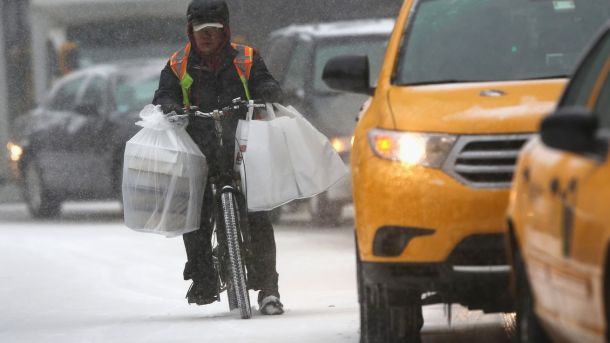
GettyImages-464182497.0.jpgSince 2014, Seamless has been quietly testing its “turnkey delivery service” – drivers and bikers whom restaurants without their own in-house delivery team can use to deliver food through the app. We say “quietly” because it’s impossible to tell through the Grubhub/Seamless interface which restaurants are using these delivery people, and which are using their own, and the company has declined to say just how many restaurants are using the service.

In the last few months, they’ve rolled out the delivery service in Brooklyn and Queens, mentioning popular spots like Mighty Quinn’ and No. 7 North as early adopters. It’s an attempt to compete in a crowded marketplace with companies like UberEats, Postmates and DoorDash, while still giving flexibility to restaurants that would like to continue using their own delivery teams. The pricing structure is similarly flexible – delivery is an added service, with an added commission charge of about 14%. Add that to their flat commission fee of around 15%, and the margins shrink fairly rapidly – although other delivery services top out at 30% already.

To read more, click here.