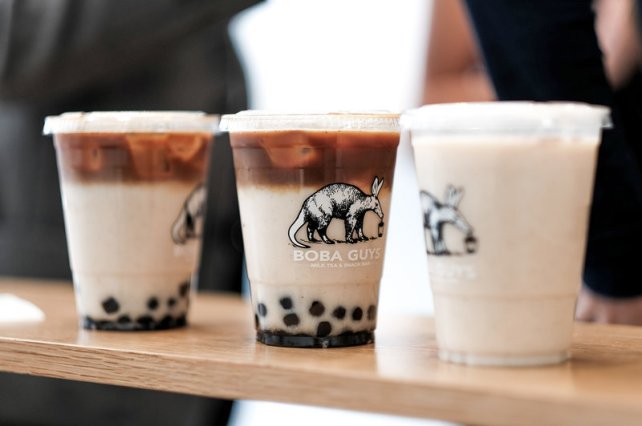
Photo via Boba Guys/NPR.org
Whatever name you know it by, it’s likely you’ve seen Bubble (or Boba) tea offered in your major metropolitan area before. The Taiwanese beverage, which originated as a sweetened, milky tea with chewy balls of tapioca drunk through a wide straw, became popular in the United States in the early 2000s on college campuses and in Asian neighborhoods. That trend largely died down until recently, but seems to be coming back – and this time, it’s picking up steam by joining forces with other trends, from speakeasy bars to horchata (the sweetened Mexican beverage made from steeped rice or barley).
As Andrew Chau, co-founder of the popular chain Boba Guys explains, “If we’re going to bridge cultures, we want to bring the best of the West and the best of the East.” Boba Guys aims to win over coffee lovers and adventurous foodies with combinations like coffee mik tea, horchata boba tea, and Indian Chai.
For a more a adult version, there is Boba 7 – the “Boba Speakeasy” behind Los Angeles restaurant Soi 7. There, owner Elton Keung makes cocktails like the “bobagasm” with Irish Cream, Kahlua and honey boba, along with a number of nonalcoholic versions. It seems clear that it’s only a matter of time before the East Coast gets their own bubbly bar.
It can be hard to build long term success on a single trend, but flexibility and reinvention allow those trends to go farther – and expand some palates along the way.
To read more, click here.
 The food delivery market is a crowded one, with new competitors emerging every day. Grubhub, which owns Seamless, may control a large portion of that market, but all that competition took a toll last year. In 2015, the company’s growth slowed significantly and their stock value followed suit. In response, Grubhub declared that they would move from handling logistics only to actually delivering the food.
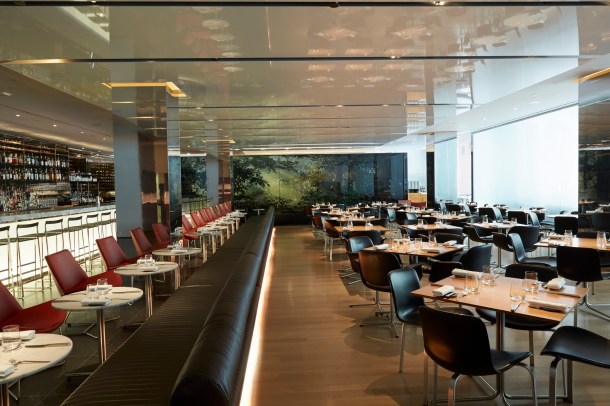 Nearly four months after eliminating tipping at the Modern, trendsetter Danny Meyer says that the first full month without tips was the restaurant’s most profitable ever. On a recent podcast of Freakonomics, Meyer declared his surprise that the two-Michelin starred restaurant had benefited so quickly. He expected that, while they would ultimately see the benefits through lower turnover and more equitable pay, the process would be slow and have initial hurdles. Instead, back of house applications have increased nearly 270%, server application shave increased 25 to 215% over three months, and there are more guests walking through the door than ever.
![beyonce-formation[1].jpg](https://paigepapers.com/wp-content/uploads/2016/02/beyonce-formation1.jpg?w=610) The song, now watched almost three million times on YouTube, includes an (explicitly worded) line about visiting Red Lobster after sex. That line immediately (and perhaps predictably) blew up social media with references to the seafood chain. The phenomenon might have ended with a few tweets, but instead Red Lobster’s sales actually spiked 33% according to CNN. Of course, that kind of publicity may only provide a flash in the pan, but if you’re looking for flash, nobody brings it better than Beyoncé.
The song, now watched almost three million times on YouTube, includes an (explicitly worded) line about visiting Red Lobster after sex. That line immediately (and perhaps predictably) blew up social media with references to the seafood chain. The phenomenon might have ended with a few tweets, but instead Red Lobster’s sales actually spiked 33% according to CNN. Of course, that kind of publicity may only provide a flash in the pan, but if you’re looking for flash, nobody brings it better than Beyoncé.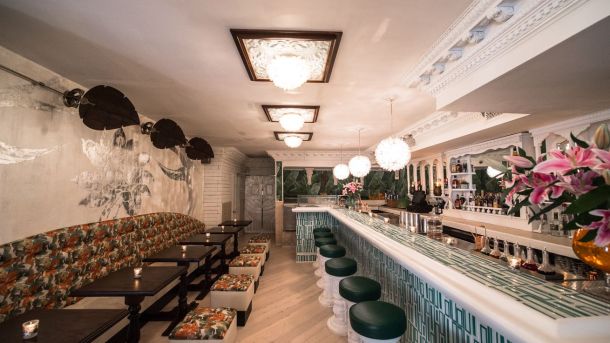 Ravi DeRossi, the restaurateur behind Death and Co, Avant Garden, Mother of Pearl and 12 other bars and restaurants around the city, is making a serious push to turn all of his operations fully animal-free. He’ll be starting by expanding the already vegan Avant Garden into multiple spinoff concepts, as well as closing the charcuterie-focused The Bourgeois Pig and reopening it as vegan wine and tapas bar LadyBird. All of his restaurants are in for some sort of shake-up, and it seems his mixologists won’t be safe either, as cocktail and beer lists will be purged of the often ignored animal ingredients that are sometimes used in drinks.
 Danny Meyer may have been the first to really make headlines by eliminating tipping, but Andrew Tarlow has now gone a step further by taking on the anti-tipping movement’s PR as well. Marlow recently pitched a standard sign which he believes all gratuity free restaurants should display in their windows in order to help retrain guests who have spent their whole lives living in a world of tips.
 paigepapers.com