Aligning Dining Patterns & Needstates

American Express provides restaurants with research-based analysis of key industry developments which is collected and analyzed by Technomic, Inc. Consumers were polled over a seven-day period and asked to describe their most recent restaurant occasion. While Technomic has recently released studies showing an increase in the snacking daypart, the majority of consumers that were polled reported their most recent restaurant occasion for breakfast, lunch or dinner. Dinner occasions were equally divided between weeknights and weekend nights, while lunch was more likely to be a weekday occasion. 60% of pollers who reported breakfast as their most recent occasion ate breakfast or brunch on the weekend.

As for takeout occasions, the poll showed that delivery occasions were twice as likely to have been a weekday purchase, of which 60% were for dinner and 30% for lunch. A very small percentage showed breakfast as their last restaurant takeout or delivery occasion. Consumers in the survey were also asked to estimate what percent of their restaurant occasions had been for each daypart in the past year. This led to some insights into generational differences; for example, while 12% of consumers aged 18-25 reported snacks or happy hour as their most substantial foodservice purchases, only 4% reported this for those 45 years or older.

Another part of the poll involved asking consumers to identify the needs or emotions they typically associated with each major daypart and weekpart.  While snacking and lunch were mainly associated with the basic need to satiate hunger, convenience was the biggest reason for consumers to use foodservice for weekday breakfast, weeknight dinner and even weekend lunch. Different dayparts showed to be more or less associated with different kinds of get togethers:  family get-togethers (weekend dinner) , friendly get-togethers (weekend dinner, happy hour) , and celebratory occasions (weekend breakfast). Other factors revealed in the poll were emotional needstates; for instance which occasions were associated with relaxing or as a treat/reward.

This data can be used to show operators the prime opportunities available to extend their daypart usage by meeting consumers’ needstates for each occasion. The data also shows where operators can get a competitive share for high-traffic meals or dayparts that are underutilized. Other business implications can be drawn from consumers’ ideas about what constitutes a ‘meal’ vs. a ‘snack.’ For example, offering items in various portion sizes and in a wider variety of combo options will satisfy a larger variety of needstates; offering lunch and dinner fare at the breakfast daypart can also help this.

To read more about the poll and the business implications that can be drawn from it, click here 
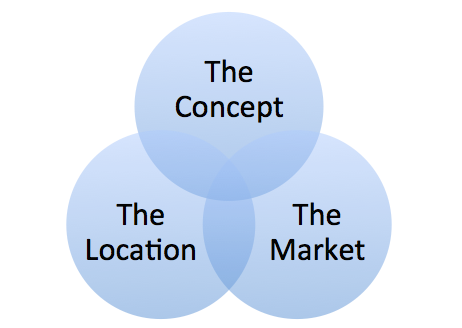


The 3 Pillars: Concept, Location, Market

Whenever a new fast casual enterprise, restaurant or bakery is in the works, it’s only natural to want to start with the menu and design. However, that won’t guarantee success. Foodservice businesses require more than an appealing menu in order to successfully launch and survive. They are the sum of three parts coming together to form a whole—the concept, the market, and the location. These three give and take from each other to form the tangible business.

In order to ensure the longevity of your new venture, it is necessary to start in the center, and work around:

Screen Shot 2014-10-21 at 9.11.11 AM

Ultimately, the first question and last question to ask is whether the concept, market, and location are all mutually supportive and financially viable.

The Concept: What are you serving and how are you serving it? This encompasses the menu, service style, purpose and values.

Concept and Location: Does the size and location of the physical space support the concept, and vice versa?

The Market: Who are your guests? What are their wants and needs, and what job is your concept doing for them—baked goods for special events, dinner for 10, or healthy lunch served fast?

Market and Concept: Does the market exist to support your concept—that is to say, if you’re opening a healthy fast-casual lunch spot, are there enough working professionals in the market looking for lunch to support the business?

The Location: Where will the restaurant be and what is the footprint?

Market and Location: Is the location accessible to your market? In the above example, the location you choose would need to be near enough to the market of working professionals seeking lunch options in a timely window.

These three come together simultaneously—you cannot begin to conceptualize your new business without giving all three equal attention. For example, a third-wave coffee shop needs great coffee, an affluent market willing to pay for premium coffee, and a location accessible to the market with a footprint small enough to be sustainable on an $8 average check.

On the opposite end, a fine dining restaurant needs a much larger location—but the average check justifies the occupancy cost so long as the market exists—Per Se would not be successful in Detroit, no matter how low the rent.

Next time you’re in the planning stages of a new restaurant, bakery, or café, remember that the old adage of “if you build it, they will come,” is not planning for success. Success requires planning around the concept, the market, and the location.

Gourmet Food Hotspot in Sunset Park

The industrial loading docks of Sunset Park, Brooklyn are transforming into a hotspot for gourmet food producers. Li-Lac Chocolate and Blue Marble Ice-Cream are a few companies who lease kitchen and retail space in Industry City, so guests can come visit the factory, see how the products are made, and buy them fresh! As manufacturers seek out more affordable spaces for their production, Sunset Park seems to be the next place that will be undergoing a food revolution.

Industry City CEO Andrew Kimball says,“What’s great is there’s a real interest in understanding what you’re eating, where it’s made, what’s in it and watching it happen.” Industry City employs 2,400 people and are expecting that number to rise to nearly 15,000 by 2023; similar foodie patterns have been seen in Dumbo, Harlem and Greenpoint recently. Master chocolatier Jacques Torres also recently moved his factory to Sunset Park where the candy is all dipped and hand-made.

Liddabit Sweets recently opened on Industry City’s ground floor and co-owner Liz Gutman explains the appeal, ““We taught classes at ICE [Institute of Culinary Education] and Brooklyn Kitchen, but we never had enough space to teach our own.” Gutman plans to offer a Candy 101 class in December and a couples chocolate class in February for Valentine’s Day. The extra space also led Gutman to feel inspired to experiment with some savory items!

To read about more manufacturers leasing kitchen and retail space in Industry City, Sunset Park, Brooklyn, click here

Increasing Speed of Service

Innovations in mobile payments lead to a more efficient and seamless experience which will increase restaurant traffic, however, as an operator you need to be equipped for the influx of guests and know how to keep a speedy service. Leaders from across the fast casual segment discussed solutions to drive the speed of service at the ninth annual Fast Casual Executive Summit held in Denver and came up with nine main solutions:

1) Adding a second line.  The addition of a second line that focuses solely on catering, online or mobile orders and carry out will help break up the line and lead to speedier service.

2)Encourage guests to break the line. Hand in hand with number 1, tweeting that online ordering lets you go in the second line will also help manage flow.

3)Choose adequate online software. Choose a software that knows to space out online orders to allow for increased efficiency.

4) Off-site phone orders. The advantage of moving phone orders from the cashier to a call center is that they can be handled as mobile orders socustomer data can be captured which opens up another segment for marketing.

To read more solutions and suggestions on how to increase the speed of service in the fast casual segment, click here

Starbucks’ 2014 Holiday Initiatives

The Starbucks Leadership Experience conference was held this past weekend in Seattle where over 2,000 district managers shared customer initiatives to elevate the Starbucks holiday experience. Having noticed that during the 2013 holidays many brick-and-mortar retailers experienced a decline in foot traffic compared to a growth in online shopping, Starbucks experts began focusing on redefining the retail experience with digital innovations.

Howard Schultz, president and CEO of Starbucks Coffee Company states, “Customers researched, compared prices, and then bought the brands and items they wanted online, frequently utilizing a mobile device to do so. Since that time, we have been focused on radically redefining the Starbucks retail experience for our partners, customers and stores. As a result of the work we’ve done, Starbucks is poised for a great holiday—our innovation pipeline is strong and we have a number of initiatives ready to launch during the holiday and into calendar 2015 and beyond.”

Aside from the holiday changes which take place every season, such as the red cups and seasonal flavors, Starbucks will be introducing new customer incentives such as ‘Starbucks for Life” which lucky customers will be able to win by paying with their smartphone or by using their Starbucks card. Starbucks will also be launching Mobile Order and Pay in stores within the Portland area before the end of the year which will allow customers to place orders in advance for pick up in store. The nationwide launch for Mobile Order and Pay is planned for 2015 which will hugely increase the company’s presence in the mobile commerce scene.

Other holiday initiatives include the 30th anniversary of Starbucks Christmas Blend and the first new holiday beverage crafted in the past five years, the Chestnut Praline Latte. The loyalty program will have added value and benefits (including access to special events and sneak previews of new products) for customers using their mobile devices. The company will also be taking initiatives to expand the Starbucks Reserve coffee line by opening an interactive Starbucks Reserve Roastery and Tasting Room which will dedicate itself to roasting, coffee education and selling the small-lot Starbucks Reserve coffees.

To read more about Starbucks’ holiday initiatives for this season, click here


Webinar: The New Mobile Wallet

The shift to mobile payments is approaching even more rapidly with the arrival of Apple pay. Apple is pushing for customers to replace their wallets with their iPhones, as is the case with mobile payment apps on other smartphones. There are many opportunities for brands to make use of the ‘mobile wallet’ era beyond even just payments. On Tuesday, November 4th Michael Hagan, Chief Sales Officer at LevelUp, and Ariel Page, Project Manager at Hale & Hearty Soups, will discuss where brands can capitalize in mobile payments to engage customers and improve their business.
The discussion will begin by explaining what mobile payments really mean for a business, and go on to explore the basic offerings of Apple’s new mobile wallet and how to move beyond the m to engage customers. The panelists will also give an overview of why encouraging customers to look beyond their Visa, MasterCard and American Express is a good idea. The webinar will also give a merchant’s perspective on the benefits of mobile payments and loyalty, and finally will include a glimpse at LevelUp’s integration into Apple’s mobile wallet and Android’s Google Wallet.
To get more details on the webinar and its panelists and to register, click here


Healthy Snacking On The Go

There is a growing opportunity for restaurants to provide guests with healthy menu items that can be eaten regularly. Since snacking has essentially created its own day part, and more people are also focusing on adapting more active and healthy lifestyles, it is beneficial for operators to provide the guest with healthy grab and go snacking options with good nutritional value. A market research firm called The Hartman Group showed in their 2013 “Modern Eating: Cultural Roots, Daily Behaviors” report that snacking represents half of all eating occasions.

Alex Blair, franchise owner of Chicago’s fast casual concept, “Freshii” notices there is an increased rush of guests mid morning and after lunch for healthy snacks and fresh juices and smoothies. As more people try to incorporate fresh juices and vegetables in their diet, Blair has noticed an increase in sales for fresh juices. “Post-gym, people come to us for our smoothies,” Blair says. “There’s a huge following for recovery foods, and lots of customers are big on small, healthy meals. Often, we see the same customer several times a day.” This has led Freshii to partner with big name gyms such as Equinox and place their stores in the gym.

According to the National Restaurant Association, 72 percent of consumers are more likely to visit a restaurant with healthy items on the menu. Being that the snacking day part continues to grow at the same rate that people are making healthier eating habits, it is a great time to add healthy fast food snacks as menu items. To read more about incorporating healthy grab and go items, click here


José Andrés to Enter Fast Casual Segment in D.C.

José Andrés, the Ferran Adrià prodigy who popularized Spanish cuisine in the U.S., will be launching a vegetable-focused fast casual concept. The first location of ‘Beefsteak” (play on the tomato variety), will open on campus at George Washington University in Washington D.C. early next year. José Andrés, aside from having his own course on food at the university, also serves as an advisor on food initiatives and has been testing dishes with his staff for months.

José Andrés would like to clarify that his concept is not “vegetarian,” it is vegetable-centric. As Jose says, “We don’t like to call it vegetarian. We want to call it tasty, fun, sexy, good-looking.” Vegetables has been around forever, so this concept is not about ‘the next big thing,’ so much as it is re-inventing and converting people’s ideas about vegetables. Roy Choi, the Los Angeles food-truck chef, recently posted on his Instagram about the future of vegetables and how he is, “trying to make vegetables relevant to a new generation by just making them fun.” Batali and Bastianich also have a portion of Eataly dedicated solely to dishes prepared with vegetables, and world famous chef Rene Redzepi of Noma is always preaching the virtues of vegetables.

Vegetable restaurants do exist, such as Vedge in Philadelphia, where chef Richard Landau reaffirms that vegetables are beginning to ‘move from the side of the plate to the center.” Jose Andre’s Beefsteak will be the first of its kind in Washington D.C. and if it is successful, will expand and open more locations. Before opening his now wildly successful Jaleo, people had their doubts about tapas and small portions; now small plates are a nationwide phenomenon. José Andrés is confident that despite the doubts about a vegetable-centric fast casual, he will be successful in giving the people “what they don’t know they are craving.”

To read more about the new fast casual concept and other vegetable-focused eateries, click here

Data-Enhanced Pricing Strategies

Small nuances and discrepancies in like-item prices are very common in the foodservice industry; this is often the result of two pricing models: cost-plus and value-based. These strategies, which have been used for years across the industry, do not fully allow for the integration of consumer behavior data that is now so much more accessible to operators and so relevant to pricing menu items. While the old methods are by no means incorrect, it is important to stay ahead of the curve and innovate at the same pace as the industry; not taking massive amount of data into consideration may be causing operators to miss out on opportunities to increase check averages.

Systems can be built to leverage large amounts of data and new technology to understand purchase behavior. Amazon has created algorithmic systems that alter millions of prices multiple times throughout the day based on e-commerce purchase behavior based off of region, time of day, aggregate consumer behavior and individual consumer behavior. Amazon is an example of how sophisticated pricing systems can be, and while the foodservice industry might not need as extreme of systems, it could definitely use an update that could borrow similar strategies.

QSR Magazine will be publishing a series of articles that explore alternative pricing strategies that can be applied to the industry using hypothetical restaurants with menu items and prices. The goal by the end of the series is to “determine quality inputs, analyze the data, optimize prices based off that data, and then do it all over again with a different set of inputs.” To read more about enhancing pricing strategies and to follow the series, click here


Impact Investing for Young Professionals

On Tuesday October 28th, the Net Impact NYC Professional Chapter will be hosting the panel: Put Your Money Where Your Mouth Is: Impact Investing for Young Professionals. Net Impact is an international nonprofit organization that aims to provide individuals with the necessary knowledge and tools to use the power of business to create a more socially and environmentally sustainable world. The panel will be discussing different ways individual investors can make a financial return while making a positive impact on society.

The guest panelists are member of various organizations including Slow Money NYC, First Affirmative Financial Network, Domini Social Investments and Return on Change as well as Financial Advisors and CPAs. If the option of meeting with a panelist or CPA for a 1:1 advising session is of interest, registration must be completed at an earlier date. Amy Cortese, award-winning author and journalist who has covered topics such as business, finance, food, wine and environmental issues, will be moderating the panel and leading the discussions.

Below is some ticket information for the event, note that Early Bird admission sales end today! To register for the event and receive more information on the panelists, click here

Ticket Information

Ticket Type SALES END PRICE FEE
Early Bird Oct 15th, 2014 $25.00 $2.37
Net Impact Paid Member Oct 28, 2014 $15.00 $1.82
Net Impact Paid Member – Admission Plus 1:1 Advising Oct 28, 2014 $25.00 $2.37
General Admission Not Started $30.00 $2.64