Restaurant Stocks Have a Rough New Year, and Chipotle Leads the Plunge

It’s no surprise that Chipotle Mexican Grill is having a rough few months, after a string of high-profile food borne illness outbreaks, a CDC investigation, and multiple lawsuits. Stocks in the company, which had been growing steadily since 2013, hit a new 52-week low last week. This means that in three rough months, Chipotle has lost three years of gains.

Although Chipotle’s losses were predictable based on recent bad press, they come with some other context as well: 2015 was a bad year for restaurant stocks across the board, and 2016 isn’t starting out any better. Many large, publicly traded chains were down 2 to 6% last week, and some hit 52-week lows, including the Cheesecake Factory, Papa John’s, and Dunkin’ Brands. As 2016 continues, this is likely to mean far fewer new concepts will go public, even as they continue to expand, and larger corporations may focus more on acquisitions. Chipotle may be the poster child for this rough year, but they should also serve as a reminder that the restaurant market has not been friendly to anyone.

To read more, click here.

David Chang Gets Feisty With Momofuku Nishi

Momofuku Nishi – David Chang’s latest project in Chelsea – has finally opened, and Chang made the announcement today through his magazine Lucky Peach along with an interview. The restaurant was rumored to be an Italian-Korean fusion, but Chang balks at that description. Instead, he asks “what food isn’t fusion?” and says,

“There are Italian words on the menu but we’re not trying to make Italian food. We’re not trying to make a Korean restaurant. We’re trying to do something that we’ve never done at Momofuku. We’re inspired by Italy but we’re not using any Italian ingredients. Things are moving at light speed here.”

Momofuku Nishi will also add to the list of major New York restaurants operating with a no-tipping policy. Chang cited the greater parity between front of house and back of house wages as the primary factor in this decision, and made no apologies for charging more.

The real cost of selling food is not accurately reflecting the labor that’s going into it. In 2000, I got paid maybe $10 an hour. Inflation has definitely risen, but cooks’ wages haven’t. That’s one of our biggest issues. We want to be able to grow as a company so we can provide for more people. This is a way we might be able to do that. And if it doesn’t work, we can always go back to the old way.

The menu is not yet available online, but Nishi is now open Tuesday – Saturday from 6:00pm-11:00pm.

To read the full interview, click here.

The Government Wants You to Have Your Coffee and Drink it Too

The federal government just released their dietary guidelines for 2015-2019, and most of them should come as no surprise. The guidelines are updated every five years to reflect current research and recommendations in the interest of promoting public health. For the most part, they tend to remain much the same: eat more vegetables and whole grains, avoid sugars and trans fats. The updates this year include changes to the recommended sugar intake (which should now be only 10% of daily calorie intake),  increases in allowable salt intake for certain demographic groups (now up to 2,300 mg a day), and the removal of a daily cholesterol recommendation. There was no recommendation to avoid red meat, despite the studies from the World Health Organization earlier this year indicating that it has carcinogenic properties on par with tobacco. All this is great news for anyone looking to replace their sugary pancakes and waffles with an extra helping of sausage and eggs.

Even better is the news that the department of health has finally gotten on board with “moderate” (up to 5 cups a day) coffee consumption. Citing a growing body of research indicating that coffee can help prevent everything from diabetes to cancer, the new guidelines say that coffee can be part of a “healthy lifestyle.” Although research indicates that, unsurprisingly, genetics play a strong role in the effects of coffee on the body, the report still acknowledges the many benefits available from your morning cup of joe. Just remember to hold the sugar with that.

To read more, click here.

Starbucks Passport App is the Untappd of Coffee

Starbucks_Digital_Coffee_Passport_.JPG

Photo via starbucks.com

Coffee connoisseurship has almost certainly gone mainstream, and the latest indication is the release of Starbuck’s “Coffee Passport” app to the general public. The app allows users to collect digital stickers in their coffee passport each time they try a new coffee (or a single-origin coffee from a new country), while recording tasting-notes and comments about the experience. The app also includes plenty of study materials to shrink the gap between coffee shop guest and trained barista, including a glossary, primer on cuppings, and tips on various brew methods.

Starbucks baristas have had a paper version of this idea since the mid 90s, and the app was pre-released to Starbucks staff a month ago. The idea of ‘collecting’ rare beverages on your phone pokemon-style has precedent with apps like Untappd (for craft beer) and Delectable (for wine). In general, these apps encourage users to expand their selection and provide an incentive to go for the “new” over the “tried-and-true.” This could ultimately hurt Starbucks, who have had a hard time breaking in to the niche coffee market, although they’ve indicated a plan to focus even more on rare, high end coffee in the future.

To read more, click here.

The $100 Donut You Probably Don’t Need

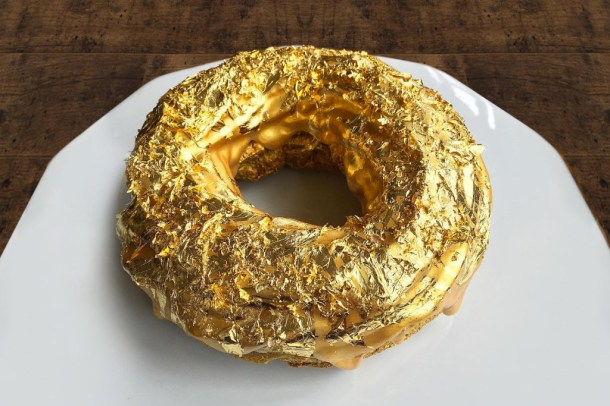
manila-social-club-100-dollar-donut-101.jpgThe New York Lottery has been running subway ads recently which feature allegedly true stories of egregious displays of wealth – thousands of dollars spent on dead bats or caviar that never gets eaten, for example – with the tagline “You’d make a much better rich person.” The idea is a catchy one, and it’s easy to find examples of people who will pay a little (or a lot) more to get the most luxe versions of everyday items, and businesses willing to provide them. The latest example is Williamsburg’s Manila Social Club, where you can now buy a $100 donut coated in 24-karat gold and Cristal champagne icing.
The donut was originally conceived by chef Björn DelaCruz to pair with Braven Brewery‘s IPA. The recipe has morphed over time, although Manila was already known for other donuts featuring the same ube filling. So far the steep price tag and over-the-top execution have generated plenty of publicity, and according to Business Insider some guests have even paid 1,200 and gotten a full dozen. All of which raises the question – can any of us really be sure we would make better rich people than the dead-bat collectors and caviar-forgetters of the world?

To read more, click here.

France Is Getting Aggressive with Food Waste

We wrote recently about tackling food waste, a major contributor to climate change causing emissions, by embracing ugly food. Although the ugly food movement has footholds worldwide, some of it’s strongest proponents are in France, including Nicholas Chabanne of Gueules Cassées. But as wonderful as the idea is to get “imperfect” produce out of landfills and onto our plates, it requires reversing a lot of momentum and decades of habits for both consumers and suppliers. Since the French government has stated that they intend to cut food waste in half by 2025, they are pulling out all the stops necessary to do so.

In May, the French National Assembly passed legislation requiring grocery stores to have formal contracts with food banks and implementing hefty fines for throwing out food or deliberately spoiling it (an apparently common practice to prevent dumpster diving). Now the French government has made it illegal for large restaurants (generally those seating over 150) not to offer doggy bags to all guests. Since the French do not have a native word for the concept, it could be slow to catch on, but every bit counts in a nation where restaurants are such a vital part of the national economy.

To read more, click here.

Eat Less “Healthy” Food in 2016

As the last days of December wind to a close, many people will be finalizing their lists of new year’s resolutions. And while it is always a good idea to renew your commitment to your health, family, friends and environment, you might want to rethink any resolutions to “eat healthy.”

Researchers from he University of Texas recently published an article in the Journal of the Association for Consumer Affairs asserting that when foods are labeled “healthy,” people tend to perceive them as less filling, and eat more as a result. Of course, eating a large volume of kale and quinoa salad is certainly better than eating a large volume of sugary treats, and the researchers don’t recommend ignoring nutritional information. The danger is that many foods can be marketed as healthy in ways that fool the brain into thinking we should eat more than necessary. Labeling like “all natural” and “low fat” are common examples. So this new year, remember to take health claims with a grain of salt – especially when you’re browsing the “low sodium” section.

To read more, click here.

New Year’s in Times Square Can Cost You $1,700

1024px-1_times_square_night_2013.jpg

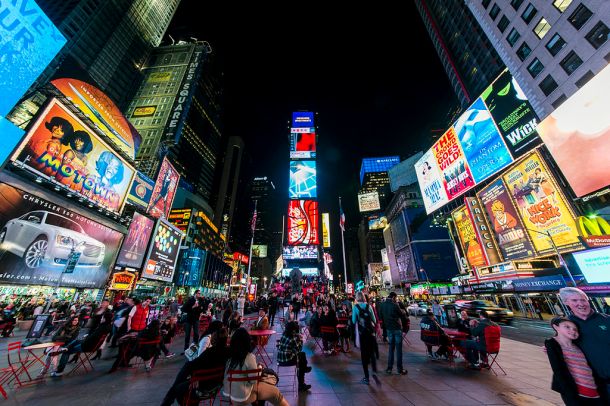
All over the city, “open bar” is the name of the game on New Year’s Eve. It makes sense: on the biggest party night of the year, bars and restaurants want you to commit to staying there. And since many people will overestimate their alcohol tolerance and underestimate the lines (or forget that tips are not included), an open bar can feel like a great deal.

There are certainly some reasonably priced covers scattered around the city, but you would be hard pressed to find them near Times Square this year. There, major chains are getting in on the action by charging triple figure covers for an all inclusive night with dinner, drinks and a (usually obscured) view of the ball drop. Olive Garden’s New Year’s dinner buffet and bar will cost you $400 a head, Bubba Gump Shrimp is $799, and Ruby Tuesday goes up to $1699 for the exclusive “couple’s table.” Maybe people got word that the recession is over – Bubba Gump Shrimp has sold out at least, according to their website.

To read more, click here.

Partying like it’s Against the Law

870caadf-f320-45a2-aac5-271f967f629d-1377282740.jpg

We may have finally hit peak-trend with ’20s era speakeasy bars and secret watering holes, now that the relatively well known (if still ostensibly “secret”) bar Angel’s Share has it’s own secret offshoot. But the fun of places like these, which reward a little internet research or in-crowd know-how with great drinks and exclusivity, is undeniable. We may not see as many pop up in 2016, but it doesn’t seem like they’ll be disappearing too quickly either.

The question is, with all these prohibition era bars around offering nightlife Gatsby would approve of, what do you do for the biggest party night of the year? Many of these bars simply do what they do best on New Years Eve: offer great cocktails and an opulent setting, and wait for those in-the-know to show up (and avoid the $100+ cover at many other places). Some offer even grander celebrations, like the Manderley Bar at the McKittrick Hotel (which you may know of as the setting of the nightlife experience that is Sleep No More). They’ll be hosting a Winter Masquerade this year with a  number of ticket options for those looking to go all in. Sleep No More‘s sister performance, the incredibly opulent Queen of the Night, likewise has a special New Year’s party which promises to (somehow) be even bigger than their usual performances. Excess is what these options offer, and they aren’t for the faint of heart. But is there any better holiday to really gild the lily?

For a list of more ’20s-themed New Years celebrations, click here.

What does 2016 Hold for Meal Kits?

f482d9a047cffbed4fc45904bffc824992dcbc63_christmas-4.jpgMeal kits and recipe delivery services exploded in 2015, with promises of convenience and easy access to all the joys of cooking. Services like Blue Apron, Plated and Hello Fresh (all available nationally), along with a number of more local startups, offer customers customizable subscription services to bring pre-portioned ingredients to your door, along with a (hopefully) easy to follow recipe selected from the frequently updated options on their sites. Many of these companies tailor their recipes to focus on specific health concerns or responsible ingredient sourcing, with the goal of providing subscribers with all the pride of a fully home-cooked meal. One plant-based version of the model even attracted the legendary Mark Bittman to their team.

Understandably, these companies have already seen some blowback from their surge in popularity, on both the environmental side (the extra packaging used to deliver a single meal’s worth of 5 spices may not be the best thing for mother earth) to the cultural (is some part of the joy of cooking lost for the sake of convenience?) But that hasn’t stopped the venture funding from flowing in. Even if the bubble doesn’t burst, some meal kit companies may face growing pains in the coming year, as competition increases and newcomers try to expand quickly. Good Eggs, a grocery delivery service with over $50 million in funding, recently laid off nearly half their employees and closed operations in all cities but San Francisco.

One important test will be how these companies take advantage of the holiday season, and increase their reach through either gift subscriptions or holiday offerings. Most sites already sell gift cards, and some offer holiday meal kits to make party-hosting easy. Blue Apron, for example, wants you to “Host a Blue Apron Christmas!” and Atlanta-based PeachDish sold out of their Christmas dinner for four, but are offering it for New Years as well. According to their website, “You provide the champagne and we’ll provide everything else for your New Year’s Eve party!” Of course, you could always get the champagne delivered too and call it a night.

To read more, click here.