Request for Expressions of Interest for an Ice Skating Rink

The New York City Department of Parks and Recreation is issuing a request for expressions of interest (RFEI) for an ice skating rink and/or winter activities at McCarren Park Pool, Brooklyn.

All proposals submitted in response to the RFEI must be submitted no later than Friday, December 18 2015 at 3 PM. There will be a site visit and meeting on Monday, November 16 2015 at 11 AM. They will be meeting in front of the entrance to the pool on Lorimer Street between Driggs Avenue and Bayard Street in McCarren Park, Brooklyn.

Hard copies of the RFEI can be obtained from Friday October 30, 2015 to Friday, December 18, 2015 between 9 AM to 5 PM excluding weekends and holidays at the Revenue Division of the New York City Department of Parks and Recreation, located at 830 Fifth Avenue, Room 407, NY, NY, 10065.

For more information, contact Zoe Piccolo, Project Manager, at (212)360-3495 or at zoe.piccoo@parks.nyc.gov.

To read more, click here.
Structure for Success!

Structuring your restaurant ownership is a balance of needs, wants, sweat, and cold hard cash. There is no one right formula, and rarely is the formula the same from restaurant to restaurant. In this month’s Enterprise Insight, we discuss some common options, and how to balance your narrative and numbers. Specifically, we will review entities, equity vs. profit distribution, management fees, and valuations.

Entities
Restaurants are most commonly set up as a Limited Liability Corporation. More importantly, though, is to actually set up two: one for the physical location, and one for the intangibles, such as intellectual property. The purpose of this is to balance the equity and access to the brand that an investor group has. For example, if you publish a cookbook with only one LLC—then your investors, who have equity in that LLC, are entitled to a share of those profits. This leads to our second point, equity and profit distribution.

Equity vs. Profit Distribution
The first thing to determine is the ownership interest of the involved parties and how that differs from the profit distribution. As an LLC, which most foodservices enterprises should be, the business can distribute profits differently than the equity is split. This allows an owner to retain a majority stake but pay out his or her investors with an accelerated distribution.

Accelerated returns are common, but they can handicap the enterprise if the operator is left with nothing to help fuel growth. This is part of the reason why we advise owners take a management fee.

Management Fees
As the creators and operators of a concept, owners should consider pulling a management fee from the top line, especially if the concept is or will be multi-unit. This allows owners to accomplish two things: fund the centralized back-office operations and lower his or her risk by not relying on profits for compensation.

This is particularly important for operators with a pre-existing brand or background in the space. These management fees get directed to the holding corporation that we previously discussed. Think of this as protecting the intellectual property and creating a salary for the developer.  Generally, the more an investor wants in equity and distribution, the more important a management fee is.

Valuation
Determining the mix of management fees, equity, distribution, and ownership locations is always murky. Some operators say the idea is worth 33%, the work is worth 33%, and so their sweat equity is worth two thirds. Some operators base the valuation on a multiplier—usually five to six times—of the third year’s EBITDA, usually the year the restaurant hits its stride.

Ultimately, we advise that operators ask two questions: what must prove true, and what happens when? The right formula is based on your needs—what you need to see happen with the business—and your comfort with balancing risk and reward—what you do when the good and bad happen.

NYCHG Event: Coffee in NYC

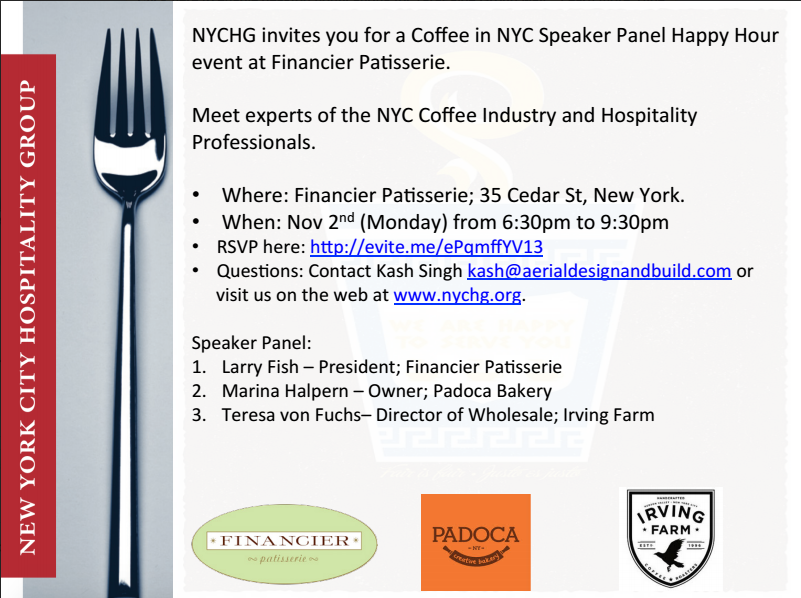
Screen Shot 2015-10-29 at 2.57.05 PMThe New York City Hospitality Group will hold an event where industry professionals can meet industry experts of the NYC Coffee Industry and Hospitality professionals. There will be a speaker panel of Larry Fish, President of Financier Patisserie, Marina Halpern, Owner of Padoca Bakery, and Teresa von Fuchs, Director of Wholesale at Irving Farm.

Where: Financier Patisserie, 35 Cedar St. New York

When: Nov 2nd from 6:30 PM- 9:30 PM

To RSVP for this amazing event, click here. For further questions about the event, please contact Kash Singh kash@aerialdesignandbuild.com or at the web http://www.nych.org.

Sadelle’s: Upscale Bagel Enterprise

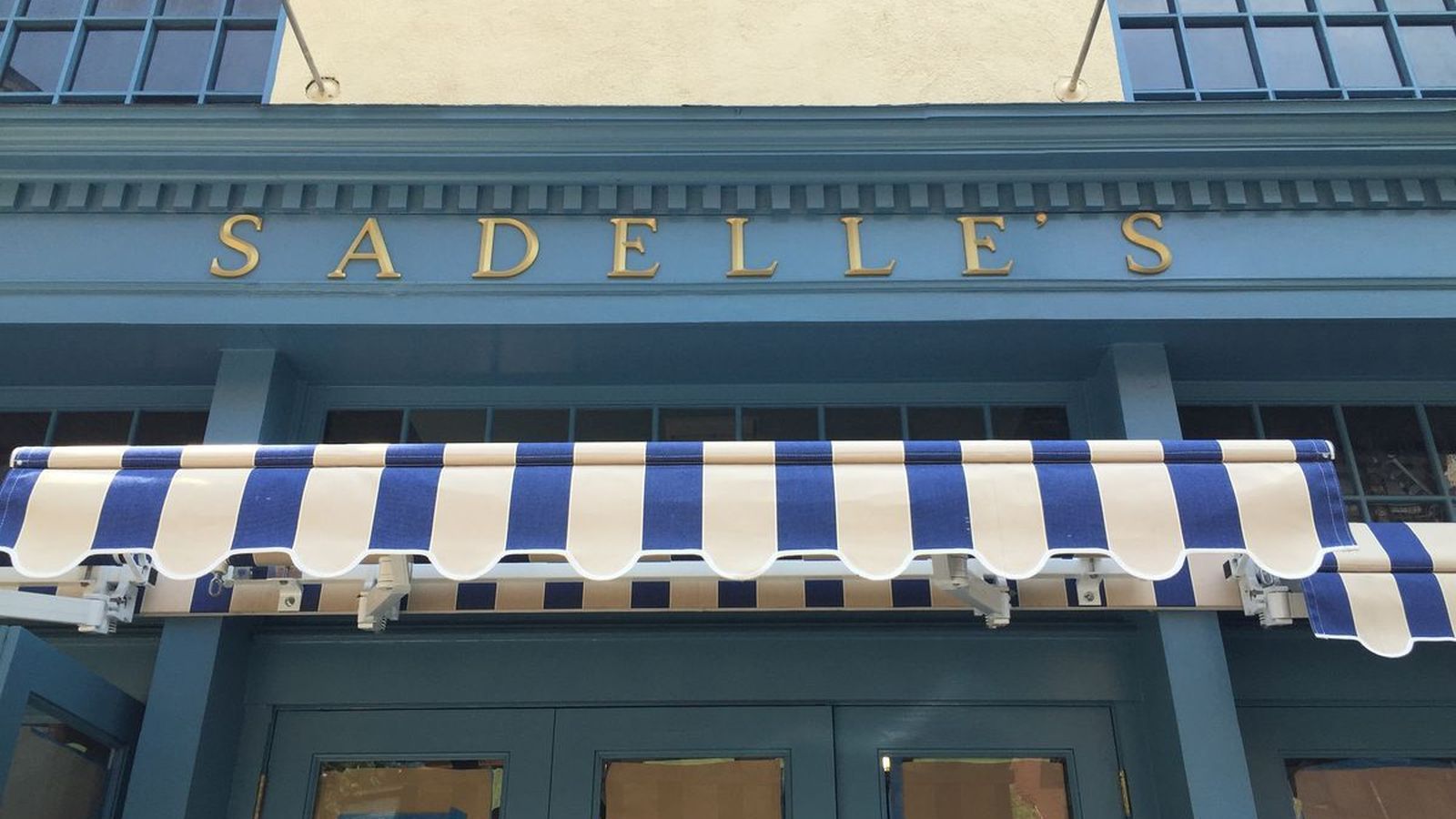
sadelles_menu.0.0Their Success…Bagels are historically more of a commodity than a specialty, and the proliferation of corner stores have flooded New York streets with mediocre crust and cream cheese.  However, Sadelle’s has taken the common and made it special; by focusing intensely on the entire experience and artisanal production methods, the Major Food Group team has made this staple memorable again.

Quoted as one of the most anticipated restaurants to open Fall 2015, Sadelle’s has made a grand opening. Located in the heart of SoHo, the bakery and restaurant specializes in one of New York City’s classic foods-bagels. Famous baker and co-owner Melissa Weller runs Sadelle’s bagel and bakery program. Hand rolled bagels, pastries and breads are made fresh on-site throughout the day in a glass-enclosed setting at the center of the restaurant. Sadelle’s offers both breakfast, lunch, dinner and quick and easy to-go service.

Sadelle’s carries an old-west with a modern city theme throughout their restaurant. The exterior of the restaurant illuminates in a pastel blue with gold letters “Sadelle’s” at the center. The restaurant is laid out with wooden flooring that corresponds with the color theme of the brick walls all across the restaurant. The chandeliers have a vintage edge, while the center kitchen, and take-away area is clean with a glassed enclosure. Similar wooden props are used both as decorative and functional items. A wooden bagel holder is both appealing as decoration but also is a bagel slot.

The front right section of the restaurant is set for customers ordering bagels, or pastries to-go. The pastries, and bagels are displayed in a glassed casing, while chefs are seen slicing fish. This extra service similar to City Bakery, where customers can have options for either sit-down or take-away attracts more customers in the early mornings, and during lunch hours. However, because the area where take-aways can be ordered is in close approximate distance with where the hostess is, and where those waiting for a table are, there is a dysfunctional aspect to the order of service. The fluidity of the direction of the lines isn’t strict, and can potentially intimidate more customers walking in.

Take Aways…The key word for services in the restaurant industry, today, is transparency. With shifts in consumer preferences and eating habits, many restaurants are forced to form towards healthy and transparent menu options. Sadelle’s successfully appeals to the modern consumer, where consumers can watch fresh lox being sliced by chefs for their bagels, and bakers baking fresh bagels at the center of the restaurant. This open kitchen appeals to customers and attracts customers to guarantee “fresh foods.”

Market Diner to Close After Service Sunday

jpgAfter 53 years of business, one of New York’s finest diners is closing. Earlier this summer, rumor spread that the Moinan Group had plans to build a 13 story mixed use development at the corner of 11th Ave and West 43rd St. Presently located on the corner is Market Diner. Market Diner has been in business since 1962 and served prominent iconic people of New York City like Frank Sinatra. Frank Sinatra and the Westies gang were noted fans of the diner and frequently ate at the diner decades ago. Moss says ” Anytime I’ve gone by the Market Diner, the place was packed. People loved it.” The Market Diner was also featured on Seinfeld.

While the diner was highly popular years ago,  now, the diner is being forced out of the complex. “Diners are a dying breed in Manhattan.” With rapid increases in costs of land, landlords want to develop buildings that can potentially be rented to generate more revenue. As an effect of new developments, many older businesses are being forced out.

The Market Diner will close at the end of service on Sunday, November 1st. The Garden Center next door will also be closing for the new development.

To read more, click here.

National Restaurant Association retaliates against $15 Minimum Wages

Screen Shot 2015-10-27 at 12.59.52 PMThe National Restaurant Association has recently filed a petition late last week challenging New York’s minimum wage increase. The NRA is asking New York’s Industrial Board of Appeals to outstate the order from the Department of Labor to gradually raise the hourly minimum wage for fast food workers to $15 an hour.

The increase in state-wide wages for fast food workers was made official in September when Governor Cuomo announced that in yearly breakdowns the wages of all fast food chains in New York would need to increase wages. The board recommended that $15 per hour was an “adequate” wage for fast food workers and was approved by Cuomo’s labor commissioner. However, NRA has submitted a 26 page appeal claiming that the wage increase is just a “thinly veiled attempt by Governor Cuomo” to avoid the hassle of getting things approved by the state legislature and finding a different way to enact his own policies. The filings include issues of separation of powers, and argues that the board made the new wage without a representative for the restaurant industry.

Many franchise owners as well are planning to file a lawsuit that argues that “it is not fair or legal to be saddled with such a significant” increase in costs that will be only applied to the fast food industry, not to all industries. The franchise owners believe the wage increase is “unfair and discriminatory.”

To read more, click here.

World Health Organization advocates Processed Meat Causing Cancer

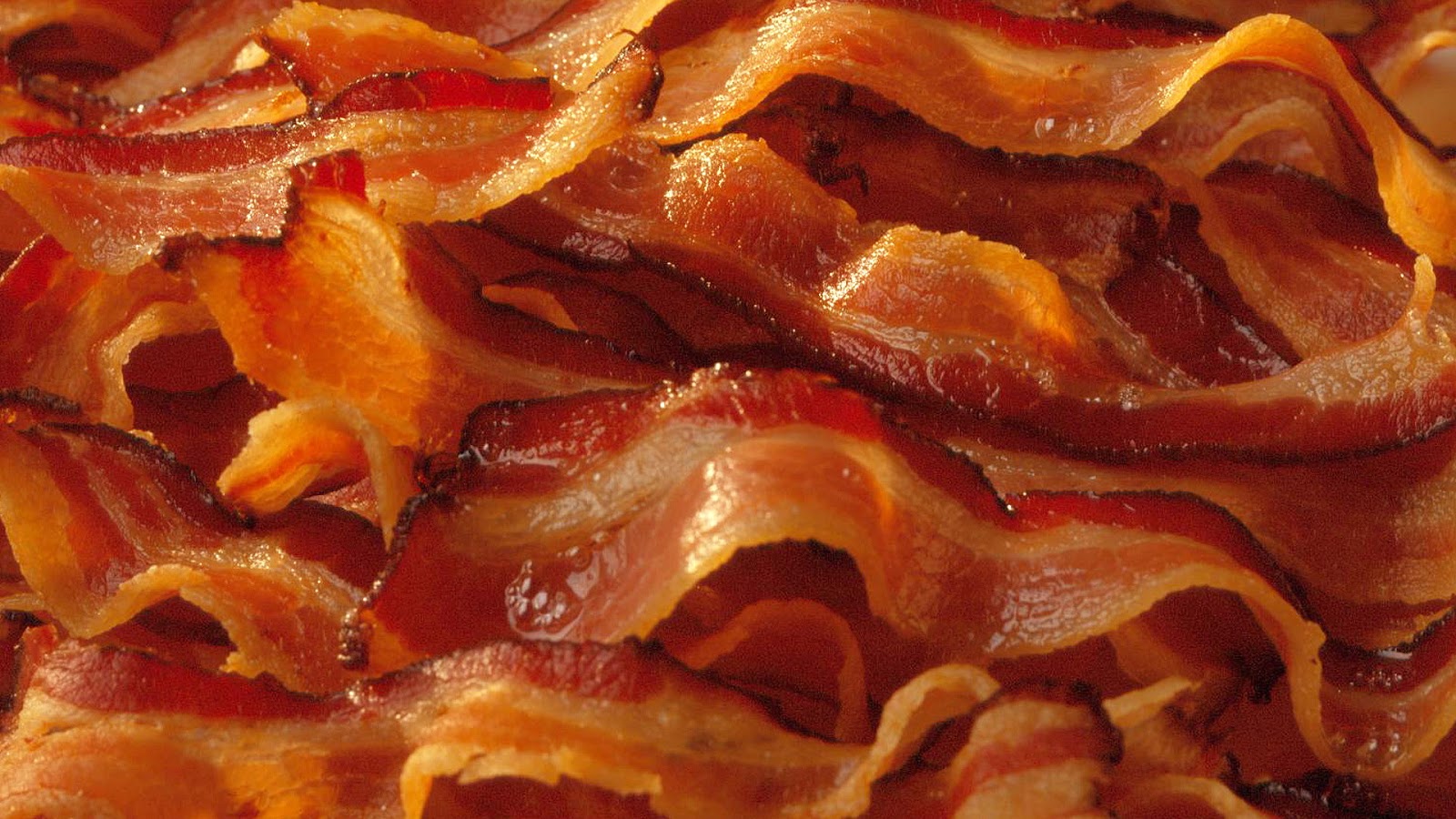
baconRed meat causing bowel cancer isn’t a new idea but rather has been a common claim the rouses a lot of attention. However, now, the World Health Organization is an advocate of red meat linked with bowel cancer especially when processed. The organization says that 50 extra grams per day of meat that is cured, smoked or loaded with preservatives ups the chances of getting colorectal cancer by 18 percent. The fatty red meat, is also a risk where it is now in group 2A or “probably carcinogenic to humans.”

However, while claims of red meat causing cancer is making major headlines, the North American Meat Institute has naturally discredited the information. “They tortured the data to ensure a specific outcome.” The trade group also notes that processed meat is just one of 940 other different things the IARC claims to pose theoretical hazards.

The IARC notes that experts are researching into this matter further into detail, however are not advocating that everyone does not eat meat in general. One expert says the decision “doesn’t mean you need to stop eating any red and processed meat. But if you eat lots of it you may want to think about cutting down. You could try having fish for your dinner rather than sausages.”

To read more, click here.

Seaweed to be the Next Kale

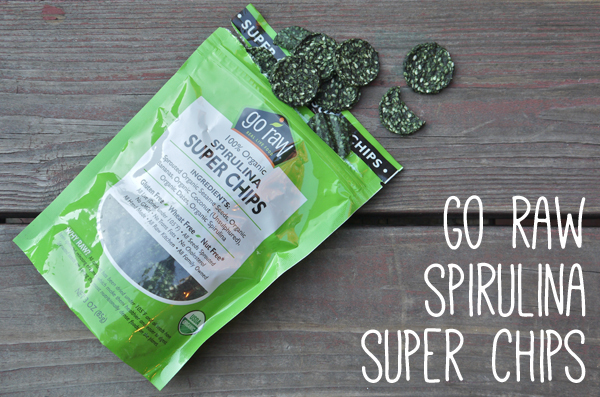
go-raw-spirulina-chipsSeaweed is “one of the world’s most sustainable and nutritious corps. it absorbs dissolved nitrogen, phosphorous, and carbon dioxide directly from the sea- its footprints is negative- and proliferates at a terrific rate” says Dana Goodyear. Because of its abundance in supply and its benefits to people, entrepreneurs, scientists, and farmers are hoping to make seaweed the next big thing, and the future of the human diet.

Bren Smith, the owner of Thimble Island Oyster Company and a pioneer of vertical aquaculture, believes the shift for Americans to tend towards seaweed can be very similar to that of kale. While Americans might be strange to the flavor and texture of seaweed, people can be taught to love the stuff. Smith is convinced that kelp is the new kale, and has already set plans for kelp smoothies, etc.

Seaweed is, of course, a regular diet of several East Asian countries, with farms producing tons of kelp, nori and jijiki to its market. However, there is an already emerging market for seaweed snacks in the U.S. Sales of seaweed snack are growing by 30 percent annually, with 2014 sales reaching $500 million.

To read more, click here.

General Mills will Fund Food Start-Ups

22-lucky-charms.w529.h529Like Budweiser who has already sponsored various breweries, General Mills is better positioning themselves for the future by funding food start-ups. Cereal-maker General Mills has seen their market shares shrink as consumers’ tastes change. General Mills has announced changes in their products like ridding GMOs and artificial coloring. However, General Mills has courted to new partnerships to better their future market shares.

The company has previously paid $820 million to acquire popular natural-food makers Annie’s. General Mills also has a stake in producers Beyond Meat. These acquisitions and investments will continue through a new venture-capital arm called 301 Inc. The company will start to invest in smaller-scale, more innovative food start-ups.

To read more, click here.

McDonald’s to Sell Monster Energy Drinks

21-mcdonalds-monster.w529.h529-1“All-Day breakfast” has become a major spur for McDonalds, and now executives have released that more implementations will take part for McDonalds. One of these will be to sell Monster energy drinks as part of value meals. “We’re always gathering feedback form customers on the food and beverages they’d like to be served at McDonald’s.” a representative said. Implementing Monster in value meals is still in limited trial at 20 locations throughout Michigan, Ohio, Georgia, Florida and Illinois. The chain says that many people are coming in to just purchase Monster, and the deal in itself could potentially be worth billions for Monster. Because, Monster is now distributed by Coke the logistics of selling Monster is fairly simple for McDonald’s as they are in partners with Coke products.

While many consumers have expressed negativity to levels of sodium and other unhealthy factors of McDonald’s, selling loads of caffeinated drinks can be a concern. The FDA has been reviewing “hundreds” or so-called “adverse event” reports involving energy drinks, and recent studies have connected them to hypertension and high chances of traumatic brain injury in athletes The American Medical Association says it should be illegal to market the beverages to anyone under 18. These regulations can potentially disregard McDonald’s plans of selling Monster drinks in all locations.

However, McDonald’s right now, don’t seem to be concerned with these rioting regulations. A spokesperson for McDonald’s said the company is also testing a value deal of two 16 ounce cans of Monster for $4.

To read more, click here.