Panel Series: Pursuing Your Own Restaurant

Culintro is hosting a panel series on Tuesday, October 28th called A Chef’s Tale: The Truth Behind Departing an Empire and Creating One’s Own. The speakers include acclaimed Chefs Missy Robbins (A Voce, Corkbuzz), Daniel Kluger (ABC Kitchen, ABC Cocina) and Chris Jaeckle (All’Onda, Uma Temakeria). The speakers will discuss their experiences rising to Chef stardom, their decisions to start their own ventures and the process behind it all. Editorial director for the Strategic Initiatives Group at the Culinary Institute of America, Anne McBride, will be moderating the discussion and revealing the challenges and positive aspects of following your dreams and pursuing your own restaurant.

The event will take place from 6PM-8PM at the NYIT Auditorium on Broadway at 1871 Broadway. Non-Culintro member tickets are priced at $45, member’s tickets are priced at $30. To read more about the panel series and to register, click here
 

Digital Employee Training

There has been lots of buzz about new mobile payment apps, menu tablets and online ordering but there has been an underwhelming focus on what new technology could mean for staff training. Digital technology can not only help scheduling but can also boost sales, teach employees correct procedures and give valuable insight to human resource departments. A company is able to have full control of online video-based training sessions whereas when an experienced employee trains a new hire, there is no sure way to trust that they are teaching the right things and in a company-approved manner.

Point-of-sale tools can help managers know whether or not servers need extra training based on the record of average sales for each table that is tracked by the POS. “Then it’s the responsibility of management to analyze those numbers and help their staff not only be accountable but also optimize sales,’ says Allan Barmark, whose firm creates custom training programs for businesses. Digital technology also allows for training to take place in a self-paced way because it is available online; there is no need to close the restaurant or hold classes that are difficult to schedule with different locations and shifts.

Food safety training is also made easier by digital technology as it ensures that employees have completed the required training and keeps a record. If there were ever to be an issue, the employer can rest easy knowing there is proof of completed training. Barmak also mentions that digital training technology gives managers and human resource departments new tools to use in identifying employees with the potential to move up in the company and tracking their progress.

To read more about what digital technology can mean for employee training, click here

Not My Day Job 2014

On Sunday October 26th the Epicurean Group is presenting Not My Day Job 2014, an event that celebrates art, talent and taste. The event will be held from 1PM-5PM in the Prince George Ballroom at 15 E 27th St in New York City.  The event gives hospitality professionals a platform to show off their talents outside of their “day jobs.” It will be an opportunity to watch some of New York City’s most notable restaurants showcase culinary skill and cocktail flare alongside side performances and artwork by talented NYC restaurant employees.

Proceeds from the event will benefit Fourth Arts Block (FABnyc), a nonprofit leadership organization founded in 2001 for the East 4th Street Cultural District. FABnyc drives community development and sustainability initiatives while preserving the rich historical heritage and creative vibes of the Lower East Side. A few restaurants participating in the event include: Mile End, The Wren, Scarpetta, Colicchio & Sons, Locanda Vini e Olii,Ward III, The Rum House, Yunnan Kitchen, Shake Shack, dell’anima, L’Artusi, L’Apicio, Anfora, The Gander, and more!

Tickets cost $60 plus a $4.29 processing fee. There is an industry perk, which is promo codes made available for restaurant staff. To register for the event, click here


Aligning Dining Patterns & Needstates

American Express provides restaurants with research-based analysis of key industry developments which is collected and analyzed by Technomic, Inc. Consumers were polled over a seven-day period and asked to describe their most recent restaurant occasion. While Technomic has recently released studies showing an increase in the snacking daypart, the majority of consumers that were polled reported their most recent restaurant occasion for breakfast, lunch or dinner. Dinner occasions were equally divided between weeknights and weekend nights, while lunch was more likely to be a weekday occasion. 60% of pollers who reported breakfast as their most recent occasion ate breakfast or brunch on the weekend.

As for takeout occasions, the poll showed that delivery occasions were twice as likely to have been a weekday purchase, of which 60% were for dinner and 30% for lunch. A very small percentage showed breakfast as their last restaurant takeout or delivery occasion. Consumers in the survey were also asked to estimate what percent of their restaurant occasions had been for each daypart in the past year. This led to some insights into generational differences; for example, while 12% of consumers aged 18-25 reported snacks or happy hour as their most substantial foodservice purchases, only 4% reported this for those 45 years or older.

Another part of the poll involved asking consumers to identify the needs or emotions they typically associated with each major daypart and weekpart.  While snacking and lunch were mainly associated with the basic need to satiate hunger, convenience was the biggest reason for consumers to use foodservice for weekday breakfast, weeknight dinner and even weekend lunch. Different dayparts showed to be more or less associated with different kinds of get togethers:  family get-togethers (weekend dinner) , friendly get-togethers (weekend dinner, happy hour) , and celebratory occasions (weekend breakfast). Other factors revealed in the poll were emotional needstates; for instance which occasions were associated with relaxing or as a treat/reward.

This data can be used to show operators the prime opportunities available to extend their daypart usage by meeting consumers’ needstates for each occasion. The data also shows where operators can get a competitive share for high-traffic meals or dayparts that are underutilized. Other business implications can be drawn from consumers’ ideas about what constitutes a ‘meal’ vs. a ‘snack.’ For example, offering items in various portion sizes and in a wider variety of combo options will satisfy a larger variety of needstates; offering lunch and dinner fare at the breakfast daypart can also help this.

To read more about the poll and the business implications that can be drawn from it, click here 


The 3 Pillars: Concept, Location, Market

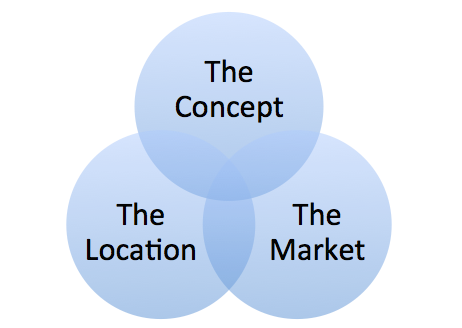
Whenever a new fast casual enterprise, restaurant or bakery is in the works, it’s only natural to want to start with the menu and design. However, that won’t guarantee success. Foodservice businesses require more than an appealing menu in order to successfully launch and survive. They are the sum of three parts coming together to form a whole—the concept, the market, and the location. These three give and take from each other to form the tangible business.

In order to ensure the longevity of your new venture, it is necessary to start in the center, and work around:

Screen Shot 2014-10-21 at 9.11.11 AM

Ultimately, the first question and last question to ask is whether the concept, market, and location are all mutually supportive and financially viable.

The Concept: What are you serving and how are you serving it? This encompasses the menu, service style, purpose and values.

Concept and Location: Does the size and location of the physical space support the concept, and vice versa?

The Market: Who are your guests? What are their wants and needs, and what job is your concept doing for them—baked goods for special events, dinner for 10, or healthy lunch served fast?

Market and Concept: Does the market exist to support your concept—that is to say, if you’re opening a healthy fast-casual lunch spot, are there enough working professionals in the market looking for lunch to support the business?

The Location: Where will the restaurant be and what is the footprint?

Market and Location: Is the location accessible to your market? In the above example, the location you choose would need to be near enough to the market of working professionals seeking lunch options in a timely window.

These three come together simultaneously—you cannot begin to conceptualize your new business without giving all three equal attention. For example, a third-wave coffee shop needs great coffee, an affluent market willing to pay for premium coffee, and a location accessible to the market with a footprint small enough to be sustainable on an $8 average check.

On the opposite end, a fine dining restaurant needs a much larger location—but the average check justifies the occupancy cost so long as the market exists—Per Se would not be successful in Detroit, no matter how low the rent.

Next time you’re in the planning stages of a new restaurant, bakery, or café, remember that the old adage of “if you build it, they will come,” is not planning for success. Success requires planning around the concept, the market, and the location.

Gourmet Food Hotspot in Sunset Park

The industrial loading docks of Sunset Park, Brooklyn are transforming into a hotspot for gourmet food producers. Li-Lac Chocolate and Blue Marble Ice-Cream are a few companies who lease kitchen and retail space in Industry City, so guests can come visit the factory, see how the products are made, and buy them fresh! As manufacturers seek out more affordable spaces for their production, Sunset Park seems to be the next place that will be undergoing a food revolution.

Industry City CEO Andrew Kimball says,“What’s great is there’s a real interest in understanding what you’re eating, where it’s made, what’s in it and watching it happen.” Industry City employs 2,400 people and are expecting that number to rise to nearly 15,000 by 2023; similar foodie patterns have been seen in Dumbo, Harlem and Greenpoint recently. Master chocolatier Jacques Torres also recently moved his factory to Sunset Park where the candy is all dipped and hand-made.

Liddabit Sweets recently opened on Industry City’s ground floor and co-owner Liz Gutman explains the appeal, ““We taught classes at ICE [Institute of Culinary Education] and Brooklyn Kitchen, but we never had enough space to teach our own.” Gutman plans to offer a Candy 101 class in December and a couples chocolate class in February for Valentine’s Day. The extra space also led Gutman to feel inspired to experiment with some savory items!

To read about more manufacturers leasing kitchen and retail space in Industry City, Sunset Park, Brooklyn, click here

Increasing Speed of Service

Innovations in mobile payments lead to a more efficient and seamless experience which will increase restaurant traffic, however, as an operator you need to be equipped for the influx of guests and know how to keep a speedy service. Leaders from across the fast casual segment discussed solutions to drive the speed of service at the ninth annual Fast Casual Executive Summit held in Denver and came up with nine main solutions:

1) Adding a second line.  The addition of a second line that focuses solely on catering, online or mobile orders and carry out will help break up the line and lead to speedier service.

2)Encourage guests to break the line. Hand in hand with number 1, tweeting that online ordering lets you go in the second line will also help manage flow.

3)Choose adequate online software. Choose a software that knows to space out online orders to allow for increased efficiency.

4) Off-site phone orders. The advantage of moving phone orders from the cashier to a call center is that they can be handled as mobile orders socustomer data can be captured which opens up another segment for marketing.

To read more solutions and suggestions on how to increase the speed of service in the fast casual segment, click here

Starbucks’ 2014 Holiday Initiatives

The Starbucks Leadership Experience conference was held this past weekend in Seattle where over 2,000 district managers shared customer initiatives to elevate the Starbucks holiday experience. Having noticed that during the 2013 holidays many brick-and-mortar retailers experienced a decline in foot traffic compared to a growth in online shopping, Starbucks experts began focusing on redefining the retail experience with digital innovations.

Howard Schultz, president and CEO of Starbucks Coffee Company states, “Customers researched, compared prices, and then bought the brands and items they wanted online, frequently utilizing a mobile device to do so. Since that time, we have been focused on radically redefining the Starbucks retail experience for our partners, customers and stores. As a result of the work we’ve done, Starbucks is poised for a great holiday—our innovation pipeline is strong and we have a number of initiatives ready to launch during the holiday and into calendar 2015 and beyond.”

Aside from the holiday changes which take place every season, such as the red cups and seasonal flavors, Starbucks will be introducing new customer incentives such as ‘Starbucks for Life” which lucky customers will be able to win by paying with their smartphone or by using their Starbucks card. Starbucks will also be launching Mobile Order and Pay in stores within the Portland area before the end of the year which will allow customers to place orders in advance for pick up in store. The nationwide launch for Mobile Order and Pay is planned for 2015 which will hugely increase the company’s presence in the mobile commerce scene.

Other holiday initiatives include the 30th anniversary of Starbucks Christmas Blend and the first new holiday beverage crafted in the past five years, the Chestnut Praline Latte. The loyalty program will have added value and benefits (including access to special events and sneak previews of new products) for customers using their mobile devices. The company will also be taking initiatives to expand the Starbucks Reserve coffee line by opening an interactive Starbucks Reserve Roastery and Tasting Room which will dedicate itself to roasting, coffee education and selling the small-lot Starbucks Reserve coffees.

To read more about Starbucks’ holiday initiatives for this season, click here


Webinar: The New Mobile Wallet

The shift to mobile payments is approaching even more rapidly with the arrival of Apple pay. Apple is pushing for customers to replace their wallets with their iPhones, as is the case with mobile payment apps on other smartphones. There are many opportunities for brands to make use of the ‘mobile wallet’ era beyond even just payments. On Tuesday, November 4th Michael Hagan, Chief Sales Officer at LevelUp, and Ariel Page, Project Manager at Hale & Hearty Soups, will discuss where brands can capitalize in mobile payments to engage customers and improve their business.
The discussion will begin by explaining what mobile payments really mean for a business, and go on to explore the basic offerings of Apple’s new mobile wallet and how to move beyond the m to engage customers. The panelists will also give an overview of why encouraging customers to look beyond their Visa, MasterCard and American Express is a good idea. The webinar will also give a merchant’s perspective on the benefits of mobile payments and loyalty, and finally will include a glimpse at LevelUp’s integration into Apple’s mobile wallet and Android’s Google Wallet.
To get more details on the webinar and its panelists and to register, click here


Healthy Snacking On The Go

There is a growing opportunity for restaurants to provide guests with healthy menu items that can be eaten regularly. Since snacking has essentially created its own day part, and more people are also focusing on adapting more active and healthy lifestyles, it is beneficial for operators to provide the guest with healthy grab and go snacking options with good nutritional value. A market research firm called The Hartman Group showed in their 2013 “Modern Eating: Cultural Roots, Daily Behaviors” report that snacking represents half of all eating occasions.

Alex Blair, franchise owner of Chicago’s fast casual concept, “Freshii” notices there is an increased rush of guests mid morning and after lunch for healthy snacks and fresh juices and smoothies. As more people try to incorporate fresh juices and vegetables in their diet, Blair has noticed an increase in sales for fresh juices. “Post-gym, people come to us for our smoothies,” Blair says. “There’s a huge following for recovery foods, and lots of customers are big on small, healthy meals. Often, we see the same customer several times a day.” This has led Freshii to partner with big name gyms such as Equinox and place their stores in the gym.

According to the National Restaurant Association, 72 percent of consumers are more likely to visit a restaurant with healthy items on the menu. Being that the snacking day part continues to grow at the same rate that people are making healthier eating habits, it is a great time to add healthy fast food snacks as menu items. To read more about incorporating healthy grab and go items, click here