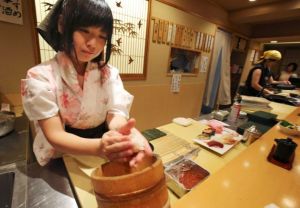
Women rise to Be Sushi Chefs

628x471A rise in the women’s movement for equal opportunities in the job force has lead many countries and companies to enforce this movement. Recently, the government of Japan has been encouraging women to take on previously male-dominated roles in an attempt to increase the country’s workforce. Japan was ranked 105th out of 135 countries with a largest gender gaps, with 40 percent of women not working. However, many Japanese women are now challenging tradition, like becoming a sushi chef.

Traditionally, there are stereotypes called “Edo-style” where woman aren’t allowed to prepare sushi as their belief that a women’s body temperature is warmer than a man’s altering the taste of sushi. Yuki Chidui, 28, sushi chef and manager of Nadeshico Sushi Restaurant in Tokyo, has created an all-women chef restaurant. “I think women are better at communicating with customers, and they’re kind and gentle.” Chidui chose to hire only women staff because she ultimately hopes to encourage other women break barriers and revolutionize Japan’s restaurant work force.

To read more, click here.
Black-Owned Restaurant Month

black-owned-restaurant-month.0.0Cities around the country host an annual “restaurant week” or “dining month” where local establishments offer dining deals to attract and market to new customers. Genese Jamilah, founder of event blog I Don’t Do Clubs, has proposed a new type of event-Black-Owned Restaurant Month. Jamilah focuses her event on black-owned businesses, to, ultimately, build a stronger black community.
Jamilah says that “Black Americans are just 13 percent of the U.S. populations and have potentially a buying power of $1.4 trillion by 2019.” She doesn’t believe that this is enough flow in money back into the black communities, and in order to strength spending into the black community, Jamilah proposes to highlight black-owned businesses around the country through this event. Moreover, with headlines in the past few years being that many black-owned restaurants were forced to move, Jamilah’s event seems more necessary. This event can potentially create more exposure to the community businesses and drive revenue stream into the community up.

Black-Owned Restaurant Month will take place this September in New York City.

To read more, click here.

NYC Restaurants are Required to Freeze Raw Fish

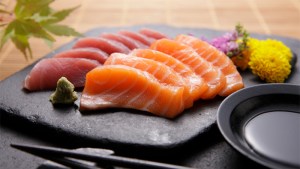
sashimi-resizedSushi restaurants have lured gourmands by boasting of the freshest fish. But with new regulations, published by the New York City Department of Health and Mental Hygiene, restaurants are required that fish served raw, undercooked or marinated raw are to be frozen first to guard against parasites. This regulations has been approved by the Board of Health and will be set to take effect in August. The Health Department regulation is that fish will be required a minimum freezer storage time of anywhere from 15 hours to a week depending not eh temperatures and storage process.


Though customers might be distasteful at their “fresh” fish coming from a freezer, the truth is that many chefs in NYC’s top restaurants have long used frozen fish to prevent serving their raw fare with a side of pathogens. “We purposely deep-freeze at negative 83 degrees, and we use one of those medical cryogenic freezers, this way it’s kind of like cooking, but instead of using heat we use freezing to remove parasites or bacteria on the outer surface.” says Yuta Suzuki, vice president of Sushi Zen. Even with these public regulations, because many restaurants have already been utilizing freezing as a method of pasteurizing, chefs believe it won’t take too much effect on their process of cooking. Moreover, frozen fish are free of parasites, and also cheaper, available out of season and sometimes even tastier.

To read more on NYC’s new regulations on Raw fish, click here

Dine – In Traffic on the Rise

In recent years, diners have been choosing to take out meals or eat at home, but a recent study from The NPD Group shows the tides are changing. Consumers are enjoying more meals at restaurants as sit down traffic has grown 2 percent in 2014, in addition to 1-percent growth in 2013. Dine-in visits currently account for 39 percent of industry traffic and generate more than $233 billion dollars a year. For years there has been growth in the take out segment, which offers lower profit potential to restaurants as NPD analyst Bonnie Riggs told Nation’s Restaurant News “When you dine in the restaurant sales are much higher, you order more items”

One reason for dine-in growth is that restaurants are taking into account customer’s wants and taking the time to understand their target demographic. One industry spotlight of this is the national fondue chain, The Melting Pot. The chain began hosting focus groups with current and past consumers who gave much insight to the wants of their target market. Through these groups they found out that the restaurant was being used mostly for specialty occasions and consumers wanted a more approachable venue that they could frequent more often. By using the consumer feedback the Melting Pot made radical changes to their menu and operations that resulted in increased sales in 2014.

To read more from Nation’s Restaurant News, click here

Opportunities: CohnReznick Presents 2015 Hospitality Webinar Series

8c1d533d77cb811b09c0b47c64360fa9

CohnReznick LLP, one of the top accounting, tax, and advisory firms in the United States, will hold the second session in their Hospitality Webinar Series on May 21st titled The Technology Landscape: Understanding What You Need and What Works. This webinar will cover the past, present and future of hospitality industry technology and identify the best platforms based on a company’s technological need. The webinar will be moderated by Christopher Mahon, Partner at CohenReznick and will feature James McGhee, Partner at Results Thru Strategy. Screen Shot 2015-04-28 at 12.39.44 PM

The series goal is to present webinars focused on the financial and operational issues that face hospitality companies. Other upcoming topics for the series include Public Relations and Social Media Strategies, The ABCs of Lending: The Finance Market for Restaurants, Both Big and Small and Legal Issues for the Hospitality Industry.

CohnReznick, headquartered in New York, offers specialized services for middle market, Fortune 1000 companies, private equity and financial services firms, government contractors, government agencies, and not-for-profit organizations. Founded in 1919, they have over 300 partners, 2700 plus employees and bring in an annual revenue of more than $500 million dollars.

To register for this webinar, please click here

EAT (RED) DRINK (RED) SAVE LIVES

This month of June Pat LaFrieda and Chef Mario Batali partnered with (RED) to raise awareness of the fight against AIDS. From June 1st – June 10th participating restaurants, bars and food trucks are donating a portion of their sales to the Global Fund to fight AIDS. The participants are getting involved by creating (RED) inspired recipes, dishes, cocktails and prix-fixe menus in order to help #86AIDS, a term used in the industry to show an item is no longer available on the menu: this is ultimately what (RED) wants to see occur with the AIDS epidemic.
A few chefs that have joined the cause include:
Chef Marcus Samuelsson
Chef David Burke
Chef Gabrielle Hamilton
Buddy Valastro
To find out more about either how to get involved or for participating restaurants click here

Product Mix Maximization

There are many forces that when working together create successful enterprises. The key ones for us are a streamlined concept, a great operator, a long-term vision, a unique selling proposition and ultimately a product mix that resonates with your guests.

For the first half of this year many enterprises have engaged our firm to advise them on store flow and product mix. The question arises often, what makes a great product mix? First and foremost, a great product mix is one where when the guest walks into your enterprise, and without thinking knows what to order. Your role as an enterprise is to guide the guest through the experience, while the guest feels as though there are many choices to make; the actual decision process is easy.

When thinking about product mix, we highlight a few quick tips to maximize the guest experience and financial success.

  • Day parts. Which ones will you be offering; breakfast, lunch, midday, dinner, late night?
  • Core products. Establish the core products that the enterprise will produce.
  • Maximize kitchen production. Are the core products you are producing actually the ones that are anticipated to be the top sellers? If not, think how to best maximize kitchen production for the top sellers.
  • Complimentary products. Once you have established the core products, think about what additional product groups compliment your menu.
  • Streamlined Concept. With all of the above, does your product mix speak to your vision of the concept.

Try not to steer far from your concept. We have worked with many enterprises that want to be everything to everyone and this formula is a recipe for disaster. No one enterprise can be everything but one enterprise can be something great with a clear message.

Happy product mix…TaraPaige Group.

5 Steps for Calculating Sales of a Food Enterprise Operational Budget

Starting an early stage food enterprise and growing to a multiunit operation involves a lot of moving parts to line up successfully. One that is paramount is to implement an operational budget in setting your business up for financial success. Budgeting is the most basic and effective tool for managing your business finances yet, many operators forego this crucial step because of the additional time and work involved. For all food businesses, the budgeting process can help identify the realistic profitability and financial metrics of the enterprise. In short, it can save you the grief of overspending and help you better manage different aspects of your operations.

We often get asked the question, “How do I go about preparing for an operational budget?”  A good budget stems from a well-understood concept with a streamlined product menu and we start with building the sales formula.  Our sales formula in preparing for an operational budget is highlighted below, we will use an early stage bakery as a sample.

1)     Identify your product groups.
The product groups are your different revenue streams that you will be offering.  Ex: Baked goods, savory product, home made beverages, coffee, tea, packaged product.

2)     Clarify your hours of operation taking into mind the seasonality of the business.
This will enable you to identify the day parts you are open, the hours per day and whether or not you are open for weekend and weekday business.

3)     Price the product groups per day part for an average check.
For example, the savory group may have a smaller check average at breakfast than at lunch.

4)     Identify a targeted location.
This is one of the most important things you can do for your enterprise. Finding a location that works for your business. Remember, rent in NYC is typically around 10% of sales. So if you are looking for a 1,000 sq foot space in NYC and the broker quotes you $200 / sq foot, your rent per year will be $200,000. This means that in order to make your rent worthwhile, your business needs to generate $2,000,000 in sales per year.

5)     Once the targeted location is set, engage in traffic counts.
We follow traffic counts for nearby food businesses of the target location you are looking to open as well as similar concepts in other locations.  You want to cover all day parts and this is the part of your research that may take a few days to cover all bases.

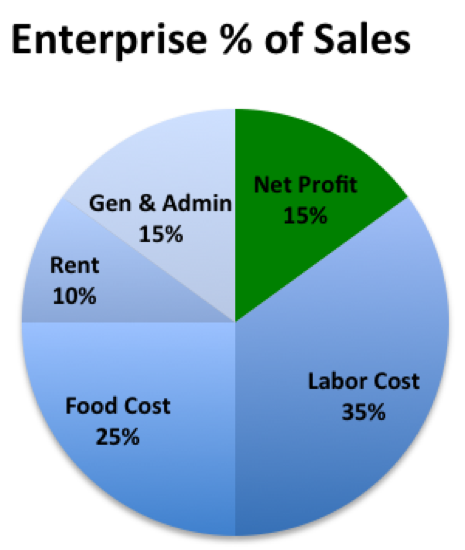
Once your research is complete, you are now ready to build your sales with the above inputs.  The key to building and best leveraging an operating budget is to make sure that your concept can support the expenses required to keep it running. It is nothing short of a balancing act.

We have a financial pie chart, which aids in this balancing act. The costs may vary for your operation, but the pie must always be equal to 100%. The level of investment made into the business goes beyond the numbers, it lies in good people, quality of food, training and standard operating procedures to keep the enterprise humming along with strong profits.

restaurant pie chart

Balancing Technology and Hospitality in the Modern Age— Is There a Happy Medium?

Restaurants are adapting to the ever-changing technology climate—is this a good thing? These days there is an app to facilitate almost any dining experience including making reservations, tracking wait times, placing orders, and processing payment. The adaptation to modern technology in the restaurant sphere has altered the dining experience for both guests and operators. Can human hospitality and technology cohabit in restaurants, or must one dominate the other?

From a guest standpoint, technology can provide a no-frills, however sterile, experience in which getting from point A to point Z requires few superfluous interactions in between. Are these interactions actually superfluous though? While it’s not far fetched to assume that one day all restaurants could be completely operated by iPads, do servers, hosts and managers possess an indispensable human quality that machines cannot replicate? Then the question becomes, “Is the hospitality experience created by the service team’s human interaction a requisite for guests, or are technological apps that can perform the same duties without the small talk sufficient?” From an operator perspective restaurant apps can ultimately lead to more profitability. Theoretically, guest traffic count would increase and fewer front of house staff would be required.

The app Cover allows guests to pay the bill without having to ask and wait for the check. Guests can select a tip percentage of their preference to be automatically calculated, and they can opt to divide the tab by the number of guests in their party. This is an example of an app that eliminates a tedious process that often leads to frustrating lag times; in this instance, hospitality is not of the utmost importance. However, when guests have control of their entire dining experience from appetizer to dessert at the tip of their fingers, literally, are the seemingly unnecessary steps of interacting with a server really that unnecessary? It may seem appealing to a single diner who is not in the mood for chit chat or to a group of friends who would rather focus on their conversation as opposed to the ordering process— but would the presence of a server actually provide an additional benefit instead of creating an unnecessary obstacle?

Servers are humans at their core, with life experience, people skills and opinions— all qualities that programs cannot acquire no matter how intelligent they are. Servers, hosts, managers and other front of house team members can guide guests in the right direction depending on guests’ moods, dietary preferences and any other concerns. Hypothetically, even if apps could somehow be designed to form humanlike judgments and opinions, will their efficiency and intelligence ever be a suitable replacement for the comfort of human interaction? Whether there’s a standard that restaurants should live up to in terms of balancing human hospitality with technology is ultimately up to the restaurateur; there may not be one right answer.

Cooking a Restaurant Through Architecture

Zakary Pelaccio of Fatty Crab will exchange views on his culinary-aesthetic collaboration with architect Michael Davis for his new restaurant in Hudson, NY. “Using period-sensitive techniques, a former 19th-century blacksmith cottage and carriage house structure underwent an adaptive reuse transformation under Davis’s expert guidance. Plenty of before-and-after photos and lively storytelling from the chef and architect illustrate the collaborative concept of ‘cooking a restaurant through architecture,'” explains the 92Y. Tickets are $21, and the event takes place at 12pm on Wed. Jan 22.