Sweetgreen Expects a Full Half of Sales to Come from their App this Year

The fast-casual salad chain Sweetgreen had a big year this year, opening 3 new stores in New York alone, moving their headquarters to California, and being dubbed “the next Chipotle” by CNN and others. One could argue that their success is built on many things – timing, a growing demand for healthy, sustainably sourced foods, their youthful aesthetic (one of their limited edition salads last year was named in honor of a Kendrick Lamar song) – but it would be a mistake to underestimate the role mobile has had in that success.  So far, 21% of Sweetgreen’s sales come through their custom app, and they expect that number to jump as high as 50% this year.

The appeal of mobile ordering is understandable: with lunchtime lines out the door, the Sweetgreen app allows guests to order from the office and pick up immediately, and once downloaded, a rewards system makes it more likely for them to keep visiting. Additional features like the ability to flag dietary restrictions, add favorites, and integrate with the iOS health app, add an additional layer of appeal.

Of course, for many small chains it simply isn’t feasible to build out this kind of ordering system. Sweetgreen has had the benefit of $95 million in total investments in recent years, and they’ve clearly dedicated a fair amount of that to building their mobile presence. But they do serve as a reminder of the kind of return such an investment can have.

To read more, click here.

David Chang’s Maple Expands Delivery Zone

As of today, workers in midtown now have the option to order there lunch from Maple – the streamlined food delivery competitor of Seamless and Grubhub backed by Momofuku’s David Chang. The Maple app launched last spring, and has since then allowed users downtown to order lunch or dinner from a rotating selection of menus (roughly 5 a day) to be delivered to their work or home. What separates Maple from other delivery apps is that there is no restaurant or selection of restaurants you are ordering from; instead, their small staff operates out of a commissary kitchen testing, preparing, and packaging the recipes each day (although Chang describes the operation as a “real restaurant,” with the app and delivery logistics taking the place of typical front of house operations).

Maple is a favorite of downtown 9-to-5’ers for it’s focus on presentation, affordability, and simple, healthy options. Chang originally invested in the project because he believed that “no one [had] ever taken the time to really do delivery food well.” They are expanding slowly for now, and still have all the trappings of a service-focused start-up: they have a small team of well-paid employees with a high attention to detail, and if you contact them with any problems (like a food order that arrives after 30 minutes), you’re likely to get emails back from a real person whose top priority is keeping you as a customer. Orders even include a free sugar cookie to set them apart. So far all thi has worked to Maple’s advantage, and press has been consistently good. We’ll know soon whether they can build the momentum necessary to compete with top delivery apps on a larger scale.

To read more, click here.

Farm-to-Table, Even in Alaska

OLYMPUS DIGITAL CAMERA

Photo via verticalharvesthydroponics.com

The expression “farm-to-table” (and it’s variants in the retail world like “bean-to-bar,” which recently got the Mast Brothers in hot water) has been around for some time; with sustainability and health on everyone’s minds in 2016, it shows no signs of going away. Even in Alaska, a state where chefs of all kinds lament the flavorlessness and cost of produce picked before its time and shipped thousands of miles, a farm-fresh movement is starting to take root.

Two new startups, Alaska Natural Organics and Vertical Harvest Hydroponics, are attempting to bring sustainable farming closer to the residents of Alaska using (relatively) new agricultural technology. The two companies rely on different solutions to the problem of climate – the former operates a small farm out of an old warehouse in downtown Anchorage, with LED lights set up to allow hydroponic vegetables to grow year round, and the latter makes portable growing pods out of repurposed cargo containers. These containers are designed to be climate-proof and easily installed as close to the consumer as possible – in the basement of restaurants or grocery stores, for example.

If successful, more start-ups could follow suit in Alaska and other harsh climates. The benefits are easy to see, as produce grown nearby saves on shipping costs, reduces emissions, keeps money in the local economy, and can be picked when ripe for better taste and nutrition.

To read more, click here.

To Pre Fixe or Not to Pre Fixe

Whether your New Year’s Eve plans are already set in stone or a little more last minute, if you’re planning on dinner out on the last night of 2015, chances are good you will be at one of the hundreds of restaurants offering a special New Year’s pre fixe menu instead of their regular options. Some of these spots even go so far as to hold limited seatings – two or three set times when guests will come in and all enjoy their appetizers, entrees and desserts at the same time. Many include an optional drink pairing list and a complimentary glass of champagne (or, more likely, sparkling wine) at midnight.

There are some obvious benefits to the restaurant in offering pre fixe menus and designated seatings on busy holidays (most often New Year’s and Valentine’s day). Since most guests will be making reservations, they can easily determine exactly how much they will make that evening, and eliminate much of the guesswork of preparing. Making 50 of the same dish is always simpler than plating orders as they come in, so an otherwise chaotic night can go as smoothly as possible. Chefs often have some license to exercise creativity and get exposure for new dishes. With set seatings, hosts and service staff can worry less about guests who might be tempted to linger until the ball drops. Finally, guests are often more comfortable paying a premium for having some stress relieved and knowing their entire experience will be taken care of – including the final glass of champagne.

In many ways, those benefits spill over to guests as well, as long as they choose their restaurant carefully and make reservations early. A quick Google search reveals plenty of lists of the best pre fixe  dinners in the city, but check menus in advance and keep in mind that everything is more expensive on New Year’s. For those not willing to pay the premium or worried about feeling rushed by the seating system, it may be more useful to check out a list of the best restaurants that are serving their regular menu (Eater also has a good one). That way you can pick and choose your favorites and go all in on an open bar later in the night instead. Ultimately, the perfect New Year’s Eve looks different for everyone. Happy New Year, and happy eating!

Danji-Interior-3-630x420.jpg

Dani on E. 60th – one option for those looking to avoid pre fixe pitfalls


Raising Restaurant Wages is Good for Everyone, According to Cornell

As fast food workers fight for $15 an hour and New York restaurateurs experiment with new pay models (mostly by eliminating tipping), there is more and more focus on the way we pay the people who feed us every day. The National Restaurant Association has consistently fought back against minimum wage increases, arguing that they will lead to price hikes and fewer new jobs in an industry with small profit margins for new comers. But a new study out of the Center for Hospitality Research at Cornell’s School of Hotel Administration argues otherwise.

The study looked at federal and state minimum wage increases from the past two decades to see if there was any connection with job loss or the number of new restaurants opening. As far as they could tell, the increases had no such effect, although they did improve employee retention and productivity. While one study may not be enough to predict the future of restaurant industry salaries, it is good news for owners, employees and patrons in the 20 states which will be raising their minimum wages in 2016.

To read more, click here.

Minibar, Drizly, and Amazon Want to Keep your Champagne Popping

minibar-delivery-app.png

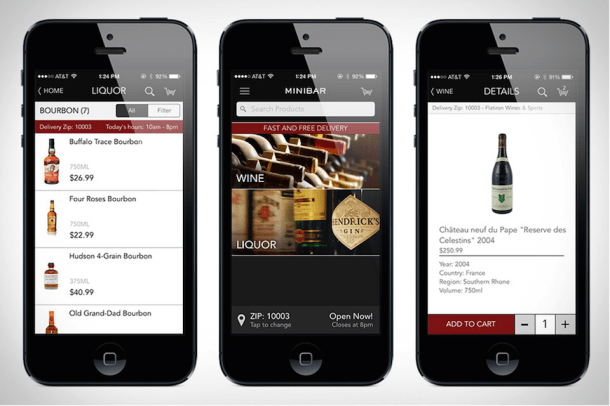
If you’ve taken the New York subway recently, you may have noticed the seasonal ads for Minibar, the alcohol delivery service that has been expanding rapidly the past few months, first by acquiring competitor Booze Carriage in March, and then by launching a subscription service for recurring orders in October. Minibar claims to have the largest share of the New York market, but that’s difficult to confirm. They certainly have plenty of competitors out there who are looking for a piece of the alcohol-delivery pie.

Most notably, and perhaps most threateningly to Minibar, is Amazon. Until early this month, Amazon only offered 1-hour booze delivery in Seattle, but as of December 9th New Yorkers with a Prime subscription can take advantage of the service as well.  Amazon is billing it as part of their Prime Pantry, so you can stock your party with other necessities like paper towels and Swiffers as well.

A third option is Drizly, which has a larger share of the Boston market, but is also available in parts of Manhattan, Brooklyn and Queens. Both Drizly and Minibar work by partnering with local liquor stores, listing their offerings via their app and website by zipcode, and taking a percentage of sales. Which service emerges as the market leader in New York may come down to who snatches up those local partners the fastest, but Minibar is also bolstering their business by providing other services – their website includes a party-planning feature to make sure you’re well stocked for any event, and if you feel intimidated by all those bottles you can even rent a bartender through their site.

To read more, click here.


Move to End Tipping Gains More Momentum

yI1Ya0x8QbiTi7potxLc_022.jpgDanny Meyer’s decision to end tipping at all his restaurants has already become the sort of high profile case that’s likely to spark conversation and debate in circles reaching far beyond the industry. As two more restaurateurs move to join him, it now seems like his announcement represents a major tipping point (pun intended) in what is considered standard.

This week both Gabriel Stulman and Andrew Tarlow announced that they would eliminate tipping at some or all of their restaurants. Stulman is the owner of six casual restaurants in downtown Manhattan, including Fedora on West 4th where he plans to eliminate gratuities in January. Stulman calls this a test drive of the new system, but ultimately he hopes to implement it at more of his restaurants as well. Tarlow, who is responsible for Diner and Marlow & Sons, said he plans to completely eliminate gratuities at all of his restaurants in 2016.

Although Meyer seems to have set off a domino effect, the trend is likely also due to the $2.50 increase in New York’s tipped minimum wage, which will go into effect in January. For many restaurants, it makes more sense to eliminate tipping altogether and hope that they can communicate the change effectively and avoid sticker-shock at higher prices.

Although the anti-tipping movement cites fairness as a major motivator, with higher wages for back of house workers as well as well as front of house, some employees may balk at the change, which puts more money in the employer’s pockets (at least until it reaches the workers paychecks). Stulman in particular is preparing for this backlash by offering “guaranteed wages for the members of our dining room team to be consistent with what they were averaging before the change.” To meet this requirement he’ll be increasing prices around 25% across the board.

To read more, click here.

NASA Engineer Makes Your New Robo-Barista

IMG_2267-1200x900.jpg

Most coffee shop regulars are willing to sacrifice at least some quality for speed, and the time-consuming process of  making pour-over coffee usually just isn’t feasible when there’s a line of customers out the door, even if the end product is a superior brew. In July, Cafe Grumpy introduced their solution to this problem at the Chelsea branch: a robotic pour-over machine capable of brewing 5 cups at a time. The Poursteady was engineered by Mark Sibenac and Stuart Heys, whose CVs include building parts for NASA’s Mars Rover, but who have now turned their attention towards quintupling the production of pour-over coffee.

Far from becoming our caffeinated robot overlord, the Poursteady actually puts as much control as possible in the hands of the barista, who can change the water temperature to within a degree, the water volume to within a gram, the timing to within a second, and the size of the drizzle pattern, all from a custom app. Outsourcing all those controls to an app keeps the machine itself clean and simple. So far, it seems to be working well for Cafe Grumpy, who originally installed the Poursteady for a trial run but bought it only a month later. Several more are currently in production, and you can even buy your own through their website.

To read more, click here.


Correction: an earlier version of this article listed Stephan von Muehlen, the product designer, as chief engineer.

Guest Post: Establishment of U.S. Hospitality Businesses Is a Win-Win for Foreign National Investors and the U.S. Economy and Culture

By Steve Maggi, Esq., SMA Law Firm

In the most international city in the U.S., New York City is full of ethnic businesses, especially in the restaurant industry, where every nationality’s cuisines has representative places to eat. Fueling the growth of foreign fare restaurants is the E-2 investor visa.

Immigrants with a reasonable amount of capital and a solid business plan to start a new company, or buy a business or franchise, can apply for the E-2 visa depending on their nationality(ies) and whether the U.S. has an investor treaty with their country(ies). The decision of whether to grant the visa is based on the probability of success of that business. This determination takes into account both how detailed and innovative the business plan is as well as the demand for the business’ products and/or services, as well as the amount of funding required to get a business up and running until it begins to generate revenue sufficient to lead to its growth and success. Here are some things to keep in mind about this particular visa:

  • The E-2 visa gives the applicant 5 years to form a successful business in the U.S.: The continuation of the individual’s legal stay in the U.S. is based upon the success of the business. So if the business fails, the visa is terminated and the holder must return to his or her country of origin or apply for a change of status to another visa or for a green card based on another venture, job offer or direct family relationship with a U.S. citizen or resident. The good news is that as long as the business remains successful, the visa holder can continue to live in the U.S. indefinitely. The visa can be continually renewed every five years as long as the business remains viable.
  • Only an individual with experience and/or interest in running a small business should apply: While the visa may accomplish an important goal of family reunification, it should not be used by someone who is not serious about running a business or lacks an entrepreneurial mindset. There are other potential means available for someone just looking to invest money and come here to stay with relatives, such as the EB-5 visa. The E-2 is best used by a person who wants to work hard and do what it takes to maintain a profitable business. If they lack experience sometimes a franchise model is the best one, as they are instructed and guided by the corporate entity which controls the brand, which of course maximizes the probability of success.
  • The application process is relatively simple: Many visa applications have a mandatory two-part process, ie. the petition must first be reviewed in the U.S. by immigration officials here and then, if approved, an applicant must apply for the visa itself at his or her corresponding U.S. embassy. In contrast, the E-2 visa can be applied for directly in U.S. embassies vis-a-vis consular processing, a process which is a quicker and less expensive application process, and can reduce the chance of denials (one chance of denial versus two). The application can also be done if the applicant is already in the U.S. through a change of status.
  • E-2 applicants are only be eligible if they come from certain nations: E-2 investor visas are only available to citizens from countries that have bilateral investor treaties with the U.S. Notably, citizens of the BRIICS countries (Brazil, Russia, India, Indonesia, China and South Africa) are not currently eligible for the E-2 visa. In those cases, the alternative may be EB-5 or other categories. However, it is important to point out that if someone possesses dual or multiple nationalities, that they can qualify based on just one nationality which has an existing treaty. For example, Israelis, Portuguese and Greeks (to name just a few) don’t qualify, but if they have any other treaty country nationality as well, they do.

In many situations, the E-2 visa can be a win-win situation for all involved. It leads to more businesses, which not only add to the cultural fabric of the nation in general, but also creates tangible jobs and improves the U.S. economy. Nowhere is that more abundantly clear than in the Big Apple and the its vibrant restaurant scene.

If you want more information please feel free to contact us at info@smalawyers.com.

© 2015 SMA LAW FIRM

Venture Capital Is Hungry for the Food Business

The food business is “ripe for disruption,” according to Steve Case, who cofounded America Online 30 years ago.  Case, who recently started his Washington-based venture capital firm Revolution, has made several high-profile bests on food: Sweetgreen, OrderUp, and Revolution Foods, a school-lunch company serving 1.5 million student meals per week.

“There are opportunities to improve the way things are done at every level: How food is produced, exported, processed, consumed,” Case said in an interview this week. “Our focus … is on investing in people and ideas that can change the world, and it’s harder to imagine anything that changes the world as much as food.”  To Case, the opportunity is, like in tech, in scalability: “It’s one thing to create one product in one particular restaurant,” Case said. “It’s another thing to roll it out to 5,000 restaurants, where the chefs are 16-year-old kids who have worked there for a few hours.”

Case thinks that the low barriers to entry and potentially high profit margins are partially why so many successful food companies have rested on their laurels, and this is where tech will come in to disrupt–especially given that eaters are embracing dining out more often and using apps for payment.  Sweetgreen, one of Case’s investments, is a salad shop that receives more than 20% of its orders through the chain’s mobile app.

“We’re in the first days, the early innings of this food revolution,” he said. “Nothing’s more important than what you put in your mouth three, four, five times a day.”

To read more, click here.