After 5 Months of Gratuity-Free, Nishi Changes Tact

20160227-Momofuku_Nishi_interior_2.0.jpgWhen David Chang opened Momofuku Nishi in Chelsea 5 months ago, the chef generated the usual buzz for a new Momofuku concept. But Nishi was also earning press as the latest addition to the gratuity-free movement, so far spearheaded by other big names like Meyer and Tarlow. Chang even gave an interview in his magazine Lucky Peach on the decision, citing their desire to pay kitchen workers a living wage.

This week, Nishi will be changing course and adding a tip line to the bottom of all checks. Prices will also lower somewhat, but wages for kitchen should stay the same. The team explained the decision in a Tumblr post, saying “This is by no means the end of the no-tipping discussion at Momofuku. But at this moment, we think a tipping model will benefit our guests and staff.”

Nishi also added brunch this week, which included a number of smaller, more affordable portions of items on the dinner menu. Hopefully the changes will satisfy early critics, who had praise for some dishes but considered them too pricey.

To read more, click here.
Fancy Coffee Has the South Bronx Talking

Formerly a deteriorating, poverty-stricken area, the South Bronx is now known for its hip-hop culture and its graffiti.  Last week, Birch Coffee opened shop on Hunts Point Avenue, a street characterized by auto shops, bodegas and cheap, variety stores.  It’s hard for Majora Carter to remember the last time Hunts Point had a spot that could serve both the community and its need for creativity.  She is a force of change in this part of New York City.

Ms. Carter collaborated on the café with entrepreneurs Jeremy Lyman and Paul Schlader, who have opened seven Birch shops in New York City.  And they are not the only ones.  Another coffee shop named Filtered Coffee opened a few months ago in Mott Haven, a neighborhood a few stops away on the No. 6 subway.  One of the business partners in Filtered is quoted as saying “Certain businesses come to fill a void in the community”.

Young people priced out of Manhattan and Brooklyn are now moving to the Bronx, regarded by some as an up-and-coming neighborhood.  Developer Keith Rubenstein is quoted as saying of Filtered partners Karen Paul and Aaron Baird, “They brought life to a place that was probably a little bit lifeless.”  New York restaurateurs may want to keep the South Bronx on their radars.

Please click here to read more…

Friday is National Donut Day 2016!!!

The annual epic donut giveaway is almost here!  National Donut Day, also known as “Free Donut Day”, is celebrated on the first Friday in June.

National Donut Day started in 1938 as a fund raiser for The Salvation Army. Their goal was to help those in need during the Great Depression, and to honor The Salvation Army “Lassies” of World War I, who served donuts to soldiers.

Soon after the U.S. entrance into World War I in 1917, The Salvation Army sent a fact-finding mission to France. The mission concluded that the needs of U.S. enlisted men could be met by “huts” that could serve baked goods, provide writing supplies and stamps, and provide a clothes-mending service. Typically, six staff members per hut would include four female volunteers who could “mother” the boys. These huts were established by The Salvation Army in the United States near army training centers.

About 250 Salvation Army volunteers went to France. Because of the difficulties of providing freshly baked goods from huts established in abandoned buildings near the front lines, the two Salvation Army volunteers (Ensign Margaret Sheldon and Adjutant Helen Purviance) came up with the idea of providing donuts. These are reported to have been an “instant hit”, and “soon many soldiers were visiting The Salvation Army huts”.

National Donut Day is celebrated at participating donut seller locations across the country.  Some of the Donut Day offerings include:

Entenmann’s: A total of more than 150,000 donuts will be given away in more than a dozen cities around the country, including Atlanta, Boston, Chicago, Cleveland, Denver, Louisville, New Haven, New York City, and San Diego

Krispy Kreme: Every customer gets a choice of any free donut on Friday, June 3, no purchase necessary.

Dunkin Donuts: Get one free donut with the purchase of any beverage

Cumberland Farms: Purchase any coffee or fountain drink between 5 a.m. and 10 a.m. on Friday and take your pick of a free donut.


Bartender, There’s a Logo in My Drink

The goal of bars these days is to make sure that guests recall the name of the place, no matter how strong the drink.  Cocktail napkins, matchbooks and cardboard coasters have been replaced by new, glittery branding techniques.

At Dante, a bar in Greenwich Village, the name of the place is stamped into the ice cubes.  The owners had a copper ice stamp custom made in Hong Kong.  The guests take pictures of the cubes, and one of the owners is quoted “In an age of Instagram, it’s hard to ignore free publicity.”

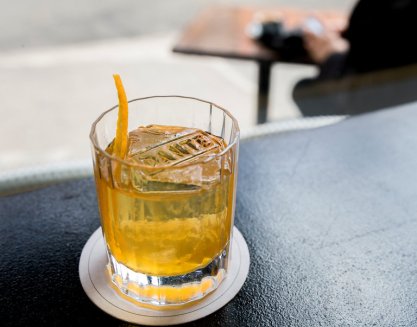
A bar in Seattle named Canon makes it easy to remember its name by branding citrus peels.  One of the owners says that his team is trying to provide guests with a “Wow” moment, or a sensory experience that takes them out of their day.

The Aviary in Chicago sears its name onto wooden coasters.  When the guests order a rum drink called “Brand New to the Game”, a pine coaster will be branded at their table with the name of the bar.  The fire created by the brand will be used to fill the inside of the glass with smoke before it is filled.  And the guest may take the coaster home.

Bar Leather Apron in Honolulu revived the bar token (special coins that can be exchanged for drinks).  A complimentary cocktail coin was created as a way to promote events or give away to visitors.

The San Francisco gin bar Whitechapel uses picks (perfect for spearing olives) to remind drinkers where they are.

To read more, please click here

For the Forager or Francophile, a Dandelion Salad

Dandelions’ sawtooth leaves bring a pleasant bitterness to the table, and make for a great salad. They’re best picked when tender, before the plant blooms, and they can be served raw or cooked.  Larger leaves may be sautéed, stir-fried or stewed with olive oil.  However, the dandelion is usually overshadowed by spring foods such as green garlic, asparagus, sorrel and rhubarb.

Dandelions grow everywhere so that foragers (searchers for wild food resources) are in luck.  The dandelions should be picked before they begin to flower.  Also, the forager should make sure that the leaves have not been treated with toxic chemicals.

Cultivated and wild, fresh-picked dandelion greens are being sold at farmers’ markets.  A long-leaved variety is also sold at supermarkets; these need to be trimmed as the top eight inches are best for salad.

A dandelion salad takes only 20 minutes to prepare and may include ingredients such as garlic cloves, grated ginger, lime juice, sherry vinegar, Dijon mustard, salt, black pepper, olive oil, beets, baguette slices, goat cheese, dandelion greens and eggs (the beets can be cooked and peeled up to two days ahead).  One version of the salad is modeled after a classic French recipe.

Nutritionists and science have shown that the dandelion is a green that’s good for you, and high in vitamins A and C.  Interestingly, the leaf was well known as a folk medicine cure-all, in the past.  Maybe dandelions could become the new kale?

To read more, please click here

Cocktail Bar Branding Gets Creative


18LOGO2-master768


Signature drinks are what cocktail bars are known for. But some bars have found ways of dropping a signature literally in the drink itself!

The trend includes branded ice cubes, citrus twists, olives, and made to order, fire-scorched wooden coasters.

Read more here


Domino’s Pizza accused of wage theft of $567,000

Three Domino’s Pizza franchises have been accused of owing $567,000 in back wages and underpayments to workers.

Importantly, the lawsuit, filed by New York State attorney general Eric Schneiderman, also lists Domino’s Pizza Inc (the franchisor) as a “joint employer” in the case. “As our suit alleges,” Schneiderman said in a statement “we’ve discovered Domino’s headquarters was intensely involved in store operations, and even caused many of these violations.” Specifically, Schneiderman accused the Domino’s Pizza Inc. of being complicit in the underpayment by urging operators to use the company’s PULSE computer system, even though the company knew the system under-calculated gross wages.

Domino’s has counted these accusations by claiming it is not responsible for the employment practices of its operators.

The most recent lawsuit follows settlements with 12 other franchisees that operate 61 locations and have agreed to pay 1.5 million to date.

To learn more, click here

It’s Dinner: But Is It Cooking?

What is a meal kit?  A meal kit includes all of the ingredients and recipes to make delicious meals at home.  More than one hundred companies now offer to do the planning, shopping, and prepping, leaving the joy of cooking, and eating, to you.  The United States meal market could grow by as much as five billion dollars over the next decade.

Meal kits are regarded by some as a positive development in cooking culture.  The kits provide ideas and eliminate the need to decide “what’s for dinner?”.  Feedback from customers, especially millennials, is that these kits are teaching them how to cook, so they can feel involved in the kitchen,

Blue Apron is one of the leaders in this category, and the company offers a subscription service with: original recipes weekly (500-800 calories per serving), fresh ingredients (pre-measured to avoid waste) and convenient delivery across the nation (arriving in a refrigerated box).  As a pricing example, Blue Apron offers a 2-Person Plan including 3 recipes per week for a total of $59.94 ($9.99 per serving) or a Family Plan for 4 including 2 recipes per week for a total of $69.92 ($8.74 per serving).

A price point of $9-$10 per meal is a lot of money for most people.  However, some believe the kits are worth the time saved driving/walking to the store and shopping.

The meal kit market gets very specialized at a point.  Fans of Northern California cuisine and chefs can join Sun Basket, and enthusiasts of Georgia farmers and Southern chefs may subscribe to PeachDish.

Meal kits might help to cut down on food waste through pre-portioned ingredients.  According to an estimate by the U.S. Department of Agriculture, up to thirty-one percent of America’s post-harvest food supply is thrown away.

One complaint about the kits is that too much packaging is used, and besides current recycling methods, there is a hope that one day the insulation will be compostable.

As far as home-cooking trends are concerned, meal kits are at the forefront.  How much staying power will they have?  Time will tell…

To read more, please click here

A Better Chocolate Babka

If you are looking to nosh on something, with your coffee, tea or seltzer, might I suggest a slice of babka?

Babka is a sweet loaf, similar to a light textured coffee cake.  Babka is made from a doubled and twisted length of yeast dough and is typically baked in a high loaf pan.  It starts with a rich, slow-rise dough made with lots of butter, real vanilla, fresh egg yolks, lemon zest, sugar and sea salt.  The dough is rolled around an almond frangipane (made from almonds, almond flour, more vanilla, butter, sugar and eggs), then brushed with dark chocolate and cinnamon sugar.  You can fill a babka with almost anything sweet: chocolate, jam, dulce de leche, homemade ganache, and Nutella to name a few.  The babka is usually scattered with brown sugar streusel.

This pastry is associated with Eastern European Jewish tradition.  The word “babka” is both Polish and Yiddish, deriving from “baba,” meaning grandmother.

Baking a babka requires commitment.  Babkas can take a day or more to make, which includes three and a half hours to bake, and six to twenty-four hours to rise.  Refrigerating the dough in between steps makes it easier to work with, and a longer proofing period gives the loaf a more complex flavor.  Proofing is the final rise of shaped bread dough before baking.

New York bakeries have joined the babka movement.  Bklyn Larder fills its babka with ganache, Sadelle’s creates a chocolate-cookie version and Breads Bakery presents a Nutella loaf.  Baz Bagel even bakes its babka into bread pudding.

Babka freezes very well, making for second servings, and another delicious snack or dessert.

To read more, please click here


Bringing Tradition Back; Bakeries Mill Again

The revolution is fermenting.  Right now, in a handful of bakeries around the country, there is a movement underway–stone mills are turning and fresh flour is turning into sourdough.  For most everyone reading this article, flour has always been ghost-white, shelf stable, and flavorless.  Fortunately for those of us who are gluten-tolerant, change is coming!

From California and Arizona to New York and North Carolina, bakeries are bringing tradition back.  In a time that none of us can remember, bakeries were where people bought their flour–freshly milled, whole grain from bran to germ–and had their loaves baked.  In the last 100 years or so, industrialization took over the process and bestowed upon us the wonderful white flour.  Unfortunately, we didn’t totally understand what was happening when we stripped wheat of its perishable part, the germ, and replaced it with a selection of vitamins to ‘fortify’ the remnants, the starchy endosperm.

Dough heavy weights such as Chad Robertson of Tartine Bakery (San Francisco), Richard Bourdon of Berkshire Mountain Bakery, and Chris Bianco of Pizzeria Bianco are popularizing on-site milling.  By milling the wheat whole, the oils, enzymes, and nutrients remain intact.  “When you compare what’s removed from wheat to make commercial flour, it tracks pretty well with the nutrients that are most deficient in the U.S. population,” says Dr. David Killilea, a nutritional biochemist at the Children’s Hospital of Oakland Research Institute.  In addition to the nutritional benefits, chefs are working directly with farmers and scientists–particularly those at Washington State University’s Bread Lab–to turn out loaves that maximize the flavor and texture profiles of different breeds.

To read more, click here and here.