Bloomfield’s Planned FiDi Opening Called Off

April Bloomfield, the chef behind NY staples Salvation Burger, The Breslin, and The Spotted Pig, has officially called off plans to open a complex of restaurants and bars at the top of 70 Pine Street in the Financial District. Bloomfield had originally planned to open the project with business partner Ken Friedman and developer Adam Rose, who is converting the the former AIG building into apartments. But by mutual agreement the plan has been called off, supposedly due to the complexity of the concept and logistics necessary. According to Rose, “we need a simple bar with basic (but nice) food to make it work 66 stories up in the air on top of a landmark.”

Rose is now working on securing another chef or operator, but has not announced any possible partners yet. He says that a future collaboration with Bloomfield and Friedman is still “highly likely.”

To read more, click here.

Major Producers Paying Farmers to Go Organic

With consumer demand for organic foods now outpacing supply, major companies like Kellogg’s and General Mills are now taking the next logical step to meet that demand: paying farmers to go organic. The move makes perfect sense from a profit perspective; organic foods are now at a 47% premium, and their sales grew 11% last year (4 times the growth industry-wide). Experts say this growth would have been even greater, if there had been more organic food to actually sell.

Given enough time, supply should theoretically increase on its own, but the large up-front costs associated with organic certification are a major hurdle for current conventional farmers. Inspection fees for the federally regulated organic label are paid by growers, who also have to cover the higher labor costs associated with organic farming methods when they abandon synthetic pesticides. Yields are also lower, which makes the switch a risky move as well. So Big Food is in some cases bridging the gap, providing start-up funding to help farmers transition and paying a premium for foods during that transitional phase.

To read more, click here.

Calorie Counts are Coming to Beer Labels

Beer-Calories

The Beer Institute recently announced a new initiative to encourage its member companies to display nutritional information on its products, packaging, and websites.

The new initiate is strictly voluntary, but with beer behemoths like Anheuser-Busch, MillerCoors, and HeinekenUSA have already signing on, the pressure is on small breweries to follow suit. In fact, the brewers involved in the new label disclosure comprise over 81% of the beer market

Consumers are increasingly interested in knowing more about the products they purchase. According to a recent survey conducted by the Harris Poll® on behalf of Nielsen, 72% of beer drinkers think it’s important to read nutritional labels when buying food and beverages.

Consumers should begin to see the impact of the Brewers’ Voluntary Disclosure Initiative immediately across the U.S. market, as many members currently provide some nutritional facts and ingredients information. 

Learn more here

NYC Department of Parks and Recreation: RFP For Union Square Snack Bar

The NYC parks department has issued a request for proposals (RFP) for the development, operation and maintenance of a snack bar at Union Square, due August 17th. Details of the RFP are below:

Request for Proposals (RFP) for the development, operation and maintenance of a snack bar at Union Square, Manhattan

All proposals submitted in response to this RFP must be submitted no later than August 17, 2016 at 3:00pm.  There will be a recommended proposer meeting on August 3, 2016 at 11:00am.  We will be meeting at the proposed concession site, which is located at 15th Street and Union Square East, in Union Square Park, Manhattan.  If you are considering responding to this RFP, please make every effort to attend this recommended meeting.
Hard copies of the RFP can be obtained, at no cost, commencing on July 15, 2016 through August 17, 2016, between the hours of 9:00 a.m. and 5:00 p.m., excluding weekends and holidays, at the Revenue Division of the New York City Department of Parks and Recreation, which is located at 830 Fifth Avenue, Room 407, New York, NY 10065.
The RFP is also available for download, commencing on July 15, 2016 through August 17, 2016, on Parks’ website.  To download the RFP, visit our Business Opportunities page and click on the “Concessions Opportunities at Parks” link. Once you have logged in, click on the “download” link that appears adjacent to the RFP’s description.
For more information or to request to receive a copy of the RFP by mail, prospective proposers may contact the Revenue Division’s Senior Compliance Officer, Jeremy Holmes, at (212) 360-3455 or at jeremy.holmes@parks.nyc.gov.
TELECOMMUNICATION DEVICE FOR THE DEAF (TDD) 212-504-4115


Food Halls Offer Unique Opportunities for Food Vendors and Guests

bergn1

Food halls have been opening at a rate that’s made them difficult to ignore.

From a guest’s perspective, food halls provide the opportunity to pick and choose from different vendors to create just the elevated (shared or single) artisanal and chef-driven meal they want. They can drop impromptu without needing to coordinate party palates ahead of time. Food halls also offer a place to linger while enjoying the hustle and bustle of a busy food market.

From the operator’s side, the format is attractive as well. Tenants share overheard expenses while getting the exposure and traffic that comes from being part of a high-profile venue. For up-and-coming entrepreneurs, it’s a way to break into the business without a lot of capital. For established, even celebrity chefs, it’s a way to meet the people where they are and sell to their food—and their brand—to a broader audience.

New food halls are emerging most often in once-abandoned urban spaces as local governments and neighborhood groups bend over backwards in to pave the way for developers. There’s fierce competition for coveted vendor spaces. For operators looking to nab a spot, this means having a tight concept that’s on-trend and can turn orders quickly—all while offering food quality that’s several notches above standard food court fare.

How To Make Your Restaurant A Pokemon Go Hotspot!

pokemon go

As smartphone apps go, the augmented-reality “Pokemon Go” really is a monster. “Pokemon Go” has been downloaded to more than 15 million smartphones in less than a week, according to the analytics consultancy SensorTower, and restaurant operators are asking how they can capture them as customers as well as Pokemon hunters catch the little Pocket Monsters.

A restaurant operator can buy 30 minutes of heightened Pokemon action by buying Lure Modules and installing them at PokeStop locations. Here’s a seven-step tutorial on buying and using the “Lure Modules” that the developer Niantic is selling and experts recommend to draw customers’ attention:

  1. Make sure your location and your smart phone are near a PokeStop, which is designated by an elevated blue cube on the app that turns into concentric three-dimensional spinning circles as you near it.
  2. If your restaurant is within yards of a PokeStop, buy Lure Modules by first tapping the red and white ball at the bottom on the “Pokemon Go” app. That will take you to a “Settings” screen with options such as Items, Pokemon and “Shop.” Tap “Shop.”
  3. You are now on a purchase screen, and you can purchase PokeCoins through the iTunes or Google Play stores by scrolling to the bottom. A Lure Module costs 100 coins (99 cents). You can buy larger amounts such as 550 Pokecoins for $4.99 and 1,200 coins for $9.99.
  4. After the PokeCoins are purchased, you can by a Lure Modules for 100 PokeCoins or eight Lure Modules for 680 PokeCoins. Your purchase will show up among the Pokeman Go “Items.”
  5. During the period when you want to increase possible “Pokeman Go” traffic for 30 minutes, tap on the spinning “PokeStop” and click on the white bar immediately beneath its location.
  6. A screen noting an “Empty Module slot” will open and tap the white bar to install the module. Your location is a “Lure” spot when you see what looks like a mini blizzard of pink leaves. The Pocket Monsters will show up for you and others for 30 minutes.
  7. Let potential customers know you’ve made in investment by posting your alluring purchase to your Facebook, Twitter and Snapchat fans, such as Just Salad did in New York as seen in the tweet pictured above.

America Throws Away Half of Its Edible Produce

fresh-produce

New research suggests that fully one-half of the nation’s produce now probably ends up as garbage. This dismal nugget from the story pretty well summarizes the findings:

Vast quantities of fresh produce grown in the US are left in the field to rot, fed to livestock or hauled directly from the field to landfill, because of unrealistic and unyielding cosmetic standards, according to official data and interviews with dozens of farmers, packers, truckers, researchers, campaigners and government officials.

The story distinguishes waste that’s “downstream,” or ruined because it goes bad on a grocery shelf or sits forever in a fridge bin, from waste that’s “upstream.” The first kind supposedly accounts for $160 billion worth of produce every year — which isn’t hard to believe when you remember each American family single-handedly trashes $600 worth of food in that time frame — but factor in ugly produce left to rot in the field or rejected by grocery stores, and The Guardian estimates this figure quickly climbs to half of all of the fruits and vegetables the country grows.

Read more here.

Angel’s Share Alums Open New Cocktail and Ramen Bar

11-rokc-009.w710.h473.2x.jpgShigefumi Kabashima and Tetsuo Hasegawa, both formerly of the popular speakeasy-esque bar Angel’s Share, have just unveiled the full cocktail menu at their new spot in Hamilton Heights. The bar is called ROKC (short for Ramen, Oysters, Kitchen and Cocktails), and the menu is a playful American twist on the high quality Japanese drinks at Angel’s Share. Examples include a Thai tea spiked with absinthe and cachaça, a matcha latte with Japanese whiskey, and a fruity cocktail called “Flower” with shochu, lavender, elderflower, and cranberry, served in a lightbulb and presented over ice in a trapezoidal pot.

These cocktails are all newly unveiled, but the ramen and limited raw bar have been available for a few weeks during he restaurant’s soft-open. Ex–Maison Premiere sous-chef Jeff Srole has been heading the seafood menu, and Isao Yoneda (formerly of Totto and Hide-Chan) is responsible for the three types of ramen bowls.

To read more, click here.

Ice Cream gets Honored With Its Own Museum

MUSEUM OF ICE CREAM .jpgBeginning in August, the meatpacking district will be home to a new museum dedicated to the wonderful world of ice cream, where guests can play in an ice cream-themed playground, learn about the history of the cold treat, and of course try samples. Co-founders Maryellis Bunn and Manish Vora originally embarked on the project last year in order to fulfill Bunn’s childhood dream of being able to swim in a pool of sprinkles. That specific fantasy will be available to all visitors at the museum, where the pair have filled a life-size pool with sprinkles that may not be edible, but are designed to look and feel exactly like the kind usually seen on sundaes.
The rest of the exhibit, which is sponsored in part by Tinder, features a playground with equipment like an ice cream scoop seesaw and ice cream sandwich swing, a tasting lab with weekly rotating flavors from New York ice cream shops, plus sculptures, paintings and murals throughout the maze-like space. Black Tap and Oddfellows have already been announced as partners.

Tickets are $18 for single admission or $30 for a couple. To read more, click here.

Craft Brewers Go Hi-Tech

craft hop

The dirty secret behind today’s IPAs: There’s little dirty about them. Brewers are sourcing their signature bitterness in sterile labs, not muddy hop fields.

The hop plant contains oils and resins that give beer its bite; lab-made extracts of those flavorful and bitter oils and resins were once relegated to Big Beer’s industrial toolbox, while craft brewers stuck to cramming whole cones of the hop vine into the brewing kettle. No more. Not that industrial hop extraction is anything new. In the 1870s, the New York Hop Extract Company supplied brewers with hop resins made by soaking flowers in gasoline. Today, labs use liquid CO2 as a solvent, boiling hops to extract oils and then venting the gas away. The liquid that remains is clean, shelf-stable and concentrated, easy to preserve and to ship. “Extracts have better longevity [than raw hops], particularly in countries with developing logistics or harsher climates,” said Alex Barth, CEO of John I. Haas.

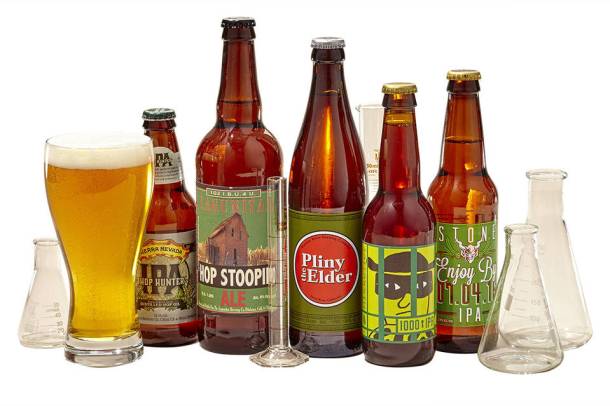
Still, the new wave of extraction is small. Robert Bourne of Extractz makes variety-specific extractions in an Ohio garage. He supplies a few local brewers but admitted he’s on the fringes: “It’s more of a home-brew thing.” Even when they come from a garage, extracts haven’t quite shed their industrial associations. The Hop Stoopid label shows a rustic barn; the fine print proclaims the “mountain of extracts” in the beer. “People read the label and call us up saying they won’t drink it,” says brewmaster Jeremy Marshall . “They think it’s some industrial, nonnatural thing.” Others maintain that whether from a leaf or a vial, flavor trumps all.

Read more here.