The Yelp Underpaid-Employee Saga Continues

140245452.jpgThis weekend a (now former) Yelp employee, Talia Jane, wrote an open letter to her employers revealing the financial struggles brought on by her low paycheck, and criticizing the irony of the company spending millions on a food delivery app while employees “can’t afford to buy food.” The post was widely shared, and Jane was subsequently let go – a move which, predictably, Yelp Human Resources claims was not caused by the letter but which Jane herself says was a direct result.

Yelp CEO Jeremy Stoppelman has since taken to Twitter to acknowledge Jane’s point that the cost of living in San Francisco is much to high, but skirt around her direct attacks. Both Stoppelman and other spokespeople have mentioned expanded entry level employment in areas where the cost of living is cheaper.

It’s likely that this event will blow over without too great of an effect on Yelp’s sales or stocks. But the viral nature of the original post reveals a distrust for the large companies like Yelp and Seamless which increasingly act as middlemen between restaurants and their guests.

To read more, click here.

Danny Meyer’s War on Airplane Food

18DELTA1-master675.jpgAlthough it seems unlikely that airline food will overcome it’s reputation any time soon, the partnership between Delta and Danny Meyer’s Union Square Hospitality Group has at least shifted the conversation. In 2013, Delta began serving food from USHG’s Blue Smoke on a select few flights, and although there were a few hurdles along the way the feedback was mostly positive. Beginning March 1st, all customers on international flights in the Delta One cabin will now be able to enjoy an updated menu from Carmen Quagliata, which tosses out some of the airline food standbys like reheated, textureless pasta and instead aims to work within the limitations imposed by small spaces and packaging. This means no more chunky soups or fried garnishes, but plenty of purees and roasted vegetables.
John Harenda, the VP of operations for USGH, has set a lofty goal for this new menu. “We want passengers to say, ‘This is great food’ — not, ‘This is great food for an airline,’ ” he tells the New York Times. Of course, the real news will be when these dishes are available in coach as well – for now, economy passengers will have to settle for smelling Quagliata’s food from the Delta One cabin.

To read more, click here.

Ravi DeRossi Turns an Empire Vegan

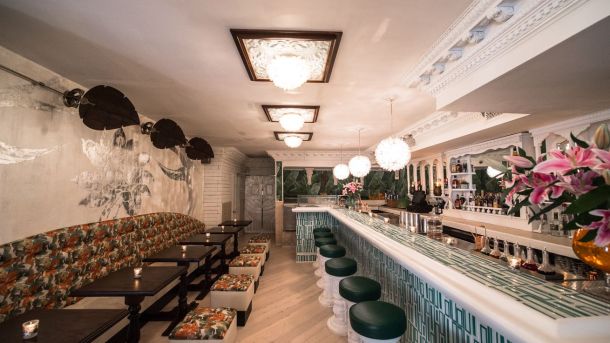
18712231573_877fb3734a_o.0.0.jpgRavi DeRossi, the restaurateur behind Death and Co, Avant Garden, Mother of Pearl and 12 other bars and restaurants around the city, is making a serious push to turn all of his operations fully animal-free. He’ll be starting by expanding the already vegan Avant Garden into multiple spinoff concepts, as well as closing the charcuterie-focused The Bourgeois Pig and reopening it as vegan wine and tapas bar LadyBird. All of his restaurants are in for some sort of shake-up, and it seems his mixologists won’t be safe either, as cocktail and beer lists will be purged of the often ignored animal ingredients that are sometimes used in drinks.
DeRossi himself has a long history with veganism, and feels passionately about the environmental and animal welfare impacts of factory farming. Before becoming involved in the hospitality industry, he spent many years living completely meat-free. As he describes to Eater, “You don’t realize that the average restaurateur does three times more destruction [to the environment] than the average person,” and, “If we’re going to do something to help this planet, it needs to start. It needs to be me not just preaching, but me just doing it. I’m in the position to do it.”

To read more, click here.

Uber Eats has Steep Costs for Restaurants

The food delivery market, once handled primarily by restaurants themselves, has gotten more and more crowded lately as both start-ups and established companies muscle their way into the fray. As the field grows, the importance of differentiating oneself is obvious – whether it’s by offering more options or fewer, a shorter delivery time or a cheaper surcharge. But one factor that’s largely invisible to the end user is the percentage these companies charge to the restaurant themselves.

A typical rate for standbys like GrubHub and Seamless falls in between 10 and 15 percent, while others (like Caviar), charge nothing to the restaurant and make their profit entirely from delivery fees paid by the customer. Uber Eats, on the other hand, will be rolling out services in major cities this month at a 30% rate – even worse than the current high of 25% charged by Amazon.

It’s worth noting that, unlike GrubHub and Seamless (who do not supply their own delivery people), Uber and Amazon offer a more complete service to restaurants. Beyond the interface they offer, the delivery itself is taken care of, not to mention promotional assistance and photographers. To some, these services and the exposure they provide more than justify the cost. But to others – particularly those with lower profit margins per-item to begin with – Uber Eats is simply out of reach.

To read more, click here.

Celebrate Some of New York’s Greatest Food Halls with Open House New York

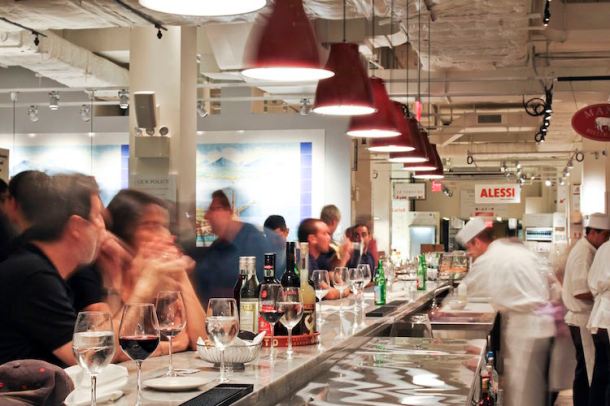
Eataly_IMG_3220_digi-AZ.jpgThe Nonprofit Open House New York states as their mission “promoting a greater appreciation of the city’s built environment; broadens public awareness by exposing diverse audiences to distinctive examples of architecture, engineering and design,” and what’s a more impressive feat of engineering and design than the city’s food system, which brings some of the greatest food in the world to millions every day?

That’s why OHNY hosts a series of public programs they call “The Final Mile” about this very system, in order to make what is largely invisible more transparent for all. For Winter 2016, this programming focuses on food halls in modern life. With a series of tours of some of the city’s best-loved food halls. These tours kick off with Eataly on February 19th, Berg’n on the 24th, Le District on March 3rd, and Gotham West on March 8th. Tickets to each are sold individually, so you can visit one or all depending on your interests.

To read more about the tours, as well as the industry insiders who will be guiding them, click here

David Chang Gets Feisty With Momofuku Nishi

Momofuku Nishi – David Chang’s latest project in Chelsea – has finally opened, and Chang made the announcement today through his magazine Lucky Peach along with an interview. The restaurant was rumored to be an Italian-Korean fusion, but Chang balks at that description. Instead, he asks “what food isn’t fusion?” and says,

“There are Italian words on the menu but we’re not trying to make Italian food. We’re not trying to make a Korean restaurant. We’re trying to do something that we’ve never done at Momofuku. We’re inspired by Italy but we’re not using any Italian ingredients. Things are moving at light speed here.”

Momofuku Nishi will also add to the list of major New York restaurants operating with a no-tipping policy. Chang cited the greater parity between front of house and back of house wages as the primary factor in this decision, and made no apologies for charging more.

The real cost of selling food is not accurately reflecting the labor that’s going into it. In 2000, I got paid maybe $10 an hour. Inflation has definitely risen, but cooks’ wages haven’t. That’s one of our biggest issues. We want to be able to grow as a company so we can provide for more people. This is a way we might be able to do that. And if it doesn’t work, we can always go back to the old way.

The menu is not yet available online, but Nishi is now open Tuesday – Saturday from 6:00pm-11:00pm.

To read the full interview, click here.

David Chang’s Maple Expands Delivery Zone

As of today, workers in midtown now have the option to order there lunch from Maple – the streamlined food delivery competitor of Seamless and Grubhub backed by Momofuku’s David Chang. The Maple app launched last spring, and has since then allowed users downtown to order lunch or dinner from a rotating selection of menus (roughly 5 a day) to be delivered to their work or home. What separates Maple from other delivery apps is that there is no restaurant or selection of restaurants you are ordering from; instead, their small staff operates out of a commissary kitchen testing, preparing, and packaging the recipes each day (although Chang describes the operation as a “real restaurant,” with the app and delivery logistics taking the place of typical front of house operations).

Maple is a favorite of downtown 9-to-5’ers for it’s focus on presentation, affordability, and simple, healthy options. Chang originally invested in the project because he believed that “no one [had] ever taken the time to really do delivery food well.” They are expanding slowly for now, and still have all the trappings of a service-focused start-up: they have a small team of well-paid employees with a high attention to detail, and if you contact them with any problems (like a food order that arrives after 30 minutes), you’re likely to get emails back from a real person whose top priority is keeping you as a customer. Orders even include a free sugar cookie to set them apart. So far all thi has worked to Maple’s advantage, and press has been consistently good. We’ll know soon whether they can build the momentum necessary to compete with top delivery apps on a larger scale.

To read more, click here.

Farm-to-Table, Even in Alaska

OLYMPUS DIGITAL CAMERA

Photo via verticalharvesthydroponics.com

The expression “farm-to-table” (and it’s variants in the retail world like “bean-to-bar,” which recently got the Mast Brothers in hot water) has been around for some time; with sustainability and health on everyone’s minds in 2016, it shows no signs of going away. Even in Alaska, a state where chefs of all kinds lament the flavorlessness and cost of produce picked before its time and shipped thousands of miles, a farm-fresh movement is starting to take root.

Two new startups, Alaska Natural Organics and Vertical Harvest Hydroponics, are attempting to bring sustainable farming closer to the residents of Alaska using (relatively) new agricultural technology. The two companies rely on different solutions to the problem of climate – the former operates a small farm out of an old warehouse in downtown Anchorage, with LED lights set up to allow hydroponic vegetables to grow year round, and the latter makes portable growing pods out of repurposed cargo containers. These containers are designed to be climate-proof and easily installed as close to the consumer as possible – in the basement of restaurants or grocery stores, for example.

If successful, more start-ups could follow suit in Alaska and other harsh climates. The benefits are easy to see, as produce grown nearby saves on shipping costs, reduces emissions, keeps money in the local economy, and can be picked when ripe for better taste and nutrition.

To read more, click here.

To Pre Fixe or Not to Pre Fixe

Whether your New Year’s Eve plans are already set in stone or a little more last minute, if you’re planning on dinner out on the last night of 2015, chances are good you will be at one of the hundreds of restaurants offering a special New Year’s pre fixe menu instead of their regular options. Some of these spots even go so far as to hold limited seatings – two or three set times when guests will come in and all enjoy their appetizers, entrees and desserts at the same time. Many include an optional drink pairing list and a complimentary glass of champagne (or, more likely, sparkling wine) at midnight.

There are some obvious benefits to the restaurant in offering pre fixe menus and designated seatings on busy holidays (most often New Year’s and Valentine’s day). Since most guests will be making reservations, they can easily determine exactly how much they will make that evening, and eliminate much of the guesswork of preparing. Making 50 of the same dish is always simpler than plating orders as they come in, so an otherwise chaotic night can go as smoothly as possible. Chefs often have some license to exercise creativity and get exposure for new dishes. With set seatings, hosts and service staff can worry less about guests who might be tempted to linger until the ball drops. Finally, guests are often more comfortable paying a premium for having some stress relieved and knowing their entire experience will be taken care of – including the final glass of champagne.

In many ways, those benefits spill over to guests as well, as long as they choose their restaurant carefully and make reservations early. A quick Google search reveals plenty of lists of the best pre fixe  dinners in the city, but check menus in advance and keep in mind that everything is more expensive on New Year’s. For those not willing to pay the premium or worried about feeling rushed by the seating system, it may be more useful to check out a list of the best restaurants that are serving their regular menu (Eater also has a good one). That way you can pick and choose your favorites and go all in on an open bar later in the night instead. Ultimately, the perfect New Year’s Eve looks different for everyone. Happy New Year, and happy eating!

Danji-Interior-3-630x420.jpg

Dani on E. 60th – one option for those looking to avoid pre fixe pitfalls


NASA Engineer Makes Your New Robo-Barista

IMG_2267-1200x900.jpg

Most coffee shop regulars are willing to sacrifice at least some quality for speed, and the time-consuming process of  making pour-over coffee usually just isn’t feasible when there’s a line of customers out the door, even if the end product is a superior brew. In July, Cafe Grumpy introduced their solution to this problem at the Chelsea branch: a robotic pour-over machine capable of brewing 5 cups at a time. The Poursteady was engineered by Mark Sibenac and Stuart Heys, whose CVs include building parts for NASA’s Mars Rover, but who have now turned their attention towards quintupling the production of pour-over coffee.

Far from becoming our caffeinated robot overlord, the Poursteady actually puts as much control as possible in the hands of the barista, who can change the water temperature to within a degree, the water volume to within a gram, the timing to within a second, and the size of the drizzle pattern, all from a custom app. Outsourcing all those controls to an app keeps the machine itself clean and simple. So far, it seems to be working well for Cafe Grumpy, who originally installed the Poursteady for a trial run but bought it only a month later. Several more are currently in production, and you can even buy your own through their website.

To read more, click here.


Correction: an earlier version of this article listed Stephan von Muehlen, the product designer, as chief engineer.