HALE AND HEARTY: SINGLE PRODUCT ENTERPRISE

40 East 23rd Street • 212.533.8800

m-YFFo_XMTeBmy7fP2WbxZ_Ob2QxqmfVKEjvM82dsPs

Their Success

There is no doubt that Hale and Hearty has become a mainstay fast-casual destination in New York City since opening its first location in 1995. The popular chain, known for its variety of soups, also boasts an array of sandwiches and a custom salad bar, appealing to New Yorker’s health conscious and on-the-go lifestyles.

While extremely popular, Hale and Hearty certainly doesn’t fit the mold of the most recent stars of the fast-casual world. There is no advertisement of organic and sustainable ingredients, no trendy menu, or flashy signage. Instead, the Company has made their stores and products accessible for their guests, striking just the right balance of consistency and variety.

Hale and Hearty soups are considered a focal product group. There are 6 staple items on the menu, which are available at any of their 31 NYC locations. Each location will typically offer an additional 12 rotating soup options providing guests with a different selection at every visit but a sense reliability as well. Popular menu staples include Ten Vegetable, Chicken Noodle and Tomato Basil – menu items that are recognizable and familiar to most everyone. Rotating selections include more international flavors and ingredients which give unique options for guests but also allow the company to discontinue if less than successful. Guests are encouraged to try a sample prior to ordering which facilitates even repeat guests to try new items.

The sandwich menu follows a similar model with a larger percentage of staple items and a few that rotate seasonally. The salad bar offers custom ordering with a fixed list of salad toppings and dressings. This gives guests the option for variety but allows for consistency in production. Each Hale and Hearty location is similar in size, layout and organization with consistency in ordering and service. Although rotating menu items might vary per store on any given day, the Hale and Hearty website offers a full menu for each retail location that is updated daily.

Take Aways

Hale and Hearty successfully focuses on a single product group (soup) and offers it in many variations. When considering the product mix of your enterprise, remember who your target guest is and how can provide the most valuable offering both efficiently and effectively. There is no way to please everyone, so stay true to your concept and to your audience.
Fast Casual Packaging Webinar presented by Borax Paper – May 27th

Join Borax and Genpak for this 30 minute Webinar on the growing brand usage of Packaging for your fast casual concept. Join on May 27th 11am – 11:30 and learn about…
• The different types of take-out packaging and how to choose the right solution for your concept
• Tips for choosing the best type of packaging to motivate the sales process
• How environmental and state legislations will have an affect on available packaging options
• An insider’s perspective to the potential ban on polystytrene and alternative materials to keep the government off your back. BORAX PAPER WEBINAR PACKAGING SIGNUP

NYC Hospitality Alliance Seminar: Protect Credit Card Information

NYC Hospitality Alliance is hosting a seminar on protecting payment and credit card information against data thieves and responding to suspected data compromise incidents.

Topics include:

  • What every hospitality merchant must do to minimize the risk of a data breach and to comply with payment card industry security standards;
  • Actions merchants must take if a compromise is suspected, both to protect customers’ information and minimize the merchant’s financial and reputational risk;
  • Coming changes in payment card acceptance practices and technology about which hospitality industry members need to be aware.

When: Monday, May 19th, 2014 | 10-11:30am

Where: NYIT | 16 West 61st Street | 11th Floor

Cost: $20 Member | $40 Non-member

Find more information and register here.

9th Annual Fast Casual Executive Summit in Denver

The 9th Annual Fast Casual Executive Summit will be held in Denver, Co from October 12-15 at the Four Seasons Hotel. Lon Southerland, senior director, global food and beverage for Marriott International, will be the keynote speakers. The event is designed to bring together the movers and shakers of the of the fast casual industry.

See the agenda and more information here.

Expert Hospitality Advice Sponsored by the New York City Hospitality Group

Join the NYCHG on May 19th 6pm – 8pm at STK Meatpacking for a special evening of expert hospitality advice. A Q&A WITH SAM GOLDFINGER, CFO OF THE ONE GROUP; ANDREW PESKOE- PARTNER, GOLENBOCK, EISEMAN, ASSOR BELL & PESKOE LLP; LUKE HOLDEN- OWNER, LUKE’S LOBSTERS; AND ANDY PFORZHEIMER- OWNER, BARCELONA WINE BAR & RESTAURANTS NYCHG EVENT

5 Steps for Calculating Sales of a Food Enterprise Operational Budget

Starting an early stage food enterprise and growing to a multiunit operation involves a lot of moving parts to line up successfully. One that is paramount is to implement an operational budget in setting your business up for financial success. Budgeting is the most basic and effective tool for managing your business finances yet, many operators forego this crucial step because of the additional time and work involved. For all food businesses, the budgeting process can help identify the realistic profitability and financial metrics of the enterprise. In short, it can save you the grief of overspending and help you better manage different aspects of your operations.

We often get asked the question, “How do I go about preparing for an operational budget?”  A good budget stems from a well-understood concept with a streamlined product menu and we start with building the sales formula.  Our sales formula in preparing for an operational budget is highlighted below, we will use an early stage bakery as a sample.

1)     Identify your product groups.
The product groups are your different revenue streams that you will be offering.  Ex: Baked goods, savory product, home made beverages, coffee, tea, packaged product.

2)     Clarify your hours of operation taking into mind the seasonality of the business.
This will enable you to identify the day parts you are open, the hours per day and whether or not you are open for weekend and weekday business.

3)     Price the product groups per day part for an average check.
For example, the savory group may have a smaller check average at breakfast than at lunch.

4)     Identify a targeted location.
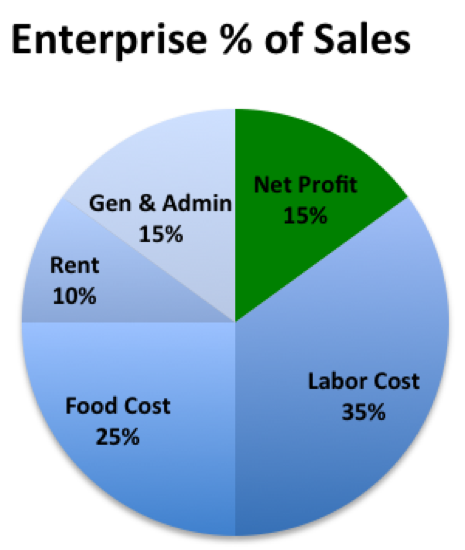
This is one of the most important things you can do for your enterprise. Finding a location that works for your business. Remember, rent in NYC is typically around 10% of sales. So if you are looking for a 1,000 sq foot space in NYC and the broker quotes you $200 / sq foot, your rent per year will be $200,000. This means that in order to make your rent worthwhile, your business needs to generate $2,000,000 in sales per year.

5)     Once the targeted location is set, engage in traffic counts.
We follow traffic counts for nearby food businesses of the target location you are looking to open as well as similar concepts in other locations.  You want to cover all day parts and this is the part of your research that may take a few days to cover all bases.

Once your research is complete, you are now ready to build your sales with the above inputs.  The key to building and best leveraging an operating budget is to make sure that your concept can support the expenses required to keep it running. It is nothing short of a balancing act.

We have a financial pie chart, which aids in this balancing act. The costs may vary for your operation, but the pie must always be equal to 100%. The level of investment made into the business goes beyond the numbers, it lies in good people, quality of food, training and standard operating procedures to keep the enterprise humming along with strong profits.

restaurant pie chart

Luke’s Lobster to Open Permanent Midtown Location

Luke’s Lobster is set to open an additional brick-and-mortar location at 685 Third Avenue, one block away from Grand Central Terminal. The company has been operating a food truck in midtown since 2011 but this will be the first permanent location in  the area. The location will serve beer and wine ans will provide guests patio seating during the warm weather months. Eventually, the location will provide delivery options to the neighborhood seven days a week. The team is looking to open a Park Slope outpost in the near future.


Domino’s Launches New Application

Domino’s, pizza chain, is launching a brand new iPad application that features a 3D “realistic pizza builder.”

The application gives  customers an opportunity to see a “more realistic view” of their end product as the customize with various sauces and toppings. In addition, the iPad app will also feature a tracker that monitors the progress of your order in real time. Similar to other Domino apps, users will have access to Domino’s national menu, coupons, and a store locator.

The new app is way of supporting and growing Domino’s strong percentage of digital orders. According to Tech Crunch, digital orders account for about 40 percent of all the company’s sales in the U.S.

Steven Starr’s El Vez Opening in Battery Park

Stephen Starr, the well-known Philadelphia restaurateur is opening his second El Vez location in Battery Park City tonight. This is the third restaurant Starr has brought to New York City from Philly after Buddakan and Morimoto in 2006. The menu at this El Vez is somewhat less extensive than the one in Philly but plenty of nachos, quesadillas, ceviches, and tacos. The space includes a massive bar and walls lined with round banquettes. There’s a photo booth and a large outdoor patio with a take-out burrito bar opening in the next few weeks.


New Air Quality Rules Target Restaurants and Food Trucks

Mayor Bill de Blasio has backed a set of antipollution laws that would have a significant impact on a number of New York City’s restaurants, commercial kitchens and food trucks. The stated goal of the laws is to target “pollution sources that currently have little or no emission control requirements.” The regulations would require businesses to install emission filters on ovens and char-broilers, ban new wood-burning fireplaces and encourage refrigerated trucks to switch to battery power from diesel fuel. The proposals would food businesses of all kinds including but not limited to mom-and-pop pizzerias, food vendor trucks, high-volume char-broilers and vehicles that deliver or serve refrigerated food or beverages.

The New York City Hospitality Alliance and the New York State Restaurant Association have yet to make a public comment.