Elon Musk’s Brother Has a Plan to Sell Organic Fast Food for Under $5

KM

Kimbal Musk, Elon’s less famous brother who made scads of money himself in Silicon Valley before leaving for culinary school, is getting ready to open the first of (what he hopes will be) many locations of a new organic fast-food chain. He tells Tech Insider that in addition to the Kitchen and Next Door, currently the two halves of his restaurant mini-empire, he’s about to launch a new concept called the Kitchenette, where everything will be fast, healthy, and organic but cost under $5. The first location is set to debut in Memphis this August.

With this venture, Musk enters a field that’s really heating up. The idea of bringing tasty and healthy affordable food to the masses has been the culinary world’s holy grail for a while. Musk is packaging the idea as sort of a Pret A Manger–style grab-and-go spot. He says the space will be like a coffee shop, with a counter, indoor seating, and a big patio out front, and the menu will mostly consist of sandwiches, soups, and salads, all made using ingredients sourced from nearby farms. The locavore bent will ensure ingredients stay seasonal, but Musk says there’s another benefit, too:

While the Kitchenette’s pricing sounds too good to be true, Musk says he will make it work with a little help from local farmers. The same farms distribute meat and produce to all three of restaurant concepts, and knock down the price based on what’s in-season.

Read more here.
Dig Inn CEO Takes Disruption To New Heights

Dig Inn CEO

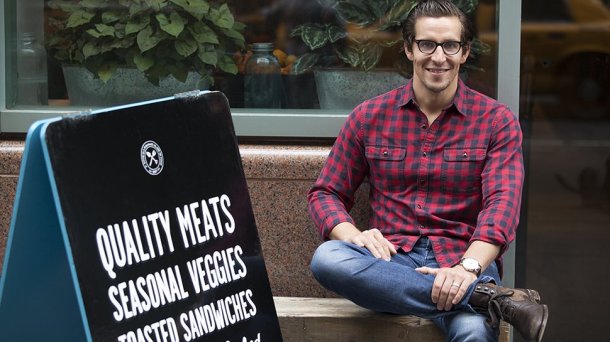
For Adam Eskin, CEO of Dig Inn, being disruptive meant severing ties with standard supply chains and developing relationships with local farmers in order to source ingredients for his New York City-based concept. The company has even helped farmers buy land and equipment and is now looking into buying farmland.

“Broken,” is how Eskin described today’s food system, which was set up decades ago to deliver food to masses of people as quickly as possible. That goal has led to obesity and a failing agriculture system, which inspired him to launch Dig Inn, a concept serving only from-scratch and seasonal food. Menu items include: flame-grilled wild salmon, Sicilian cauliflower, roasted kale, five-spice meatballs made with chicken or pork and free-range roasted turkey from Koch’s Turkey Farm in Tamaqua, Pennslyvania.

Dig Inn’s seasonal and innovative menu means talented chefs must always be in the kitchen, and Eskin admitted that finding NYC chefs who want to work in a fast casual setting can be challenging. Eskin found a solution by developing his own in-house culinary school, where he transforms employees into chefs. In an effort to inspire and help his chefs grow, Eskin partners with some of New York’s high-end restaurants, including Danielle, to provide them with the opportunities to work in their kitchens. It’s a win, win; young chefs study under pros and then put new skills to use at Dig Inn.

Read more here.


Cold Brew In An Ice Pop!

cold brew pop

Cold-brew coffee, emphasis on the cold, is what you get in this new ice pop from Brewla, a company whose other flavors are fruit based. The bar is a lightly sweetened mixture of the coffee and organic milk.

Brewla was founded by Daniel and Rebecca Dengrove, a brother and sister team with over 15 years of experience in food science and technology. The idea for Brewla Bars was born when the budding entrepreneur Daniel noticed an untapped market at the intersection between popular high-end juices and the boom in trendy frozen yogurt. A rising star in the beverage industry, Rebecca zeroed in on teas with health boosts. Although the concept was originally for a brick-and-mortar store, the siblings’ full-time jobs and cross-country residences created roadblocks, so Rebecca rented space in the industrial kitchen at her old graduate school, decorated a rolling freezer, and Brewla Bars began.

Brewla Barista, box of five, $5.99 at Union Market stores in Manhattan and Brooklyn, brewlabars.com.

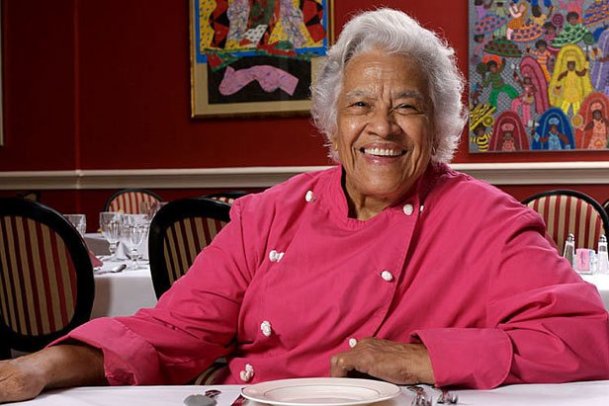
James Beard Honors More Than Just a Chef With Leah Chase

Leah-Chase2_t750x550.jpg

The James Beard Foundation announced on Thursday that Leah Chase would receive their Lifetime achievement award this year, an honor she shares with chefs like Wolfgang Puck and Richard Melman. Chase, now 93, is known as the “queen of Creole cooking,” and has been a mastermind at Dooky Chase’s Restaurant in New Orleans since the 1940s. The restaurant, which she runs with her husband, has transformed over the years from sandwich shop to fine dining to Southern comfort and Creole, and despite massive flooding from Hurricane Katrina which shuttered them temporarily, they reopened and remain a destination for both tourists and locals alike. As recently as 2014, the Times-Picayune named her “damn-near perfect” fried chicken the best in the city.

More than just a chef, Leah Chase has been an advocate for civil rights for decades, flouting segregation laws at her restaurant in the 50s and 60s and hosting NAACP and other activist meetings there “over gumbo and fried chicken.” (Dooky Chase’s Restaurant even gets a mention in Ray Charles’ Early in the Morning.) Chase and her husband also founded the Dooky Chase Foundation to support cultural arts, education, culinary arts and social justice in New Orleans and Louisiana.

While this is not Chase’s first lifetime achievement award (she was previously honored by the Southern Foodways Alliance), it is well deserved and an excellent choice for the James Beard Foundation, which strives to honor not only culinary genius but the integral connections between food and culture, politics, economics and community.

To read more, click here.

Papa John’s Entrepreneurial Advice on Growing A Business

John Schnatter impressively built the global pizza franchise that is now Papa Johns. Schnatter has shared some of his most valuable lessons learned through his experiences to entrepreneur.com last month in Washington D.C. during National Small Business Week. One of the major lessons he learned from his father before he even started building his pizza empire was that hiring the best people did not necessarily mean hiring the most experienced; he stated, ” You look for people who are positive and who have integrity…That’s how he taught me to train for aptitude, hire for attitude.”

Schnatter believes in the importance of being surrounded by people with great can-do attitudes and spirits that are full of passion. The key is not to be too controlling of employees but to give them a direction to head in and provide them with the appropriate resources and lead by example. It is important to motivate and reward them when they are doing things right so that they can begin to motivate themselves.

Of course Schnatter states that one of the most important elements to growing a business is to have an effective business model. However, he also shares some advice on how important it is to make a few mistakes along the way and not get down on yourself because of them; mistakes need to be made in order to learn from them, analyze and innovate.

To read more on John Schnatter’s advice on growing a business, staying competitive and establishing a culture of entrepreneurship, click here


NYCHG / NYSRA Event: Golf Outing

The New York City Hospitality Group and New York State Restaurant Association is hosting a golf outing at Paramount Country Club in Garden City, NY. The event will include breakfast before a morning tee-time followed by a BBQ lunch and cocktails by the pool. A portion of proceeds will benefit the NYS Restaurant Association Educational Foundation.

Date: June 30, 2014, 9:00am – 5:00pm

Location: Paramount Country Club

Schedule:                                                                                                                                                                                                            Breakfast & Driving Range, 9:00-10:20 a.m. Shotgun Start 10:30 a.m.                                                                                                  BBQ Lunch, 2:00-4:00 p.m.                                                                                                                                                                                Cocktails by the Pool, 4:30 p.m.

Various ticket types are available. Visit the NYCHG website here to register and learn more.

NYCHG Event: Meet the Owners of Analogue Feb 24th

The New York City Hospitality Group invites you for an evening of “Cocktails & All That Jazz” at Analogue featuring owners Jesse Wilson and Jared Gordon.

Meet the owners and learn more about how they have successfully launched their new restaurant in the West Village. This exclusive event will include an open forum with educational session and Q&A. Live jazz, cocktails and food will be included.

Monday, February 24th

6-9pm

Anaologue

19 West 8th Street

RSVP by February 20th, as this private event has limited capacity.

Meet the Owner(s): Alison Cayne of Haven’s Kitchen

Meet the Owner(s) is a new column on PaigePapers featuring enterprise owners running bakeries, cafes, markets, specialty food shops, and fast casual restaurants in New York City and around the country.  In speaking with enterprise owners, we hope to offer readers unique perspectives on the challenges and triumphs of ownership, as well as valuable insights to apply to their own enterprises.

Recently, we spoke with Alison Cayne, founder of Haven’s Kitchen, a specialty food shop, recreational cooking school and event space in Manhattan.  Located just blocks from the Union Square Greenmarket, Haven’s Kitchen “is dedicated to the preparation and enjoyment of delicious, sustainable, seasonal food.”  TaraPaige Group helped Alison and her team with the opening of Haven’s Kitchen and were thrilled to catch up with her again.

Below is an abbreviated version of TaraPaige Group’s conversation with Alison.

TPG:       How did the idea for Haven’s Kitchen come about? 

AC:             “When I first was out of college I really wanted to open a little sandwich shop, and I always loved making food for people and thought it would be fun to do that as a job.  [T]hen when I went back to school, I started teaching again. I had always given my friends cooking lessons here and there, and as I started learning more about food systems, my cooking classes turned into more of food classes…about sustainability and nutrition.”

TPG:       And then you started looking for a space for the school?

AC:            “I didn’t really at all envision this, I just pictured the kitchen part, and I thought there’d be a little retail…and this place came up and it was way bigger than I [was looking for].”

But after seeing the building, Alison began to envision a ground level café and school, and the event spaces on higher floors. “So the idea for the whole thing as one big business didn’t really happen until the building happened.”

TPG:      What was the most challenging part of starting a new venture? 

AC:            “I had no idea what I was doing…It was also my greatest asset, because someone with more understanding of this business and everything that goes into it probably wouldn’t have taken this on.  And it’s been challenging in that I’m a very trusting person and unfortunately I’ve been challenged with having to face the fact that not everyone deserves that trust…There have been those…typical business challenges, getting this permit or that…certificate, but all of that doesn’t really get to me in a core way, it’s more the interpersonal stuff that has been challenging.”

TPG:      What has been the most exciting part?

AC:            “Honestly, every day is exciting.  That there are people changing the way that they eat and understand sustainable and local, that chefs come to us because they like our coffee and our granola…We work with JustFood [where Alison is on the board], we work with Rural & Migrant Ministry, we work with Edible Schoolyard, we work with FarmAid.  We’re actually doing very cool stuff, and that’s exciting.  [P]eople have responded so well and I’m so honored.”

TPG:       How have things changed now that you’re past your first year?

AC:            “I’m less challenged by the interpersonal stuff now. I think I’ve gotten a little tougher skin, and I think I’ve learned how to not personalize things that are not personal.  But the excitement grows.  It just gets bigger.  It’s still all really exciting.”

TPG:       What about your day-to-day?

AC:            “I taught more at the beginning…And I don’t have the time really to do that [now].  I was behind the counter a lot more at the beginning, too.  I’m still behind the counter, but it’s not probably the most efficient use of my time.  Although I do love our regulars and they all know me.”

“My days change from day to day.  We are still dealing with contractors, we’re still growing our website.  I do the Pinterest. I do the Instagram.  I’m writing for the Huffington Post.  I’m still in school.  I still end up talking to customers because I’m always sitting in the front.  I do the flowers for every private event. Every day is different, which is really fun because it keeps it very exciting.”

TPG:       Sustainability is a core value of your enterprise.  Can you talk a bit about building it into your enterprise?

AC:            “If you’re a values-driven business, you’re going to have questions every day…My primary goal is yes, to keep the lights on, but my very, very close secondary goal is to represent the values that I am espousing.  So every day is a decision, [for example when a private event] really wants to have Coke at their party, but we don’t support Coke, generally, as a business.  And they don’t understand why we would prefer to serve Boylan’s…Everything is a case-by-case, and that’s the good news about being a very small team is you get to make those decisions.  But they’re constant…You constantly have to keep checking yourself against that mission…We keep checking against [a set of questions]–‘are we who we say we are; are we who we want to be; have we lost something because we’re so busy.’”

TPG:       You have 3 revenue streams at Haven’s Kitchen (classes, retail, and events).  How do you manage all three under one roof?

AC:            “It’s been and asset and it’s been a liability… Our ricotta is a perfect example.  We make the ricotta from the unused milk from the coffee [bar], so that’s a really good way…to have the businesses feed off of each other.  We have really good ways of being more sustainable in terms of food waste.”

But she noted it does have some challenges. “The private events right now support the whole building. We would like each business unit to be more self-sustaining.  I thought the school would be more profitable.  As it turns out, right now I think we have about six classes a week.  I thought we’d have three classes a day, six days a week.” Furthermore, Alison noted, “Figuring out what the costs are for retail and the school are actually challenging because so much of it is tied in [to the other revenue streams].”

TPG:      What are some things you wish you had known before starting your enterprise?  Is there anything you would do differently?

AC:            “It would be great to [have known] what COGS [Cost of Goods Sold] are.  I kept looking at sales, and [saying] I don’t get it.  We have such great sales, why are we losing money?  And I didn’t really understand that …[y]ou can have a program where you figure out your margins.  And you should run everything through that program just to know where you are.  It’s the same thing with management.  It’s about if you’re bringing out the best in people that you’re managing… That’s something that I wish I had known earlier on because I think that I was very nice, but I don’t necessarily think that I was as helpful as I could be.  And I thought that I was giving people autonomy, but I probably wasn’t giving people enough leadership.”

TPG:      What’s your favorite product or class that Haven’s Kitchen offers?

AC:            “I really love everything.  I happen to love our granola cookie.  And I love our ricotta.  And I love our pancake mix.  No one would ever say that [our food is] health food, because we use butter.  It’s not a quinoa-chia-date raw bar.  But it does have good quality ingredients; it is made with everything you would want your food to be made with.  It’s just real food and it’s really good.”