Ikea Gets into the Hyper-Local Game

635925890195816807-242942337_Header.jpgAt first glance, it might seem like an affordable furniture company has very little to do with the farm-to-table movement. But where others might see apples and oranges (or apples and bookshelves, as the case may be), Ikea sees opportunity.

The brand recently partnered with Space 10, a “future-living lab” and exhibition space in Copenhagen, to produce an environmentally sustainable hydroponic gardening system (called “The Farm”) made primarily using Ikea products like LED lights, shelving, and plastic bins. All told, 80% of the materials in The Farm come from Ikea’s product lines.

Ikea plans to roll out the new hydroponic system in their in-store cafes. Those cafes have historically been known more for Swedish meatballs, lingonberry jam and baked goods than for fresh produce, but that may change in the near future. Although food sales represent a very small portion of Ikea’s overall revenue, they ultimately plan to market The Farm to restaurants and home gardening enthusiasts interested in producing more of their own vegetables. If the hyper-local movement is any indication, this market will continue to grow in the coming months – and Ikea may just be on to something.

To read more, click here.
Restaurants Are Googling You!

Service

Before you go to a restaurant, you probably look it up online for some reason or another. Maybe you’re making a reservation through the website or maybe you’re checking the menu. You might look at photos to see how fancy the place is or maybe you just need to look up the address. What if a restaurant were doing this to you?

Restaurants google the names of patrons who’ve made reservations more often than you might think. In 2010 the subject surfaced to the surprise, amusement and horror of restaurant goers and chefs alike. People were understandably alarmed, but most people didn’t seem to care. In a poll conducted by CNN, almost 40 percent of people were okay with restaurants googling them if it meant special treatment, and about 4 percent hoped restaurants would research them. Sixteen percent thought it was a little strange but could live with it, and 15 percent thought it was creepy. Four years later, the practice has grown further in the name of  offering bespoke and differentiated services. Justin Roller, the maître d’ at New York restaurant Eleven Madison Park googles every single patron that visits Eleven Madison Park. He looks for anything that can help make a customer feel special and at home. “If I find out a guest is from Montana, and I know we have a server from there, we’ll put them together,” Roller told Grubstreet. He doesn’t stop at cursory information either. “If, for example, Roller discovers it’s a couple’s anniversary, he’ll then try to figure out which anniversary,” Grubstreet reports.

Restaurants also take notes on customers after they’ve dined, to track preferences and habits, like if someone is a good or bad tipper. According to the New York Times, hundreds of restaurants record traits and preferences about their customers, like allergies, favorite foods and even if a customer likes to linger at the table.

Read more here.

What Are You Printing For Dinner?

3d printed food

Peter Callahan, a celebrity caterer credited by Martha Stewart with inventing the bite-sized slider, bought his first 3-D plastics printer two years ago to wow guests at a holiday party. Today, he has his sights trained on printing the food itself. He imagined drumsticks with edible bones; could they be made of celery? Blue cheese? Hot sauce? Callahan already makes an edible cracker spoon to use with caviar, but he envisions an entire line of cutlery, plates and menus that could be printed and consumed at parties. He sees mini-milk cartons made of chocolate and Asian-style takeout boxes formed from wontons.

“People like new,” he says. But when it comes to food, most of us still cook like cavemen, over fire. Kitchens are “the most primitive thing in our house,” says Hod Lipson, an Israeli engineering professor at Columbia University, who was a pioneer in the field of 3D printing, and food printing in particular. But soon, Lipson claims, we’ll be able to download and print dinner.

Food printers use powders (mostly sugar) or pastes (cooked or uncooked pureed meat, vegetables, grains). The most advanced models have multiple syringes, like printer cartridges, each containing a different ingredient. The syringes extrude the ingredients layer by layer, allowing the printers to build elaborate, computer-generated shapes that would be difficult, if not impossible, to shape by hand or mold. Currently, the food needs to be cooked either before or after printing. But scientists, including Lipson, are working on a printer that cooks as it prints.

Read more here.

Meatless Moo-vement; Impossible Foods Readies Burger Launch

Over the past four years, a small, well-funded startup has been developing a new burger just a few miles from Stanford University.  It’s not meat, and it’s not just a veggie burger.  What Impossible Foods is trying to do is create a meat replacement that looks, tastes, feels, and cooks like regular ground beef.

Like most other Silicon Valley startups, Impossible Foods is looking to disrupt an existing industry.  For the founder, Patrick Brown, that is the inefficient, international meat supply, which relies on a huge carbon footprint to maintain.  Industrial animal farming uses a third of the planet’s land, destroys millions of trees per year, and consumes a third of the global water supply.  “We’re getting into this very scarily unstable area where we’ve never gone before in terms of pushing the boundaries of a stable planetary system,” Brown says. “We’re driving toward the cliff with our foot on the accelerator—and nobody was working on this as a solvable problem.”

Brown is working on this problem by approaching the “veggie burger” from a different angle: less quinoa and beets and more “proteins, fats, amino acids and vitamins derived from wheat, the roots of soybean plants, coconuts, potatoes and other plant sources.”

And now the chefs are talking.  Tracy Des Jardin, chef-owner of Jarindiere in San Francisco, will be the first to put the product on her menu, and she’s excited.  “I equate this to when grass-fed beef first hit the market. Initially consumers were skeptical, but now some prefer it.”  Later this summer, select New York restaurants will launch the burger, as well.  We will keep you posted when it comes to town!

To read more, click here.

The Coffee Pendulum Swings Again

Rejoice! Coffee is good for you again; as usual, the tide has shifted and your favorite morning beverage is back on the table.  The World Health Organization has concluded that coffee does not pose a cancer risk, and a regular habit of drinking coffee might even have a positive health effect.

Coffee is no stranger to the spotlight–good or bad.  In 1991, the WHO’s International Agency for Research on Cancer listed coffee as a possible carcinogen based on “limited evidence” that coffee was associated with a higher risk of bladder cancer.  However, the past 25 years have changed the evidence in a new direction.  Researchers reviewed more than 500 studies on over 20 different types of cancer and concluded that coffee might actually help prevent against uterus and liver cancers, and reduce the risk of colorectal cancer.

Consider replacing your pour-over with cold brew, though; research is also turning up some connection between consumption of very hot beverages and the risk of esophageal cancer.

To read more, click here.

A Pioneering Global Standard to Reduce Food Waste

Pilot-scheme-shows-promise-in-repurposing-commercial-food-wastes.jpgThe issue of food waste is something of a hot topic these days, from proposed regulations overseas  to the ugly-food movement and the startups it has already spawned. This attention is well deserved. Besides the tragedy of waste in a world where 800 million still go hungry, wasted food also produces 8% of global greenhouse gas emissions and costs $940 billion worldwide every year.
The micro-movements that have sprung up on this front are important, but they face some major hurdles, even as more governments and large organizations commit to joining the cause. Most notably, food waste is extremely difficult to track and report on. Since it occurs all along the supply chain, and often across borders, the costs associated with this waste are typically baked into other operational costs and nearly impossible to quantify. Until now, there has been no consistent reporting standard on the issue.

To address this, a partnership of international organizations convened  at the Global Green Growth Forum (3GF) 2016 Summit in Copenhagen to come up with the first-ever set of global definitions and reporting requirements for companies, countries and others to consistently measure and report their food waste. Such standards will be crucial to measure the success of all these organizations as they make commitments to improve. Many major international organizations, including the UN, Consumer Goods Forum, and World Business Council for Sustainable Development, are already behind the coalition’s Food Loss and Waste Accounting and Reporting Standard (FLW Standard). 

The new standard will have the greatest impact on large corporations and governments, but food waste is a costly issue for all retail and restaurant businesses as well. We recommend following the lead set at the 3GF Summit, and making a commitment to tackle waste on a small scale as well.

To read more, click here.

New Lawsuit Against Chipotle Execs

With sales and stocks still reeling, a small group of Chipotle shareholders have now filed an additional lawsuit against the company’s executives, claiming that they “abused their control of the Company, and dealt themselves excessive compensation worth hundreds of millions of dollars through a corrupt stock incentive plan.”

The suit explicitly names Co-CEOs Steve Ells and Montgomery Moran, and CFO Jack Hartung, among others. It claims that these executives, using insider knowledge about the food safety protocols that would cause Chipotle’s well-reported downfall in 2015, dumped their stocks at an artificially inflated price and raked in millions before the food poisoning scandals began. Supposedly Ells made $78 million by selling 119,057 shares, Moran raked in $107 million, and Hurtung $28 million.

Chipotle has not admitted any wrong doing, and both this suit and one from January are still pending.

To read more, click here.

Philly Paves the Way For Diet-Soda Taxes

In less than a week, Philadelphia will vote on a new tax on sodas which they are all but certain to pass. The tax will add 1.5 cents to every ounce of soda sold – an amount which adds up quickly on larger bottles and value-packs. The measure will make Philly the first large city to tax soda (Berkeley being the only other city in the U.S. to pass a similar law), as well as the first city to extend taxes to diet sodas. While the original proposal taxed only drinks with added sugar at 3 cents an ounce, critics argued this was too steep and disproportionately affected those with lower-incomes. The city council then amended the measure to tax all sodas at a lower rate, since upper- and middle-income consumers are more likely to reach for the diet soda.

Big Soda is already suffering from tanking sales and bad PR, so this move has understandably put them on the defensive. In the weeks leading up to the vote, soda companies have poured millions into ad campaigns against the tax, and the city has responded with some of their own. The council can also expect some litigation once they vote, since the industry is not likely to go down without a fight.

To read more, click here.

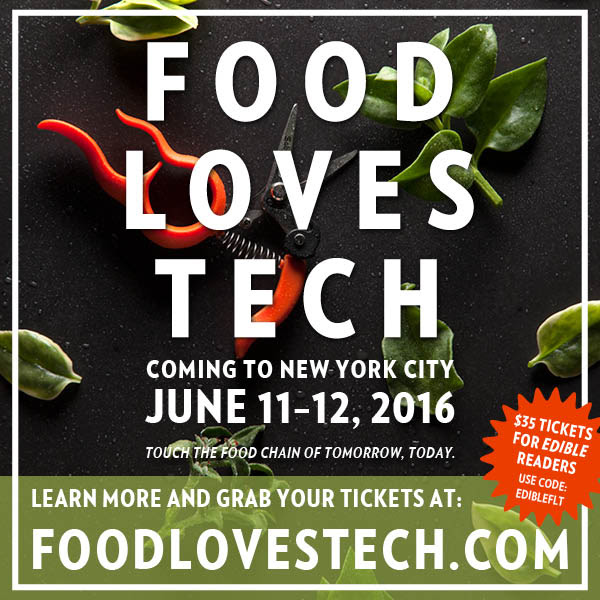
Food Loves Tech: Touch The Food Chain Of Tomorrow, Today

foodlovestech

A collaboration with Vayner Media, this eats-of-tomorrow gathering in the Waterfront Tunnel in Manhattan will allow attendees to see, smell, touch and taste the food culture of the near future.

Food Loves Tech is your chance to walk up to vertical farms, taste-test crickets, review dozens of food system apps, and talk to the inventors behind juicebots and beerbots, food computers for your home, and smart kitchens that listen to your food.


Event details are as follows:

Food Loves Tech
June 11–12, 2016
The Waterfront
241 11th Ave (at 27th St), NYC

Buy Tickets Here.


The Wizard Retools His Lab

David Bouley dreams of engineering a whole different concept of a restaurant.

The famous chef’s eponymous restaurant opened at 165 Duane Street, Tribeca in 1987.  According to Bouley, the restaurant will be going “on sabbatical” and then reopening in a smaller space (planned for Tribeca) with a mission of healthful eating.  The new space will accommodate only 20-25 seats and open five days a week.  The Bouley that New Yorkers have come to know over the past thirty years will be gone in a few months.

In recent years, Mr. Bouley has become obsessed with health issues.  Towards the end of the year, he will engage in a deep study of the relationship between health and food.  He plans to take nutrition classes at New York University and consult with doctors and experts, internationally.

The new restaurant’s mission will be to optimize health.  Tasting menus will be developed to address a variety of dietary restrictions and medical concerns.  “Food should give you calories that you burn off, not calories that you store,” said Mr. Bouley.

David Bouley plans to rejuvenate his restaurants and projects (Bouley, brushstroke, Bouley Test Kitchen and Bouley Botanical) and himself.  He is quoted as saying “Gastronomy and science, meeting together.  I want to learn how to do that better”.

Please click here to read more…