People, Process, Products

In October, we discussed the process of conceptualizing your foodservice enterprise by reviewing the market, location, and concept components and how they fit together. This month, we are discussing what’s next in the development process: planning profits, people, and processes. Similar to before, we will review these pieces individually and how they’re interconnected.

Plan for Profit: Business—any and every—exist to make money. If your foodservice enterprise isn’t planned to make penny, the chances of success and sustainability are slim. Thus, we have to start with the financials. Once you’ve determined your concept, market, and location, you must take a closer look at your budget.

Budgeting begins with determining the following:

  1. Capital Budget: based on the three pillars, you should be able to estimate the necessary capital required for construction and startup.
  2. Revenue: you will need to model the following:
    1. Product Prices: Based on your concept, market, and location, determine the range of prices you will charge for your products
    2. Number of Transactions per hour: you should take traffic count from similar concepts near your desired location to determine an estimated transaction count
    3. Product Sales: based on your traffic counts, estimate the sales of each product per transaction
    4. Average Check: use the prices, transactions, and sales to determine average check
  3. Recipe Costing: during menu development, it is absolutely necessary to cost your recipes to ensure that the product, price, and profit potential are aligned.
  4. Labor: this is the second piece of this puzzle, and is further discussed below.
  5. Expenses: Evaluate your location and concept to determine approximately what your expenses will be.

Plan your People: Next, it is important to determine what your labor needs will be. In a previous Enterprise Insight, we discussed labor costs at length. Just as in that discussion, it is important to plan ahead for your labor needs with an eye to costs, as per planning for profit.

Additionally, though, developing your talent pipeline has as much to do with culture as it does your profit and loss statement. When hiring for a new location—whether it’s the first or fifth—ensure that the team is going to fully embrace, embody, and deliver the brand and what your company stands for. Hire slowly and intentionally, and plan ahead for the needs of the organizational structure.

Plan your Processes: Equally as important as your people and profits is your process—you need to know how things will operate in order to maximize both people and profits. Thus, this piece needs to be considered at the same time as the previous two, because it is systemic.

For example, if you own a bakery, you need to understand how and when your baked goods will be restocked. This decision is both tied to and will drive the people and profit portions—not enough staff and you won’t be able to restock in a timely manner, and sales will suffer. Or, you might have too much staff, which can drive sales, but may overrun your labor budget.

All in all, this gives a snapshot of how the different components of the development process are interconnected.
Using Instagram To Help Build Your Brand

Social media can be both a blessing and a curse for a foodservice enterprise. In this month’s Enterprise Insight, we will discuss the benefits of using Instagram for your business, and how to use it successfully. Instagram is more than just photo sharing; it is a worthwhile tool for your business for three core reasons:

  • It is cost effective
  • It is fast
  • It is dynamic

Instagram helps build brand awareness for you at no cost. Instagram allows you to create a dialogue or a connection or spread a message instantaneously; once you post, the content you uploaded is immediately shared across the dashboards of each of your followers. Instagram can help you get information about your business out in real time, in addition to using it to highlight or promote products or events. The best food-business accounts use the service to give followers an inside look at the business—the inner workings of the kitchen, the company culture, and the staff. Keep the following items in mind as you use Instagram as part of your social media efforts:

  1. Use Good Lighting
    1. The best light for photographing food is natural light, says Nicole Franzen, a food and lifestyle photographer from Brooklyn. Correctly lighting a dish is one of the most important elements of capturing a good photo and conveys the right message. Just ask Martha Stewart; she recently posted some less-than-desirable photos of her lunch that left her followers in dismay. Always remember; guests eat with their eyes first—even on Instagram.
  2. Use A Hash tag
    1. Using a hash tag for your business gives your followers a way to tag you and spread the attention. This way, anyone who searches for #yourbusiness will find photos taken not only by you—the owner/operator—but by your loyal fans as well. This helps extend that reach and build awareness. Also, it helps you maintain our third point: using the service frequently.
  3. Use It Frequently
    1. There are over 160 million active users on Instagram each month. In order to stay relevant and grab the attention of your followers, you need to post frequently—with quality content!
  4. Analyze
    1. This is the most overlooked necessity in ensuring you post quality content; your content needs to be tracked and evaluated for effectiveness. This means monitoring how many likes, regrams, and comments individual posts receive, your hash tag, usage, and offer response rate. Instagram is free to use, but the time you spend using it will become costly if your posts elicit brand engagement.

Instagram is an invaluable tool for helping to build brand awareness and engagement; the platform is cost effective, fast, dynamic, and can connect you with your fans in ways not possible by other methods, given that you are posting quality content, using the platform effectively, and analyzing your efforts!

Restaurant Finance and Development Conference 2014

Every November, TaraPaige heads to Las Vegas to attend the annual Restaurant Finance and Development Conference. The conference is attended by restaurant CEO’s, owners, operators, and finance professionals from all over the country. Attendees have the opportunity to meet, mingle and learn from investment firms, real estate developers, and other financial firms to source financing, make deals, and locate new business opportunities. Each year brings a new set of hot topics regarding the current lending and investment environment for food enterprises.

As we begin 2015, we would like to share with you a few of TaraPaige’s key takeaways from this year’s conference.

  1. Markets Are Still Strong! Contrary to popular belief, recent markets conditions are still promising for the restaurant industry. It is understood that restaurant sales follow consumer discretionary income and with recent index highs, increased household income, and more diverse dining options than ever before, we can expect total restaurant sales to benefit. Even since 2009, the U.S. restaurant industry has returned to historical growth rates, with total sales rising about 3 percent a year, slightly ahead of inflation.
  1. Capital Raising – Know Your Audience: Raising capital for your enterprise is never an easy feat, but knowing the stage of growth for your business is key. First time owners and operators will typically source initial funding from friends, family or themselves as banks and institutional investors are often weary of new concepts without a proven business model. For institutional capital, lenders and investors like to see a clear path for growth, strong cash flow, and established operations. This is also geared towards later-stage growth companies looking for larger capital commitments. High net worth individuals may be another financing opportunity for those who have the right concept, created the connection, and are looking for a substantial investment and partnership.
  1. Casual Dining Revival: Perhaps the forsaken stepchild of recent years, casual dining is at an interesting turning point. After seeing a significant evolution from family dining, to the popularization of ethnic foods and a focus on healthy cuisine, owners and operators are looking to reset and restart growth in this category. Strong brand positioning, concept differentiation, target market knowledge, and end-to-end engagement across the organization will contribute to positive growth. After all, consumers will make their choice by brands and experiences, not based on industry dining segments.
  1. Future Food Trends: By the time you’ve nailed down the current food trends, it’s likely the industry has already moved on. However, there are a number of movements that have made their way across dining segments and different concepts across the country. Ever since the explosion of ethnic and fusion cuisine, flavor and more specifically, spice is here to stay. Consequently, menu differentiation and chef-driven concepts have soared in popularity. Seasonality and local-sourcing now play a large role in menu items while non-traditional menu structures such as small and shared plates are popping up everywhere.

The restaurant industry is constantly evolving, with new opportunities for growth and investment each year. The Restaurant Finance and Development Conference offers great networking opportunities, but also insight into practical operational and financial topics presented by the top experts in the industry. We thoroughly enjoyed our trip and will see you again next year!


For The Love of Local

“Farm-to-Table” restaurants have gone from niche to mainstream, and using local products is now nearly a rule for any restaurateur or chef opening a new enterprise. However, not every cafe needs to rely entirely on the city’s Greenmarkets in order to make an impact with local items. In this month’s Enterprise Insight, we will review three methodologies for sourcing locally and examples of each.

Generic

Sometimes, the easiest way to keep it local is simply by sticking with what you can get in each season. For Maman, a new bakery-café in SoHo, their strategy is just that; vegetable-focused fare that’s seasonally and locally sourced. The café doesn’t call out specifically from which farms their products are coming; they let the produce speak for itself. This method goes hand in hand with the café’s preference for vegetable—but not necessarily vegetarian—dishes, which we discussed earlier this month in our Retail Spotlight.

 Item-Specific

Eataly’s items might be mostly imorted from Italy, but its flour is New York State grown and milled. Obviously, the majority of Eataly’s products are coming from Italy—jams, sauces, coffee, etc—but the bakery runs on flour milled in nearby Clinton Corners by Wild Hive Farm. Wild Hive Farm owner Don Lewis sources whole grains of heirloom wheat from local farms and mills over 300 acres worth just for Eataly—roughly 3,000 pounds of local flour per week!

Programs similar to these are most common—using local ingredients for high-impact items balance the benefits of using and highlighting local ingredients with the problems of availability and seasonality. For example, a patisserie could exclusively use local eggs, and make a note of it on the menu. Bars have a huge inventory of local wine, beers, and spirits to choose from, and intrinsically must note where the beverage comes from.

Farm-Forward

The most obvious and most common form of using local ingredients is now almost a necessity. Citing the provenance of specific ingredients started back in the days of Savoy, Blue Hill, and Union Square Café getting their food from the greenmarkets. Restaurants like these put a strong emphasis on farms and the relationship between the chef and the farmers. This movement has evolved to the use of rooftop gardens, like Rosemary’s, and functioning farm-restaurants, such as Blue Hill at Stone Barns.

For many hospitality enterprises, accessibility is the biggest issue with local sourcing. Fortunately, New York State is making big progress in this area—going as far as to set up a marketing campaign around local products. “Taste NY”, as the program is called, even has a retail store in Grand Central Terminal, which exclusively sells products made in state. And GrowNYC, the agency that runs the Greenmarkets around the City, has started a local distribution company, Greenmarket Co, which delivers from farmers to wholesale customers. Whether you’re operating a fine dining enterprise that is showcasing the best in season from the best producers or seeking to bolster local agriculture on a larger scale, using regional product can drive revenue and good will.

The 3 Pillars: Concept, Location, Market

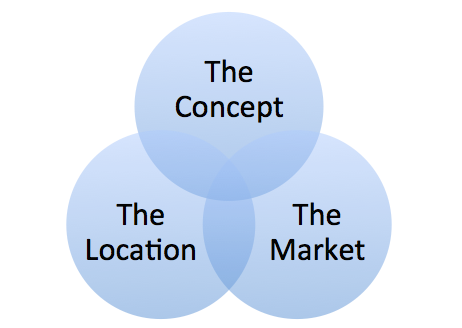
Whenever a new fast casual enterprise, restaurant or bakery is in the works, it’s only natural to want to start with the menu and design. However, that won’t guarantee success. Foodservice businesses require more than an appealing menu in order to successfully launch and survive. They are the sum of three parts coming together to form a whole—the concept, the market, and the location. These three give and take from each other to form the tangible business.

In order to ensure the longevity of your new venture, it is necessary to start in the center, and work around:

Screen Shot 2014-10-21 at 9.11.11 AM

Ultimately, the first question and last question to ask is whether the concept, market, and location are all mutually supportive and financially viable.

The Concept: What are you serving and how are you serving it? This encompasses the menu, service style, purpose and values.

Concept and Location: Does the size and location of the physical space support the concept, and vice versa?

The Market: Who are your guests? What are their wants and needs, and what job is your concept doing for them—baked goods for special events, dinner for 10, or healthy lunch served fast?

Market and Concept: Does the market exist to support your concept—that is to say, if you’re opening a healthy fast-casual lunch spot, are there enough working professionals in the market looking for lunch to support the business?

The Location: Where will the restaurant be and what is the footprint?

Market and Location: Is the location accessible to your market? In the above example, the location you choose would need to be near enough to the market of working professionals seeking lunch options in a timely window.

These three come together simultaneously—you cannot begin to conceptualize your new business without giving all three equal attention. For example, a third-wave coffee shop needs great coffee, an affluent market willing to pay for premium coffee, and a location accessible to the market with a footprint small enough to be sustainable on an $8 average check.

On the opposite end, a fine dining restaurant needs a much larger location—but the average check justifies the occupancy cost so long as the market exists—Per Se would not be successful in Detroit, no matter how low the rent.

Next time you’re in the planning stages of a new restaurant, bakery, or café, remember that the old adage of “if you build it, they will come,” is not planning for success. Success requires planning around the concept, the market, and the location.

Enterprise Insight: Being Present

The restaurant business is fundamentally a service business, one that requires attention to the guest and constant execution on their wants and needs. Thus, this month, we are going to discuss being present for your guests; what it means and why it is important.

What

Being present seems like an obvious concept; management and servers interacting with guests must be present in order to do their jobs, correct? To a point, yes, but that is the difference between good service and great service. Every point of contact with a guest needs to be treated as both an opportunity and a threat. For example, glancing at the next guest in line or trying to communicate with another server while helping a guest destroys the sense of connection and gives the guest the impression that you’re not paying attention. Repeated violations of this sort, and the guest will lose interest in the experience and distrust in the team.

Conversely, if the server is giving his/her full attention to the diner, you can create an opportunity—to upsell, to educate, to build rapport with the guest. In the above example, let’s say the guest was curious about the difference between two signature coffee roasts. As an opportunity, the team has the chance to wow the guest with their knowledge and maybe sell them on the more expensive cup. At the very least, the team has showed the patron that they’re listening, and they’re there to help. This is, in essence, the ethos of Danny Meyer’s enlightened hospitality; put your team first, so that the team can concentrate on going above and beyond for the guest. Small gestures from small conversations with your guests can lead to big raves—which they will share with their friends.

Why

The reasons for being present should be more obvious: it’s good service, and good service is good for business. The actual “ROI” on attentive service and guest connection is hard to calculate, but the implications are not. When your team is truly present and keyed in to the operation of the restaurant, guests are happier, the team is more efficient, and, ultimately, the business will reflect that in positive ways—word of mouth, good reviews, and busier nights. Ultimately, every single guest interaction has a tiny impact on the bottom line that will, eventually, build or erode your business.


The foodservice business is inherently busy and sometimes chaotic. The guest, though, should never feel as though the team is not paying attention. Being present for the guest is fairly simple—paying close attention and executing efficiently. However, the difference in being and not being present is the different between great service and poor service, success and failure.


The Hedgehog Concept and Foodservice Businesses

In Jim Collins’ seminal book, Good to Great, he outlined what enterprises have done to go from a good company to a great company. One of these principles, the Hedgehog Concept, can be perfectly applied to foodservice businesses in any stage—whether just starting up or expanding.

The idea is simple in concept but trickier in execution. It consists of three parts: being the best in the world, being passionate, and knowing what drives your economic engine. In this Enterprise Insight, we’re going to look at the three parts and how they apply to a foodservice business.

Being Passionate

This is the easiest for some and hardest for others; you have to be honestly excited and in love with what you’re trying to achieve. The type of restaurant an owner operates is largely driven by what they’re passionate about—whether that’s a great hospitality and a café, high-end cuisine and a fine dining restaurant, or coffee and coffee shop. If you’re not passionate about coffee, your coffee shop won’t be as good as it can be; you’ll never get to be the best without passion for what you’re doing.

Being the Best in the World

“Best” is subjective and someone’s world is tied the context of what that person has experienced. So, what we mean here is simply doing what you’re passionate about better than anyone else in your market. The goals for a local-favorite, third-place café are drastically different from a restaurant like Noma. However, they both are executing on what makes them great; warm service and familiarity with the café and cutting-edge, locally-driven cuisine at Noma.

Knowing What Drives Your Economic Engine

This is the integral third leg on the stool because all the passion and expertise in the world won’t guarantee that you turn a profit. Jim Collins explains the economic denominator as the “Profit per X”—the metric that would have the greatest, most sustainable impact on cash flow over time. In the foodservice industry, the most obvious economic metric that comes to mind is average check, and this is certainly valuable information. However, you can understand and drive your business in a more specific direction by choosing the metric that best reflects your ability to make money, because your average check is limited to your type of business.

For example, a coffee shop that’s focused on being the best in a given market would want to capitalize as much as possible on repeat guests. The average check at a coffee shop is not going to be able to increase drastically over time simply because of the product category. However, you could drive more sales per repeat customer per, say, week, by focusing on quality and service, thus compelling more customer visits. So, in this case, the average sales per repeat guest.

In a fast food or quick service restaurant, again, average check won’t rise over time. A better metric to push might be profit per labor hour. Limited-service restaurants need to run lean in order to be profitable, so finding the balance between maximizing sales while minimizing labor could drive you in the right direction. Meanwhile, a full-service casual restaurant should consider profit per seat, because it needs to maximize the number of turns per shift.

Applying Jim Collins’ Hedgehog Concept to your foodservice business can help to define or reposition your strategy. It is important to remember that the three items are reliant on one another: being passionate, being the best, and knowing your economic denominator, and when applied simultaneously, can be a powerful tool.

Managing Labor Costs

Labor Cost is both one of the major cost centers in a foodservice operation and one of the most difficult to control. In this Enterprise Insight, we will discuss labor costs on the monthly P&L statement, labor by the hour, and the importance of scheduling.

The Monthly P&L Statement: At this level, operators can really only glean two significant bits of information about their labor cost: what percentage of total sales is hourly cost and what percentage is management. And, yes, you can find out if you’re keeping within the general rules—25% hourly and 10% management. However, this analysis is insufficient for three reasons:

  1. It’s the view from 50,000 feet. In order to accurately and effectively control costs, you need to know how and why you spent the money you did on labor—but this ratio doesn’t provide that level of detail.
  2. The ratio looks backward. If, at the end of the month, you find that you’re way out-of-bounds with your labor costs, it’s already too late, and the cost percent of total sales won’t tell you why.
  3. The payroll-to-sales ratio fluctuates depending on internal and external changes in revenue. For example, if you have a great month of sales that stretched your labor force, your cost will shrink as a percentage—but not because scheduling was done accurately.

Thus, it’s importance to calculate and analyze labor not just as a percent of sales on a monthly basis but on a more detailed level.

Labor by the Hour: Tracking labor by the hour allows you to examine, in detail, your labor cost and adjust as necessary:

  1. Individuals and Job Types: Knowing what hours individuals and groups worked can help you find fat in your schedule. For instance, if you are drilling down into this data on a weekly basis and see that the hours for kitchen staff are higher than the previous week, you can start to determine why and what needs to change.
  2. Variance: Every week, it is important to compare the actual worked hours to the forecasted hours from the schedule. This is important to track because it can alert you to differences that might be occurring at the individual or department level on a consistent basis.
  3. Labor Cost Per Labor Hour: Divide the labor cost for a given time period by the corresponding number of hours worked. This ratio will tell you the average cost of your labor per hour. It is easy to monitor week-to-week and quickly spot positive and negative changes, and maintain an appropriate budget.

Knowing the actual labor hours worked by the team provides the granular data necessary to make informed conclusions about your labor cost. Without it, an operator can only guess what’s happening!

Scheduling: Scheduling is the most important part of managing labor cost because salaries and wages can’t be adjusted week to week according to volume, but labor hours can. Labor cost is driven by labor hours, not by pay. To schedule properly, it is necessary to determine labor pars, forecast sales, and cost the schedule.

It is necessary to determine labor pars because part of your labor cost is always going to be fixed. If, for example, an operation needs at a minimum one manager, one receiver, one prep cook, and one service staff to open the business, then you can flesh out a schedule based on that in relation to the sales forecast.

It is necessary to forecast sales each week to determine the number of labor hours to schedule. Forecasting should take into account the sales of the previous week, the same week last year, the weather, external factors such as holidays or regional events, internal factors such as a change in operating hours, and anything else that might affect revenue stream for the time period.

Lastly, it is important to cost the schedule and calculate labor hours every week to have an idea of what the labor expense will be. This gives an operator the chance to be on the offensive—finding flaws in the schedule before it is too late and making adjustments based on how the forecast is actually playing out.

*

In order to manage labor effectively, operators should be proactive rather than reactive by starting with the schedule and tracking labor hours rather than relying on the end of month P&L labor cost percentage.

Ancient Grains Driving Profits in Fast Casual Enterprises

Ancient grain products such as kamut, quinoa, amaranth, chia and hemp amongst others have been rapidly re-entering the consumer’s diet over the past few years. These grains are not only attractive to the health-conscious consumer but have been proven to drive profits for restaurants. Integrating ancient grains into a menu will help add variety but most importantly will lower food costs. Aside from adding great texture and flavor, grains are also easy to maintain and can be served at breakfast, lunch or dinner.

The New York Restaurant Association surveyed 1,300 professional chefs (all members of the American Culinary Federation) to compile the 2014 Culinary Forecast and ancient grains came up high on the list of new trends to expect. According to Innova Market Insights, the launch of products containing quinoa rose nearly 50% over the past year, and 500% over the past five years. This massive increase proves that consumers are showing significantly more interest in these types of grains.

Quinoa is one of the fastest growing grains to appear on menus in everything from salads to soups to beverages and even to sweets. Quinoa is naturally wheat and gluten free as well as being low in carbohydrates, high in fiber and packed with different vitamins and minerals. Quinoa is also a great source of protein since it is a complete protein, containing the full nine amino acids. It is no wonder that as consumers become more health conscious, these nutritionally valuable grains become higher in demand.

Grains are no longer found solely in health stores but have made their way into the mainstream. It is now common to find quinoa cookies and chia seed bars at the check out counter of most coffee shops, prepared food markets and fast casual establishments. Apart from appearing on menus in restaurants they have also become attractive to the processed foods market.

The integration of grain products into menus is not only attractive to consumers but is also extremely beneficial to the commercial buyer. Aside from adding great flavors and textures they also have a very simple and fast preparation. Most importantly however, is the fact that grains are cheap to purchase, shelf stable, easy to store, and easy to hold (cold/hot/ambient). The fastest growing price on any food item is on meat, so if an enterprise is able to use small amounts of meat in a grain dish or can substitute it all together on the menu, it can really help get a better handle on food costs.

Grains also offer amazing versatility as they can be incorporated into the enterprise’s menu as a starter, main, or side and can be served in any of the day parts. Of course they also are a great option for dessert and mid meal snacks. Grains add variety and provide alternatives to more traditional options. For instance, here are some examples of how grains are being used at these well-known reputable enterprises:

  • Pret A Manger offers a steel-cut oatmeal breakfast option but also offers five-grain oatmeal with quinoa, flax seeds, amaranth and chia seeds.
  • Panera Bread has made way on its menu for orzo, quinoa and wheat berries among other grains. Gluten-free diners are glad to find a hearty substantive grain dish (such as barley or buckwheat noodles) as an alternative to otherwise starchy dishes such as pasta or rice.
  • Chains like Just Salad, Hale & Hearty and Chop’t are incorporating quinoa and wheat berries to add bulk to their already existing items.
  • Juice Generation offers a chia seed tapioca as a guilt free alternative to a high calorie dessert pudding.

Consumer interest in nutrition will only continue to grow, and grains are an easy product to incorporate into your product mix to attract health conscious diners in order to boost sales.


Product Mix Maximization

There are many forces that when working together create successful enterprises. The key ones for us are a streamlined concept, a great operator, a long-term vision, a unique selling proposition and ultimately a product mix that resonates with your guests.

For the first half of this year many enterprises have engaged our firm to advise them on store flow and product mix. The question arises often, what makes a great product mix? First and foremost, a great product mix is one where when the guest walks into your enterprise, and without thinking knows what to order. Your role as an enterprise is to guide the guest through the experience, while the guest feels as though there are many choices to make; the actual decision process is easy.

When thinking about product mix, we highlight a few quick tips to maximize the guest experience and financial success.

  • Day parts. Which ones will you be offering; breakfast, lunch, midday, dinner, late night?
  • Core products. Establish the core products that the enterprise will produce.
  • Maximize kitchen production. Are the core products you are producing actually the ones that are anticipated to be the top sellers? If not, think how to best maximize kitchen production for the top sellers.
  • Complimentary products. Once you have established the core products, think about what additional product groups compliment your menu.
  • Streamlined Concept. With all of the above, does your product mix speak to your vision of the concept.

Try not to steer far from your concept. We have worked with many enterprises that want to be everything to everyone and this formula is a recipe for disaster. No one enterprise can be everything but one enterprise can be something great with a clear message.

Happy product mix…TaraPaige Group.