5 Steps for Calculating Sales of a Food Enterprise Operational Budget

Starting an early stage food enterprise and growing to a multiunit operation involves a lot of moving parts to line up successfully. One that is paramount is to implement an operational budget in setting your business up for financial success. Budgeting is the most basic and effective tool for managing your business finances yet, many operators forego this crucial step because of the additional time and work involved. For all food businesses, the budgeting process can help identify the realistic profitability and financial metrics of the enterprise. In short, it can save you the grief of overspending and help you better manage different aspects of your operations.

We often get asked the question, “How do I go about preparing for an operational budget?”  A good budget stems from a well-understood concept with a streamlined product menu and we start with building the sales formula.  Our sales formula in preparing for an operational budget is highlighted below, we will use an early stage bakery as a sample.

1)     Identify your product groups.
The product groups are your different revenue streams that you will be offering.  Ex: Baked goods, savory product, home made beverages, coffee, tea, packaged product.

2)     Clarify your hours of operation taking into mind the seasonality of the business.
This will enable you to identify the day parts you are open, the hours per day and whether or not you are open for weekend and weekday business.

3)     Price the product groups per day part for an average check.
For example, the savory group may have a smaller check average at breakfast than at lunch.

4)     Identify a targeted location.
This is one of the most important things you can do for your enterprise. Finding a location that works for your business. Remember, rent in NYC is typically around 10% of sales. So if you are looking for a 1,000 sq foot space in NYC and the broker quotes you $200 / sq foot, your rent per year will be $200,000. This means that in order to make your rent worthwhile, your business needs to generate $2,000,000 in sales per year.

5)     Once the targeted location is set, engage in traffic counts.
We follow traffic counts for nearby food businesses of the target location you are looking to open as well as similar concepts in other locations.  You want to cover all day parts and this is the part of your research that may take a few days to cover all bases.

Once your research is complete, you are now ready to build your sales with the above inputs.  The key to building and best leveraging an operating budget is to make sure that your concept can support the expenses required to keep it running. It is nothing short of a balancing act.

We have a financial pie chart, which aids in this balancing act. The costs may vary for your operation, but the pie must always be equal to 100%. The level of investment made into the business goes beyond the numbers, it lies in good people, quality of food, training and standard operating procedures to keep the enterprise humming along with strong profits.
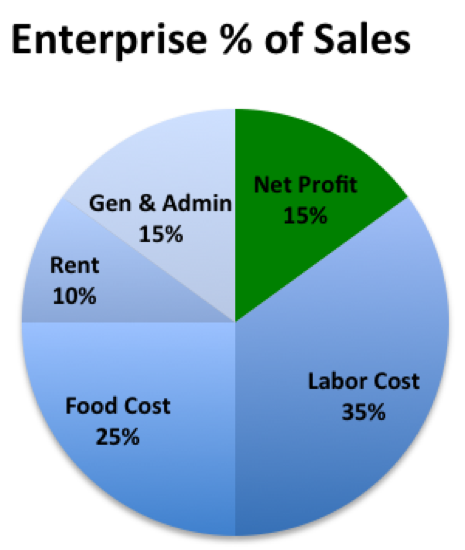
restaurant pie chart

Balancing Technology and Hospitality in the Modern Age— Is There a Happy Medium?

Restaurants are adapting to the ever-changing technology climate—is this a good thing? These days there is an app to facilitate almost any dining experience including making reservations, tracking wait times, placing orders, and processing payment. The adaptation to modern technology in the restaurant sphere has altered the dining experience for both guests and operators. Can human hospitality and technology cohabit in restaurants, or must one dominate the other?

From a guest standpoint, technology can provide a no-frills, however sterile, experience in which getting from point A to point Z requires few superfluous interactions in between. Are these interactions actually superfluous though? While it’s not far fetched to assume that one day all restaurants could be completely operated by iPads, do servers, hosts and managers possess an indispensable human quality that machines cannot replicate? Then the question becomes, “Is the hospitality experience created by the service team’s human interaction a requisite for guests, or are technological apps that can perform the same duties without the small talk sufficient?” From an operator perspective restaurant apps can ultimately lead to more profitability. Theoretically, guest traffic count would increase and fewer front of house staff would be required.

The app Cover allows guests to pay the bill without having to ask and wait for the check. Guests can select a tip percentage of their preference to be automatically calculated, and they can opt to divide the tab by the number of guests in their party. This is an example of an app that eliminates a tedious process that often leads to frustrating lag times; in this instance, hospitality is not of the utmost importance. However, when guests have control of their entire dining experience from appetizer to dessert at the tip of their fingers, literally, are the seemingly unnecessary steps of interacting with a server really that unnecessary? It may seem appealing to a single diner who is not in the mood for chit chat or to a group of friends who would rather focus on their conversation as opposed to the ordering process— but would the presence of a server actually provide an additional benefit instead of creating an unnecessary obstacle?

Servers are humans at their core, with life experience, people skills and opinions— all qualities that programs cannot acquire no matter how intelligent they are. Servers, hosts, managers and other front of house team members can guide guests in the right direction depending on guests’ moods, dietary preferences and any other concerns. Hypothetically, even if apps could somehow be designed to form humanlike judgments and opinions, will their efficiency and intelligence ever be a suitable replacement for the comfort of human interaction? Whether there’s a standard that restaurants should live up to in terms of balancing human hospitality with technology is ultimately up to the restaurateur; there may not be one right answer.

Real Estate Selection Process

You’ve developed a business plan and secured the investors— you are now ready for the real estate hunt. This essential component is the final step that will ensure your enterprise dream comes into fruition. Both emerging and existing retail enterprise operators should have a clear idea of requisites to consider before the search begins, and they should know the right questions to ask during the process.

Before viewing spaces with a realtor, or by yourself, it’s important to do as much research as possible. This way, you can come extra prepared with questions and can more easily form accurate judgments. Be sure to line up a qualified real estate agent who understands your needs and preferences. Consider securing an architect and contractor to view the space once you’ve decided you are interested. When one hears the term “research,” a slew of intimidating and exhausting thoughts arise. This research, however, only need be informal; it should involve some online investigation of the following:

  • will this location attract your target market?
  • what is the traffic flow across the street compared to the that of the street where the enterprise is located?
  • what is the size of the retail location?
  • is outdoor seating crucial to your enterprise, and will it be possible to make happen?
  • is the space located on a corner of the street or in-line (meaning there are other enterprises on either side)?

It would also be wise to perambulate the block of the prospective retail location at different points in the day and week to gauge foot traffic and guest demographic of the vicinity.

Once you’ve completed this preliminary, informal research, the next step is to actually view the space in person. You’ll want to bring a camera to capture specific amenities in order to further analyze later, and you should be prepared to take scrupulous notes. Typical specs worth gaining more insight on include:

  • good guy clause
  • asking price
  • lease terms
  • short-term lease options
  • liquor license terms, if a liquor license is required
  • will you need a basement?
  • whether the building is up-to-code (e.g. a ramp to guarantee wheelchair accessibility)
  • demolition clause terms
  • hood ventilation system access
  • why did the space close, or why will it close?
  • what is the background of the previous tenants?
  • what are the neighboring enterprises (especially competitors)?
  • what is the proximity to subways and other common methods of transportation?
Never hesitate to clarify anything that may seem confusing with your agent during the site visit— it can be easy to overlook crucial details during this momentous step. The more photos you take, questions you ask, and amenities you examine will only ease your decision making process later. Keep in mind that once you make an offer and receive the lease, a lawyer must review. As long as you do your part in performing preliminary research and proactively seek spaces that meet your requirements, your ideal enterprise location will become apparent.
Happy Hunting…TaraPaige Group.

Financial Reflections for the New Year

The start of a new year is typically a time for reflection, new perspective and a sense of excitement about what lies ahead. For many of us, it is also the end of our fiscal year—  a time to close any outstanding items, prepare annual statements, and evaluate both our financial history and future strategic goals. For many operators, this becomes a daunting task that can be burdened further by unreliable and inconsistent financial information. For those who have dependable financial records available to them, it is often difficult to tie this information back to specific business operations. While financial statements are frequently prepared by third-party affiliates, there is rarely any context, interpretation or explanation accompanying them. Owners and management teams are in turn, left to fend for themselves.

Detailed statements and the right financial analysis can offer extremely valuable insight into key business drivers as well as areas for operational improvement and growth. It is essential to have the ability to compare and benchmark against historical periods as well as relevant industry standards. Beyond analyzing past information, operators often have no predictability and little foresight into future months or quarters.

At TaraPaige Group, we understand the powerful insight detailed financial records and analysis can provide. In our own work, we consistently rely on and implement the following building blocks to help our clients achieve financial success:

  1. A robust accounting management system that is customized and fitted to your business
  2. Accurate and timely recording of sales and vendor transactions
  3. Standardized reports and materials with relevant operating and financial metrics to be monitored on an ongoing basis
  4. Detailed operating budget that focuses on revenue drivers, expense breakdown and payroll
  5. Weekly and monthly performance tracking against operating budget to unlock opportunities for improvement and growth
  6. Long term financial that accurately reflects company’s growth strategy

Whether your business is in early stages of development or positioned for near-term growth, there’s no time like the present to evaluate your current financial operations. It’s the start of a new year, which calls for a fresh perspective and the right tools to tackle your strategic and financial goals. At TaraPaige, our goal is to create the optimal financial and operating foundation for our clients’ long-term profitability and success. For more information on how we partner with clients, please visit www.tarapaige.com.

Happy Reporting…TaraPaige Group.

Marketing to Millennials

At a Culintro panel event earlier this month, we heard insights about marketing to millennials from Corey Cova (Chef and Owner of Earl’s Cheese Bar, ABV and Dough Loco), Andrew Tarlow (Owner of Marlow and Sons, Diner, etc.) and Harris Damashek (CEO of Underground Eats). Millennials are the segment of customers who are ages 13 to 30, and they are transforming the way restaurant owners market their brand. In this month’s Enterprise Insight, we review factors that are most important to consider when attracting millennials.

1) Ambiance

Generation Y is seeking an “experience” that goes beyond just a good meal. Twenty-somethings view a meal as a meaningful gathering with friends and family, not just a source of sustenance. This is in contrast to how the Baby Boomer generation once perceived eating out. The décor, lighting and music have just as much of a role as the quality of the food.

2) Food Sourcing

Millennials comprise the first generation that, as a majority, was raised consuming ethnic cuisine. Sushi and Indian food were just as commonplace as a slice of pizza and a hamburger. Because ethnic foods are so familiar to this generation, it’s important not only to reinforce cuisine variety, but also to add an innovative touch. This generation possesses a solid awareness and places importance on ingredient sourcing. They value where their food comes from and whether it’s local, organic and sustainable.

3) Social Media Marketing

This segment is fluent in a variety of social media platforms and employs them as a means of communication with friends and restaurateurs. The preponderance of social media apps has changed how owners respond to customer feedback. Back in the day when a customer had a complaint, he or she would pick up the phone and inform a manager; now if someone posts an unflattering food picture to Instagram or tweets a negative comment, the whole world can see. Social media can be used to a restaurateur’s advantage in addressing complaints quickly and genuinely, but also in maintaining positive relationships with customers. Millennials rely on social media to seek restaurant discounts and loyalty programs. Staying current and maximizing your restaurant’s social media presence reinforces the simplest method of marketing: word-of-mouth.

4) Community Ties

Millennials like to feel a connection with restaurants. They take note and are attracted to restaurants that both internally and externally exhibit ties to the community. Internal examples include staff interacting with guests. Sponsorship and support of local artists and musicians as well at charitable donations are some of the external community ties Millennials appreciate.

No generation is more important than another, however Millennials’ pervasiveness should make you analyze your current marketing strategy.

Happy Millennial Marketing…TaraPaige Group.

Staffing Assembly Lines

Establishments where employees have specific roles and function in an assembly line fashion perform with maximized efficiency. Creating specific roles for staff not only avoids the inevitable confusion that comes with the unnecessary overlap of job responsibilities, but it also creates a more pleasant and seamless experience for the customer.

Chipotle is a prime example of a fast casual restaurant that operates in an assembly-line fashion. Whether it’s your first time or you’re a weekly regular, at Chipotle, there’s never any confusion about where to wait on line. Because food is being prepared in front of the customer, not only does this prevent any possible miscommunications from occurring, but it also consolidates the queue. There’s only one line to order, pay and pick up food.

The seamless assembly line ordering process is not Chipotle’s only advantage— there’s a specific formula each time. It’s consistent. You know when you enter Chipotle (or maybe you don’t, if you’ve never been) that one employee is in charge of asking whether you’d like a bowl, salad, burrito or tacos, another employee is assigned to certain additions (type of protein, what kind of beans etc.), and a separate employee is responsible for another group of additions (sour cream, cheese, guacamole, etc.), and finally a fourth employee manages the payment transaction. Ordering and paying in one line and divvying separate tasks amongst employees diminish the frequency of incorrect orders. It also eliminates the confusion and frustration guests feel when they aren’t sure where to order verses where to wait and pay.

Similarly, Just Salad administers specific roles to employees. There’s the official “order taker” who repeats back everything the customer requested, and then the written order is delivered to salad/wrap preparer number one, and so on. Once again, one employee is assigned a specific task; the order taker doesn’t also handle the payment transaction.

Assigning specific roles to each employee is crucial to maximizing efficiency, especially in fast-casual restaurants. If you want to avoid confusion, chaos and miscommunications that could easily develop from multiple employees unknowingly performing the same task, you may want to consider assigning specific roles for each employee. Assembly lines are one of the easiest methods to achieving higher efficiency. Increased efficiency leads to decreased expenses and greater profitability!

Happy assembling and Happy Thanksgiving…TaraPaige Group.

Overcoming the Unthinkable: Local Artisan Brooklyn Slate Bounced Back from Sandy

When Superstorm Sandy hit nearly a year ago, many local enterprises were directly in its path.  Their operations were disrupted, their inventory destroyed, their staff stranded, their spaces and equipment ruined.  Unfortunately, some enterprises were unable to recover.  And even for those who could weather the storm—both physically and financially—the past year has been a rebuilding one.  But in spite of the challenges, New York City enterprises are thriving.  In this month’s Enterprise Insight, we profile Brooklyn Slate, which has come back strong since Sandy, to explore how they prepared, rebuilt, and are looking ahead to this year.

Founded and operated by Brooklynites Sean Tice and Kristy Hadeka, Brooklyn Slate sells slate cheese boards and coasters using slate from Kristy’s family’s quarry upstate, as well as cheese knives, high-end sweets, and pantry items.  In addition to their wholesale business, Brooklyn Slate has seasonal outposts and a Red Hook retail storefront.  They were just moving in to the Red Hook location when Sandy hit.  In the storm, they lost significant inventory, experienced construction setbacks, and had to work double-time to prepare for the upcoming holiday season and open the store.  Below, we share some of Sean’s lessons-learned and advice for other enterprises about how to be prepared for the unthinkable.

1)    Assess Your Risk and Adjust Accordingly

Whether you are opening a new location or even just doing an annual enterprise assessment, it is important to reassess your risks and insurance needs on a regular basis.  In their old location, Brooklyn Slate did not have much risk of flooding, said Sean, so the enterprise did not have flood insurance.  “So when we moved, we didn’t even think about it.”  It is much harder to get a policy such as flood insurance after you or your area experiences a risky event, so stay ahead of the game and maintain regular contact with your insurance agent to keep your policy current.

2)    Have an Operating Plan for Contingencies

Even though New York shut down in the wake of infrastructure failures, business nationwide proceeded as usual. “We can’t stop operating,” said Sean. “Even if a storm comes through here, we still have to get product out.”  With their office destroyed and their staff unable to travel to work, Sean and Kristy took matters into their own hands and created a temporary office in their apartment.  They realized that, in the future, having a contingency plan no matter the situation will minimize confusion and downtime so that they can continue operating as normally as possible.  “Have some plan in place to respond accordingly no matter what may happen,” advised Sean.

3)    Take Charge of Your Financial Preparedness

Make sure your enterprise has working capital for an emergency, as you will still have some operating expenses to cover even though you may not be able to open your doors.  Furthermore, insurance may not cover the full extent of your damage.  And while many volunteer organizations launched commercial recovery efforts, the only way to ensure your enterprise is prepared is to prepare yourself.  “You really can’t rely on grants and such,” said Sean.  Coming into this year, they are focused on “having that rainy day fund always being there, just in case.”

4)    Communicate and Work with Other Enterprises

Sean said communicating with other enterprises—from fellow owners to vendors and suppliers—was key during the initial aftermath of the storm.  When it came to accounts payable, Brooklyn Slate was able to negotiate for extra time to minimize the impact of the storm on their cash flow.  Suppliers may not realize the extent of your disruption, so let them know your situation and ask for a way to work together.  Furthermore, they gained valuable support from other local enterprises.  “Everyone was suffering in some way,” said Sean. “So talking to one another is really important.”

5)    Connect with the Community

Let your guests know when you are open again after a disruption.  After the storm, “no one knew who was open,” said Sean, which hurt businesses regardless of how they were affected.  Ask loyal guests to spread the word through social media that you are open again, support your rebuilding efforts with more frequent visits, and bring friends along.  Knowing your guests are excited to see you come back will also be a huge boon to your outlook and your staff morale.

This year, Brooklyn Slate is still seeing sales growth and plans to return to the Union Square Holiday Market.  And after opening their Red Hook space in April 2013, they are back in the swing of business.  “Now things feel pretty normal,” says Sean, although they are of course preparing for “the slim but definite possibility that it could happen again. It’s 100% worth it…to prepare.”

No matter the obstacle, your enterprise can be prepared with some operational and financial planning to minimize disruptions and get back on track as quickly as possible.

Happy preparing…TaraPaige Group.

Operational Keys to Multi-Unit Enterprises

Expanding to multiple locations is exciting for every enterprise. But while there are many benefits to expansion, it can also bring on new operational challenges, as well.  Before expanding, it is important to assess your operations.  Whether you are a fast-casual restaurant, bakery, coffee bar, prepared foods enterprise, or any other type of food business, owning a multi-unit enterprise requires efficient, standardized operations that are clearly expressed and can be implemented in all locations.  As you expand, you as an owner cannot be everywhere, so staff will need to rely on protocols and you will need to rely on your staff.  In this month’s Enterprise Insight, we discuss key operational considerations that all expanding food enterprises should address.

The Big Picture

1)      Production

If you produce items in-house, such as pastries, sandwiches, or other foods, determine how your production will work with multiple locations.  Will each location set its own production schedule and order and produce for itself?  Will the original location produce for all stores? Or, alternately, consider a commissary kitchen if you plan to expand to many locations.

2)      Management Structure

Set up a clear structure for corporate management as well as for each retail outpost.  With multiple locations, you as an owner will likely go from managing your retail location on a day-to-day basis to overseeing the broader business strategy of your growing enterprise.  You may need to hire managers for each location.  Write out job descriptions and responsibilities, and specify decision-making powers, for each position in your enterprise.  This will keep the chain of command and responsibility clear for everyone, from your counter staff to your CEO.

3)      Reporting and Sales Analysis

Consider how your POS system will function with multiple locations.  You will want to be able to see the sales analysis for each location individually in order to optimize your product mix, production, and staff, for the target market in each location, as well as track revenue for each, so be sure to speak with your POS system representative to ensure you have the proper service and equipment and can retrieve and analyze the data.

The Day-to-Day

1)      Steps of Service

Steps of service guide your employees through the day, from opening to closing. Steps of service should also address guest service, including in-store guests, phone inquiries, and email inquiries.  They should detail how to greet a guest, take an order, ring up a guest, package products, and answer questions.  Detailed steps of service will ensure your guest experience is the same across locations and that your employees know and adhere to company standards.

2)      Catering and Wholesale Orders

Consider what system you will use to take and fulfill catering and wholesale orders.  Will each store fulfill its own orders, or will a central location fulfill them?  If the latter, consider how orders will be communicated to the producing location and delivered to the guest.  Regardless of which system you choose, be sure to write a clear order form and include the procedures in the steps of service.

By addressing these key points, you will be able to expand confidently and efficiently to your second location and beyond.  At the same time, you can be sure that your management and staff know what to do in all situations, so that you as an owner can focus on growing your enterprise.

Happy expanding…TaraPaige Group.

The Market Tour: Defining Your Concept in the Marketplace

Concept development is a critical phase in creating a new enterprise.  A strong, well-articulated concept defines who you are in the marketplace and will guide you in writing your business plan, seeking funding, and setting up your enterprise’s operations.  It will also aid you in making decisions about the look, feel, and experience in your enterprise, from design and décor to service style.  In this month’s retail spotlight, we highlighted Williamsburg bakery Bakeri, whose concept is both authentic and clear.  But while developing your concept is an exciting and necessary step, it can also be challenging.  Below, we discuss one of TaraPaige Group’s methods for developing new concepts with our clients—a market tour.

A market tour is the perfect first step to defining your concept.  After all, if you want to define yourself in the landscape of your market, you have to know what else is out there.   To build a great market tour, create a list of enterprises that are similar to the one you envision.  Then consider enterprises that differ in a specific way— perhaps they are in a different neighborhood, have a different service style, offer different products, or have a slightly different target market.  By creating a diverse list, you give yourself the broadest slice of your potential inspirations and competitors, allowing yourself to learn from their successes and their missteps.  You may find in the course of your tour that your concept changes and adapts from what you originally envisioned, or you may have your original ideas confirmed.  Either way, seeing a varied group of enterprises will give you guidance on the direction of your concept.

Furthermore, by seeing many different concepts and discussing them, you will also make sure that you and your business partners or team are thinking similarly about your concept.  What one partner means by “simple breakfast items” or “open layout” may differ from the rest of the team’s interpretation.  Seeing concrete examples of different spaces, products, and service styles will open a constructive dialogue amongst your team.

Most importantly, a market tour will allow you to determine the size and scope of the general market, including generating revenue estimates, determining traffic, discovering trends, and finding unmet demand in the marketplace around you.  Maybe, for example, there are very few coffee shops near a major university, or a lack of made-to-order sandwich enterprises near a large office building, or not enough authentic ethnic food enterprises in your city to meet the demand.

By discovering a need in the market, you begin to define the key descriptor of your enterprise—your mission statement.  Your mission statement answers three questions: why does your enterprise exist, for whom does it exist, and what need does it serve?  When you have discovered the answer to the final question, the other two will fall more easily into place.  Moreover, by addressing a clear and demonstrable market need, you give more weight to your business plan and show investors the market potential for your concept.  The additional data you can gather about market size will further serve to underscore the strength of your proposed enterprise.

Beginning your concept development with a market tour is a fun, effective, and productive way to kick off the important work of positioning yourself in the marketplace.

Happy touring…TaraPaige Group

Operational Keys to Implementing the 80-20 Rule

Recently, we posted about the 80-20 rule, which says that roughly 80 percent of an enterprise’s sales will come from roughly 20 percent of its guests.  This powerful realization means that you as an owner need to know who those “valuable few” guests are and how to optimize your operations to serve them well and increase their numbers.  Below are some operational keys to help you do so.

 1)    Harness the Power of Your Service Flow

In order to take advantage of the 80-20 rule, you need to know which of your guests are your regulars.  A loyalty program can be a simple way to do so, but in order to utilize it well, you have to make the program visible and easy to use for your guests.  Whether you choose a program with reporting and advanced data collection, or a simple e-mail list, make sure that you integrate the sign-ups, check-ins, or other loyalty activities with the flow of your retail store.  Guests should be invited to use the program as they move through the enterprise, whether it is by a check-in point at the door, a message advertising a promotion for loyalty program members as guests browse the grab-n-go cases, or a sign-up and reward redemption reminder at the register.

2)    Integrate Your Systems

Make sure that your P.O.S. system, loyalty program, and contact-management program work together, so that you don’t lose track of valuable information.  Integration does not need to be high-tech.  Even if you just use an email program for sending emails to regular guests, make sure that your P.O.S. has an entry to record whether e-mailed promotions were redeemed and by which guests, for example through a unique promotion code.  Another simple option is a mobile loyalty app, which can have multiple features that integrate and offer easy data reporting.  For more about mobile loyalty programs, see our recent piece here.

3)    Empower Your Employees To Be Your Greatest Asset

Train staff so they know how important building a base of regular guests is to the enterprise, and ask them for their help in doing so.  Include in their steps of service a question asking guests if this is their first visit to the enterprise and whether they belong to your email list or loyalty program.  Be sure they know what special promotions, considerations, rewards or extra services are available to regular guests and that they use them.  And when staff encounters new guests, always be sure they make a spectacular first impression by welcoming new faces and inviting them to return.

Happy implementing…TaraPaige Group.