In France, the Magic Word Could Get You a Cheaper Coffee

While we all know that “please” is helpful for getting mom to pass the spaghetti at family dinner, the magic word (or it’s French equivalent) now has an added power – it can lower the price of your coffee. French cafes are increasingly turning on to the trend of charging their rude guests more. In many cafes, this practice is kept discrete, although at least two spots have become open about the tiered pricing. At L’Hamburgé in Grenoble, France, coffees range from €1.50 for the most demanding guests, down to €1 for those who ask nicely. At La Petite Syrah in Nice, the divide is even more extreme: a full “Hello, coffee please” costs only €1.40, but saying only “Coffee” is a full €7. There is a middle tier of €4.25 for adding a s’il vous plaît but no bonjour. It’s also unclear if tourists who are still struggling to be polite in a new language get any special dispensation – or added penalty.

While it would be nice if we could all be a little kinder to each other before the morning coffee, we don’t think a trend like this would (or should) catch on here. Hospitality and human connection are the x-factor you just can’t put a price on. Even if a guest forgets the magic word, chances are they won’t forget your great service; next time, just hope they come in with mom to remind them.

To read more, click here.

June 6th: The 2016 Welcome Conference

On June 6th, the Welcome Conference  will return with the theme “Being Present.” The Welcome Conference is an annual forum for those in the hospitality industry, (and those who bring hospitality to other industries) to exchange ideas and perspectives, and to establish new connections. Last year’s theme focused on the idea of “Being Right,” and featured talks by Steve Ells, Sarah Robbins, Bill Golderer and Jon Batiste, among others.

This year’s attendees can attend forums with some of the most creative and passionate individuals in the industry on:

1. Being present as individuals – giving ourselves the time and grace to contemplate life rather than rushing through it. 

2. Being present with each other –  putting aside all of our to dos and distractions and truly, deliberately connecting with those around us.

3. Being present at work – allowing ourselves to engage deeply in one thing at a time and questioning whether multitasking is always the most efficient approach to take. 

Tickets go on sale April 26th. For more information about the conference, click here.

One Way to Go Green Today: Apply to be a Mobile Food Vendor at NYC Parks

The NYC parks department has issued a request for bids (RFB) for mobile food vendors at various park locations in Central Park and around the city. See below for details, and apply before Thursday, April 7th.

In accordance with Section 1-12 of the Concession Rules of the City of New York, the New York City Department of Parks and Recreation (“Parks”) is issuing, as of the date of this notice, a Request for Bids (“RFB”) for the sale of food from mobile food units at various park locations citywide (Solicitation #CWB2016B),and a Request for Bids for the sale of food from mobile food units at various locations at Central Park, Manhattan (solicitation #CWB2016A).

Hard copies of each RFB can be obtained, at no cost, commencing Wednesday, March 16, 2016 through Thursday, April 7, 2016 between the hours of 9:00 a.m. and 5:00 p.m., excluding weekends and holidays, at the Revenue Division of the New York City Department of Parks and Recreation, which is located at 830 Fifth Avenue, Room 407, New York, NY 10065.   All bids submitted in response to each RFB must be submitted by no later than Thursday, April 7, 2016 at 11:00 a.m.

Each RFB is also available for download, Wednesday, March 16, 2016 through Thursday, April 7, 2016 on Parks’ website.  To download the RFB, visit www.nyc.gov/parks/businessopportunities, click on the link for “Concessions Opportunities at Parks” and, after logging in, click on the “download” link that appears adjacent to the RFB’s description.

For more information related to the RFB contact Zoe Piccolo (for Bronx and Staten Island Parks) at (212) 360-1397 or via email: zoe.piccolo@parks.nyc.gov; Eric Weiss (for Brooklyn Parks) at (212) 360-1397 or via email: eric.weiss@parks.nyc.gov; Joseph Conforti (for Queens Parks) at (212) 360-1397 or via email: joe.conforti@parks.nyc.gov, or Glenn Kaalund (for Central Park and Manhattan Parks) at (212) 360-1397 or via email: glenn.kaalund@parks.nyc.gov.  

TELECOMMUNICATION DEVICE FOR THE DEAF (TDD) 212-504-4115

Brazilian Chain Fogo de Chão Finds U.S. Success in 2015

fogo-de-chaojpg-152fc25e6d984682.jpg

Meat cooking at Fogo de Chao

The Brazilian steakhouse Fogo de Chão, known for it’s all you can eat buffet of meat, carved table side for guests, had a very good year in the U.S. Same-store sales rose 3.5% in the fourth quarter, and 6 more U.S. locations were opened (plus one unit in Mexico), leading to a 12.8% increase in revenue from the previous year. Net income increased even more, up 58.7% to $27.9 million, or $1.06 per share.

CEO Larry Johnson attributed their success to “initiatives we implemented to drive trial and frequency while at the same time growing our average check.” He specifically mentions the group dining platform, which markets the restaurant to large corporate gatherings, wedding parties and other celebrations. Johnson also calls out their expansion to other dayparts, including lunch and brunch.

The Brazilian branch of the chain did not meet the same success last year, due to the continuing Brazilian recession. Same store sales in Brazil fell 8.8% after a successful 2014, in which the world cup brought new guests from around the globe.

To read more, click here.

Roman’s Runs Into Trouble Going Gratuity-Free

14-romans.w529.h352.jpg

After Danny Meyer, Andrew Tarlow is arguably the biggest name behind the no-tipping groundswell, and one of the first to vow that all his establishments would eventually go gratuity-free. But unlike Meyer, who recently announced that the change had gone unexpectedly well and generated more business than ever at his two Michelin starred The Modern, Tarlow is running into a little more trouble.

At Roman’s, the Fort Green Trattoria where Tarlow eliminated tipping in mid January, the change has reportedly been contentious. Although wages for both front of house and back of house employees have risen to $15 to $17 an hour, that wage still represents a significant decrease from what a server would earn on a typical Friday or Saturday night. As Roman’s bartender Anna Dunn puts it, “Some people want to pursue their art for 40 hours a week and then work 28 hours a week in a restaurant to pay the bills. Those people are really vital to a room. What are they going to do to make the most amount of money in the least amount of hours?”

Friction was likely aggravated by the way the change was announced; servers found out they would be losing tip income on December 15th – the same day the public was told. At least 2 veteran servers quit shortly after. Still, these hiccups are along the lines of what Tarlow – as well as Meyer – expected, and ultimately they still believe that the friction will be worth the change.

To read more, click here.

Grubhub Hopes a Greater Delivery Focus Will Keep Copycats at Bay

443145850_1280-e1393607221897.jpgThe food delivery market is a crowded one, with new competitors emerging every day. Grubhub, which owns Seamless, may control a large portion of that market, but all that competition took a toll last year. In 2015, the company’s growth slowed significantly and their stock value followed suit. In response, Grubhub declared that they would move from handling logistics only to actually delivering the food.
Currently, Grubhub handles the physical delivery of about 8% of their orders. The other 92% are delivered by the restaurants themselves, which use the Grubhub equipment and software to take the orders. Taking over delivery gives the company greater control, and may make them more appealing to the restaurants themselves – but the strategy is not without its pitfalls. Hiring contracted companies to handle the food can be very expensive, and consumers are reticent to pay much for the convenience. In the fourth quarter of 2015, Grubhub lost $5.5 Million on delivery.

CFO Adam DeWitt claims that that loss was still a significant improvement over the third Quarter, so the momentum may be in Grubhub’s favor. That’s good news, since Uber and Amazon are no insignificant threat. Whatever their strategy this year, Grubhub’s biggest advantage may be simply that they got there first.

To read more, click here.

The Financial Toll of Chipotle’s Troubles

Now that the saga of Chipotle’s food safety issues, stock market tumbles, and attempts to win back loyalty are finally dying down (or so it seems), it’s reasonable to ask: what exactly was the cost of that widely publicized downfall? When a company sees a 25% drop in shares, and a 14% decrease in sales in one quarter, what does it actually cost the executives behind the brand?

In Chipotle’s case, it meant about a 50% decrease in profits for the two CEOs, Steve Ells and Monty Moran – or 15 million dollars each. While that is a steep hit, it’s worth keeping in mind that the two are among the highest paid executives in America, each reportedly earning more than the heads of McDonalds, Starbucks and Panera combined prior to 2015. So it stands to reason that Ells and Moran will weather the storm – even if the company’s struggles continue.

To read more, click here.

Pommes Frites Plans to Reopen in April

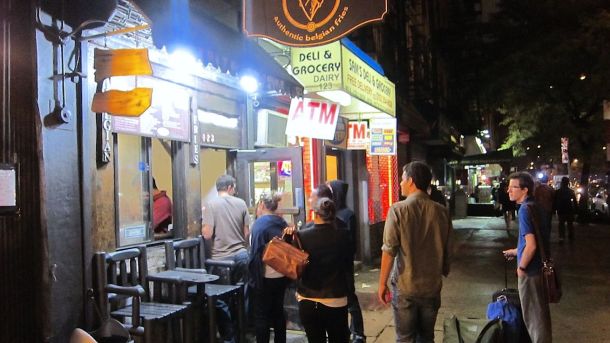
pommesfritesExterior2.0.0.jpgThe beloved East Village spot Pommes Frites, which was destroyed last March in the massive Second Avenue explosion, has announced plans to reopen this April in their new storefront at 128 MacDougal. The french fry spot, known for their dozens of homemade sauces, faced some hurdles getting up and running again – including delays from the Department of Buildings and opposition from the local community board to their liquor license.
Despite those hurdles, co-owners Omer Shorshi and Suzanne Levinson are excited for the new space, which will have more deep fryers and a larger seating area. “Hopefully, all the people don’t have to wait in line as long,” Shorshi tells Eater – although we’re guessing that line will be plenty long on opening night.

To read more, click here.

Eliminating Tipping Goes Even Better than Expected for Danny Meyer

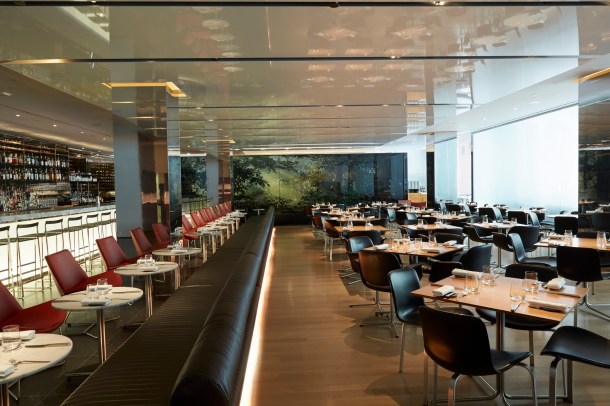
94678Interiors_4349.jpgNearly four months after eliminating tipping at the Modern, trendsetter Danny Meyer says  that the first full month without tips was the restaurant’s most profitable ever. On a recent podcast of Freakonomics, Meyer declared his surprise that the two-Michelin starred restaurant had benefited so quickly. He expected that, while they would ultimately see the benefits through lower turnover and more equitable pay, the process would be slow  and have initial hurdles. Instead, back of house applications have increased nearly 270%, server application shave increased 25 to 215% over three months, and there are more guests walking through the door than ever.

Of course, the Modern stands to benefit from a lot more publicity than the average restaurant considering this change. As one of the first New York restaurants to go gratuity-free, not to mention one with an established name for itself, the publicity alone is enough to make up for any sticker shock at higher menu prices. Still, the news is another piece to add to the puzzle when deciding: to tip, or not to tip?

To read more, click here.

Whole Foods Begins Testing Ugly Food

In the latest indication that ugly produce has gone mainstream, Whole Foods recently announced an upcoming partnership with Imperfect Produce to begin selling their “cosmetically challenged” fruits and vegetables in a handful of Northern California sales. This move is largely a test run for the huge retailer, but if international success is any indication, the trend may very well take off at Whole Foods as well.

Whole Foods already purchases this produce for their Fruit and Smoothie bars, but a recent Change.org petition helped move them toward test running larger sections of the store. Consumers who are drawn to the grocery store’s organic ethos but turned off by it’s prices may flock to the imperfect produce section, where discounts can be as great as 50% on items like blemished oranges and misshapen carrots.

To read more, click here.