Tartine Bakery New York Bound

TartineBlue-Bottle-Logo4-250x140

San Francisco’s most beloved bakery, Tartine, has announced that it will be joining forces with another San Fran favorite, Blue Bottle Coffee. Opened in 2002 by Chad Robertson, Tartine Bakery is highly renowned for their artisanal baked goods and their cult following. Blue Bottle Coffee, also celebrating its thirteenth year, was founded in Oakland, California by James Freeman and is best known for their extensive brewing guides and focus on single-origin beans.

Robinson will become CEO of the bakery which will now be a part of Blue Bottle. Blue Bottle founder and CEO James Freeman has been friends with Robinson for 10 years, but their alliance is only a recent and spontaneous development reports Inside Scoop. Tartine’s restaurant, Bar Tartine, will remain independent as it will be sold to chefs Nick Balla and Cortney Burns.

With the merger, the famed San Francisco bakery will be introduced to New York as well as Los Angeles by the end of the year. Previously, Tartine had previously announced their plans for an expansion that would bring them overseas to Japan, where Blue Bottle recently opened their first Tokyo based venture. This fall will also bring the debut of the bakery’s first ice cream shop, Tartine Cookies and Cream, which will open in the Heath Ceramics building in the Mission District. Blue Bottle currently has 19 locations throughout California, Manhattan, Brooklyn and Japan. In 2012 Blue Bottle made the news when it raised $19.6 million from investors and in 2014 they raised an additional $25.75 million.

To read more from the New York Times, click here
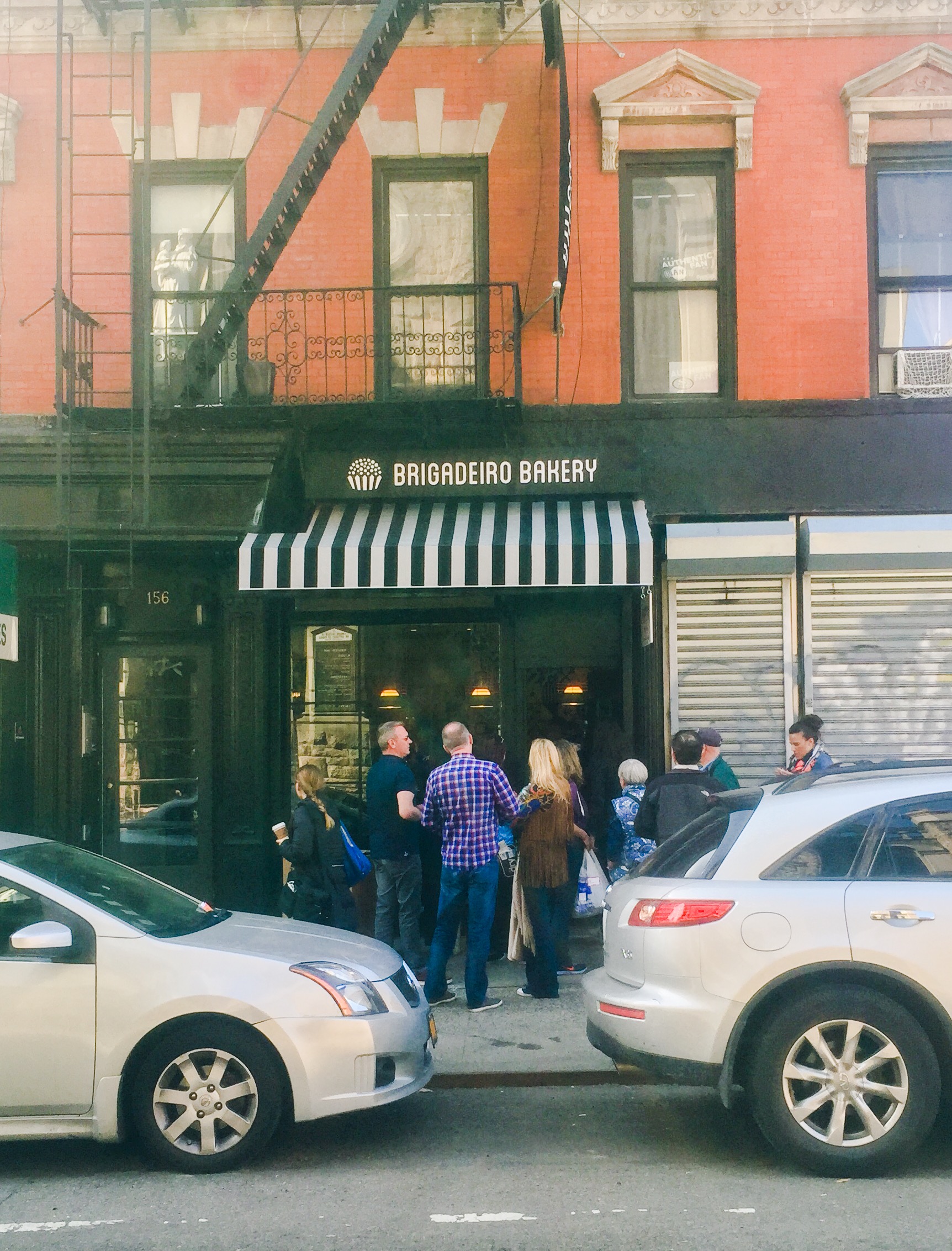
Retail Spotlight: Brigadeiro Bakery

IMG_4908

Across the city, more and more foodservice shops are opening to serve a singular product type. This isn’t a new idea, but it has certainly become the trend among bootstrapping entrepreneurs looking to get started in this competitive and pricy city.

It isn’t always successful, but when it’s done right, it can be great! This month, we are taking a close look at Brigadeiro, a small shop in the north west corner of SoHo serving sweet Brazilian specialties.

Brigadeiro is both the name of the shop and the name of the sweet, condensed-milk confection that the store specializes in. The shop, which seats fewer than 12, is simply and attractively decorated with tile, blonde wood, and splashes of color in the packaging and product display. The narrow space with minimal distraction draws you right in; you know immediately what the place is about. The display case sits center in the service counter showing off the namesake treats:

Chocolate. Pistachio. Chocolate+Vanilla. Banana Cinnamon. Oreo Cookie. The store has a rotating selection of brigadeiro that range from the modest and traditional to modern and approachable. At its core, the same product, but dressed differently to great effect. This is the way to do a single-product shop. Everything we tried was delicious, and the packaging was as much a feast for the eyes as the candy was for our sweet tooth.

The confections were definitely great. However, from the business standpoint, there is a lesson just as worthwhile to learn from the Brigadeiro shop: high-value and creative alternatives to traditional items of expense. Brigadeiro is turning butter, sugar, and condensed milk into $2.33-per-piece, high-margin products. Instead of sinking capital in static, expensive branded packaging, Brigadeiro uses attractive printed paper to wrap boxes and seal with a branded sticker—an inexpensive, dynamic approach. And ultimately, instead of trying to start an enterprise that demands a bigger space, a broader concept, and a larger staff, Brigadeiro is staying small and staying focused on making the best Brazilian candy in the city.

Brigadeiro Bakery is located on Sullivan Street at the corner of West Houston.  To read more, click here.

Guest Post: Establishment of U.S. Hospitality Businesses Is a Win-Win for Foreign National Investors and the U.S. Economy and Culture

By Steve Maggi, Esq., SMA Law Firm

In the most international city in the U.S., New York City is full of ethnic businesses, especially in the restaurant industry, where every nationality’s cuisines has representative places to eat. Fueling the growth of foreign fare restaurants is the E-2 investor visa.

Immigrants with a reasonable amount of capital and a solid business plan to start a new company, or buy a business or franchise, can apply for the E-2 visa depending on their nationality(ies) and whether the U.S. has an investor treaty with their country(ies). The decision of whether to grant the visa is based on the probability of success of that business. This determination takes into account both how detailed and innovative the business plan is as well as the demand for the business’ products and/or services, as well as the amount of funding required to get a business up and running until it begins to generate revenue sufficient to lead to its growth and success. Here are some things to keep in mind about this particular visa:

  • The E-2 visa gives the applicant 5 years to form a successful business in the U.S.: The continuation of the individual’s legal stay in the U.S. is based upon the success of the business. So if the business fails, the visa is terminated and the holder must return to his or her country of origin or apply for a change of status to another visa or for a green card based on another venture, job offer or direct family relationship with a U.S. citizen or resident. The good news is that as long as the business remains successful, the visa holder can continue to live in the U.S. indefinitely. The visa can be continually renewed every five years as long as the business remains viable.
  • Only an individual with experience and/or interest in running a small business should apply: While the visa may accomplish an important goal of family reunification, it should not be used by someone who is not serious about running a business or lacks an entrepreneurial mindset. There are other potential means available for someone just looking to invest money and come here to stay with relatives, such as the EB-5 visa. The E-2 is best used by a person who wants to work hard and do what it takes to maintain a profitable business. If they lack experience sometimes a franchise model is the best one, as they are instructed and guided by the corporate entity which controls the brand, which of course maximizes the probability of success.
  • The application process is relatively simple: Many visa applications have a mandatory two-part process, ie. the petition must first be reviewed in the U.S. by immigration officials here and then, if approved, an applicant must apply for the visa itself at his or her corresponding U.S. embassy. In contrast, the E-2 visa can be applied for directly in U.S. embassies vis-a-vis consular processing, a process which is a quicker and less expensive application process, and can reduce the chance of denials (one chance of denial versus two). The application can also be done if the applicant is already in the U.S. through a change of status.
  • E-2 applicants are only be eligible if they come from certain nations: E-2 investor visas are only available to citizens from countries that have bilateral investor treaties with the U.S. Notably, citizens of the BRIICS countries (Brazil, Russia, India, Indonesia, China and South Africa) are not currently eligible for the E-2 visa. In those cases, the alternative may be EB-5 or other categories. However, it is important to point out that if someone possesses dual or multiple nationalities, that they can qualify based on just one nationality which has an existing treaty. For example, Israelis, Portuguese and Greeks (to name just a few) don’t qualify, but if they have any other treaty country nationality as well, they do.

In many situations, the E-2 visa can be a win-win situation for all involved. It leads to more businesses, which not only add to the cultural fabric of the nation in general, but also creates tangible jobs and improves the U.S. economy. Nowhere is that more abundantly clear than in the Big Apple and the its vibrant restaurant scene.

If you want more information please feel free to contact us at info@smalawyers.com.

© 2015 SMA LAW FIRM