Whenever a new fast casual enterprise, restaurant or bakery is in the works, it’s only natural to want to start with the menu and design. However, that won’t guarantee success. Foodservice businesses require more than an appealing menu in order to successfully launch and survive. They are the sum of three parts coming together to form a whole—the concept, the market, and the location. These three give and take from each other to form the tangible business.
In order to ensure the longevity of your new venture, it is necessary to start in the center, and work around:
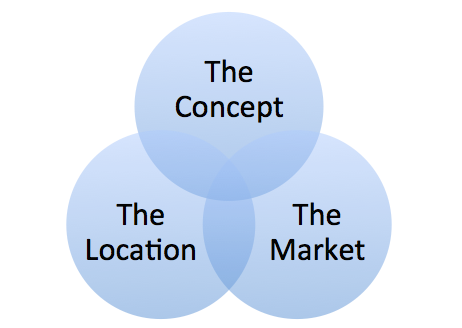
Ultimately, the first question and last question to ask is whether the concept, market, and location are all mutually supportive and financially viable.
The Concept: What are you serving and how are you serving it? This encompasses the menu, service style, purpose and values.
Concept and Location: Does the size and location of the physical space support the concept, and vice versa?
The Market: Who are your guests? What are their wants and needs, and what job is your concept doing for them—baked goods for special events, dinner for 10, or healthy lunch served fast?
Market and Concept: Does the market exist to support your concept—that is to say, if you’re opening a healthy fast-casual lunch spot, are there enough working professionals in the market looking for lunch to support the business?
The Location: Where will the restaurant be and what is the footprint?
Market and Location: Is the location accessible to your market? In the above example, the location you choose would need to be near enough to the market of working professionals seeking lunch options in a timely window.
These three come together simultaneously—you cannot begin to conceptualize your new business without giving all three equal attention. For example, a third-wave coffee shop needs great coffee, an affluent market willing to pay for premium coffee, and a location accessible to the market with a footprint small enough to be sustainable on an $8 average check.
On the opposite end, a fine dining restaurant needs a much larger location—but the average check justifies the occupancy cost so long as the market exists—Per Se would not be successful in Detroit, no matter how low the rent.
Next time you’re in the planning stages of a new restaurant, bakery, or café, remember that the old adage of “if you build it, they will come,” is not planning for success. Success requires planning around the concept, the market, and the location.
 paigepapers.com