Mixology Moves Outside of Alcohol, and Vice Versa

1653847_10152889012450820_2052556431145819038_n.jpgIt’s getting a lot harder than it used to be to walk down a grocery store aisle and tell what will give you a buzz – at least at first glance. For starters, there’s the growing proliferation of alcoholic versions of sodas from childhood, like Not Your Father’s Root Beer, or Crabbie’s Ginger Beer. But the trend also moves the other direction, as more and more foods and beverages without alcohol draw on the flavor profiles of beer, liquor and cocktails.

The Republic of Tea, for example, now offers The Sonoma Teas Collection, which is inspired by Sonoma County and includes flavors like red wine with orange and currant. The teas are free of caffeine and alcohol, but contain grape skins for the antioxidants. Cuvee coffee now offers a beer-flavored coffee in a can, reminiscent of dark coffee stouts. Even Starbucks tested a Dark Barrel Latte last year.

To read more, click here.

Food52’s New App Wants Us to Move Beyond The Recipe

d515f71c-7b45-46cd-b072-faab5fbfdd36--2015-0609_enchilada_assembly_bobbi-lin_1344.jpgIn today’s interconnected world, there are more and more ways to decide what’s for dinner (or lunch, or breakfast, or brunch, or a midnight snack, or…you get the idea). There are brick-and-mortar bookstores riddled with cookbooks from seemingly every popular restaurant or bakery, not to mention every food network star and popular blogger. It’s also easier than ever to Google a dish and find countless recipes for it, each with a rating, time estimate, detailed instructions and lengthy comments section. Or you can subscribe to one of the many meal kit companies like Blue Apron, and have the ingredients delivered to your door along with the recipe.
While we love the exchange of ideas and inspiration that happens across all these channels, there are times it can be a bit overwhelming – and doesn’t necessarily reflect the way we cook on a daily basis. The app (Not)Recipes, released by Food52 last week, acknowledges this divide, and aims to bring us a new way of sharing food inspiration. (Not)Recipes is a sharing platform for images and short descriptions dishes, of the sort that you might email to a friend to let her know how to make those cookies you’ve been whipping up forever. The pictures themselves are beautiful, with filters inspired by famous chefs from different eras, and a simple hashtag system makes them all easy to search. Just don’t call it the “Instagram of” anything – users can’t follow their friends or favorite chefs, and that’s by design. Cofounder Amanda Hesser explains that they “wanted to get the message [out] that this really is about the cooking, and the social element will follow. It’s not a popularity contest.”

We still recommend hanging on to all your favorite cookbooks (we certainly will be), but consider adding (Not)Recipes to your rotation for some easy weekday inspiration. To read more, click here.

The New Bubble Tea Trend Plays Nicely With Others

dirtyhorchata-1_edited_custom-fd552ea83cdba01d367d50896993db554c3428a8-s800-c85.jpg

Photo via Boba Guys/NPR.org

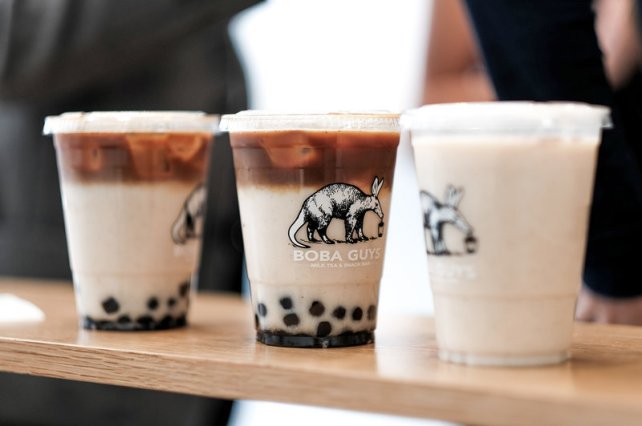
Whatever name you know it by, it’s likely you’ve seen Bubble (or Boba) tea offered in your major metropolitan area before. The Taiwanese beverage, which originated as a sweetened, milky tea with chewy balls of tapioca drunk through a wide straw, became popular in the United States in the early 2000s on college campuses and in Asian neighborhoods. That trend largely died down until recently, but seems to be coming back – and this time, it’s picking up steam by joining forces with other trends, from speakeasy bars to horchata (the sweetened Mexican beverage made from steeped rice or barley).

As Andrew Chau, co-founder of the popular chain Boba Guys explains, “If we’re going to bridge cultures, we want to bring the best of the West and the best of the East.” Boba Guys aims to win over coffee lovers and adventurous foodies with combinations like coffee mik tea, horchata boba tea, and Indian Chai.

For a more a adult version, there is Boba 7 – the “Boba Speakeasy” behind Los Angeles restaurant Soi 7. There, owner Elton Keung makes cocktails like the “bobagasm” with Irish Cream, Kahlua and honey boba, along with a number of nonalcoholic versions. It seems clear that it’s only a matter of time before the East Coast gets their own bubbly bar.

It can be hard to build long term success on a single trend, but flexibility and reinvention allow those trends to go farther – and expand some palates along the way.

To read more, click here.

In France, the Magic Word Could Get You a Cheaper Coffee

While we all know that “please” is helpful for getting mom to pass the spaghetti at family dinner, the magic word (or it’s French equivalent) now has an added power – it can lower the price of your coffee. French cafes are increasingly turning on to the trend of charging their rude guests more. In many cafes, this practice is kept discrete, although at least two spots have become open about the tiered pricing. At L’Hamburgé in Grenoble, France, coffees range from €1.50 for the most demanding guests, down to €1 for those who ask nicely. At La Petite Syrah in Nice, the divide is even more extreme: a full “Hello, coffee please” costs only €1.40, but saying only “Coffee” is a full €7. There is a middle tier of €4.25 for adding a s’il vous plaît but no bonjour. It’s also unclear if tourists who are still struggling to be polite in a new language get any special dispensation – or added penalty.

While it would be nice if we could all be a little kinder to each other before the morning coffee, we don’t think a trend like this would (or should) catch on here. Hospitality and human connection are the x-factor you just can’t put a price on. Even if a guest forgets the magic word, chances are they won’t forget your great service; next time, just hope they come in with mom to remind them.

To read more, click here.

Roman’s Runs Into Trouble Going Gratuity-Free

14-romans.w529.h352.jpg

After Danny Meyer, Andrew Tarlow is arguably the biggest name behind the no-tipping groundswell, and one of the first to vow that all his establishments would eventually go gratuity-free. But unlike Meyer, who recently announced that the change had gone unexpectedly well and generated more business than ever at his two Michelin starred The Modern, Tarlow is running into a little more trouble.

At Roman’s, the Fort Green Trattoria where Tarlow eliminated tipping in mid January, the change has reportedly been contentious. Although wages for both front of house and back of house employees have risen to $15 to $17 an hour, that wage still represents a significant decrease from what a server would earn on a typical Friday or Saturday night. As Roman’s bartender Anna Dunn puts it, “Some people want to pursue their art for 40 hours a week and then work 28 hours a week in a restaurant to pay the bills. Those people are really vital to a room. What are they going to do to make the most amount of money in the least amount of hours?”

Friction was likely aggravated by the way the change was announced; servers found out they would be losing tip income on December 15th – the same day the public was told. At least 2 veteran servers quit shortly after. Still, these hiccups are along the lines of what Tarlow – as well as Meyer – expected, and ultimately they still believe that the friction will be worth the change.

To read more, click here.

Grubhub Hopes a Greater Delivery Focus Will Keep Copycats at Bay

443145850_1280-e1393607221897.jpgThe food delivery market is a crowded one, with new competitors emerging every day. Grubhub, which owns Seamless, may control a large portion of that market, but all that competition took a toll last year. In 2015, the company’s growth slowed significantly and their stock value followed suit. In response, Grubhub declared that they would move from handling logistics only to actually delivering the food.
Currently, Grubhub handles the physical delivery of about 8% of their orders. The other 92% are delivered by the restaurants themselves, which use the Grubhub equipment and software to take the orders. Taking over delivery gives the company greater control, and may make them more appealing to the restaurants themselves – but the strategy is not without its pitfalls. Hiring contracted companies to handle the food can be very expensive, and consumers are reticent to pay much for the convenience. In the fourth quarter of 2015, Grubhub lost $5.5 Million on delivery.

CFO Adam DeWitt claims that that loss was still a significant improvement over the third Quarter, so the momentum may be in Grubhub’s favor. That’s good news, since Uber and Amazon are no insignificant threat. Whatever their strategy this year, Grubhub’s biggest advantage may be simply that they got there first.

To read more, click here.

Eliminating Tipping Goes Even Better than Expected for Danny Meyer

94678Interiors_4349.jpgNearly four months after eliminating tipping at the Modern, trendsetter Danny Meyer says  that the first full month without tips was the restaurant’s most profitable ever. On a recent podcast of Freakonomics, Meyer declared his surprise that the two-Michelin starred restaurant had benefited so quickly. He expected that, while they would ultimately see the benefits through lower turnover and more equitable pay, the process would be slow  and have initial hurdles. Instead, back of house applications have increased nearly 270%, server application shave increased 25 to 215% over three months, and there are more guests walking through the door than ever.

Of course, the Modern stands to benefit from a lot more publicity than the average restaurant considering this change. As one of the first New York restaurants to go gratuity-free, not to mention one with an established name for itself, the publicity alone is enough to make up for any sticker shock at higher menu prices. Still, the news is another piece to add to the puzzle when deciding: to tip, or not to tip?

To read more, click here.

The New Meal-Kit on the Block Raises $3.7 Million

hungryroot-variety-pack.jpgIt is now nearly impossible to ignore meal-kit companies like Blue Apron and Hello Fresh, which continue to plaster subway cars with advertisements and encourage huge investments to start-up competitors. The latest is Hungryroot, a meal-kit delivery company that wants to fill several niches at once: healthy, vegetarian, and quick.

Hungryroot has raised $3.7 million in funding from Lightspeed Venture Partners, Crosslink Capital and others, justified by the success of their predecessors and their own rapid growth. Unlike Blue Apron, Hungryroot’s business model does not involve subscriptions; one-off meals are available to order on Amazon and the company plans to expand to Whole Foods soon. While some have questioned whether the meal-kit trend is a bubble waiting to burst, the success of any business is directly tied to its ability to stand out. In this sense, Hungryroot’s biggest selling point is its innovative recipes: brownies made from black beans which somehow taste like the real thing, and noodles made from sweet potato with a  “Creamy Cashew Alfredo” sauce.

While there’s no replacement for good old fashioned comfort food, there’s definitely a market for substitutes like this – especially if they’re easy to prepare. Look out for Hungryroot in your neighborhood Whole Foods soon.

To read more, click here.

Thai Food Goes Mainstream

Thai food has long been a favorite for late-night take out and hole-in-the-wall dining, but the flavor profile of Thai cuisine (including fish paste, chili, lime, and coconut) has had trouble entering the mainstream. There are now signs that this is changing, and the winning Thai formula of sweet and spicy is propelling it onto menus and into retail in places you might not expect.

Thai chili sauces are available at more and more locations, including Cincinnati-based Buffalo Wings & Rings, and many casual chains are doing Thai versions of their standbys. Pie Five Pizza Company in Texas released a limited edition Thai-rrific pie, with sweet chili sauce, chicken and cilantro, and Boston based burrito company Boloco offers a “Bangkok Thai Burrito” with peanut sauce and asian slaw. Some beverage companies, like Los Angeles’ The Coffee Bean & Tea Leaf, have even been getting in on the action – experimenting with condensed milk and black tea to make Thai iced lattes.

To read more, click here.

Neurogastronomy Comes into Its Own, in Restaurants and the Snack Aisle

Food and Science have had an intimate relationship since humans first learned that fire could make things taste better, but when molecular gastronomy entered the common lexicon that relationship became one of the hippest trends in hospitality. Neurogastronomy represents the next phase of this relationship, and the focus is not just on changing food but on changing the entire experience of eating.

Neurogastronomy is the study of the human brain the way it perceives taste. This ranges from questions like, what color plate makes my lava cake taste better? to do people with weight problems eat more because their tongues are different? Understandably, that breadth of study has implications for many, from chefs and restaurateurs to doctors and dietitians. Chef Heston Blumenthal of the three-Michelin starred Fat Duck is focused on how discoveries in this field could make healthier food more satisfying through, for example, the principle of encapsulation – using bursts of flavor rather than dispersed flavor for a greater effect. Blumenthal is even working with NASA and the UK’s space agency to bring astronauts tastier zero-gravity meals.

If neurogastronomy gains enough traction, we may see more and more mass-marketed foods using these techniques in the snack aisle as well. Consumers are becoming increasingly aware of the ingredients and nutritional content of their food, and more suspicious of labels like “Natural” or “Low Fat.” A greater understanding of taste perception could be good for everyone if it allows companies to meet that demand without sacrificing flavor.

To read more, click here.