
Cold Brew In An Ice Pop!

cold brew pop

Cold-brew coffee, emphasis on the cold, is what you get in this new ice pop from Brewla, a company whose other flavors are fruit based. The bar is a lightly sweetened mixture of the coffee and organic milk.

Brewla was founded by Daniel and Rebecca Dengrove, a brother and sister team with over 15 years of experience in food science and technology. The idea for Brewla Bars was born when the budding entrepreneur Daniel noticed an untapped market at the intersection between popular high-end juices and the boom in trendy frozen yogurt. A rising star in the beverage industry, Rebecca zeroed in on teas with health boosts. Although the concept was originally for a brick-and-mortar store, the siblings’ full-time jobs and cross-country residences created roadblocks, so Rebecca rented space in the industrial kitchen at her old graduate school, decorated a rolling freezer, and Brewla Bars began.

Brewla Barista, box of five, $5.99 at Union Market stores in Manhattan and Brooklyn, brewlabars.com.
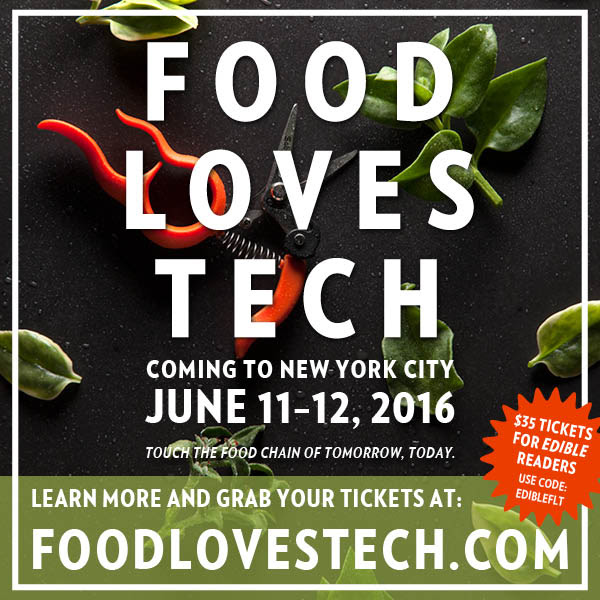
Food Loves Tech: Touch The Food Chain Of Tomorrow, Today

foodlovestech

A collaboration with Vayner Media, this eats-of-tomorrow gathering in the Waterfront Tunnel in Manhattan will allow attendees to see, smell, touch and taste the food culture of the near future.

Food Loves Tech is your chance to walk up to vertical farms, taste-test crickets, review dozens of food system apps, and talk to the inventors behind juicebots and beerbots, food computers for your home, and smart kitchens that listen to your food.


Event details are as follows:

Food Loves Tech
June 11–12, 2016
The Waterfront
241 11th Ave (at 27th St), NYC

Buy Tickets Here.


The Wizard Retools His Lab

David Bouley dreams of engineering a whole different concept of a restaurant.

The famous chef’s eponymous restaurant opened at 165 Duane Street, Tribeca in 1987.  According to Bouley, the restaurant will be going “on sabbatical” and then reopening in a smaller space (planned for Tribeca) with a mission of healthful eating.  The new space will accommodate only 20-25 seats and open five days a week.  The Bouley that New Yorkers have come to know over the past thirty years will be gone in a few months.

In recent years, Mr. Bouley has become obsessed with health issues.  Towards the end of the year, he will engage in a deep study of the relationship between health and food.  He plans to take nutrition classes at New York University and consult with doctors and experts, internationally.

The new restaurant’s mission will be to optimize health.  Tasting menus will be developed to address a variety of dietary restrictions and medical concerns.  “Food should give you calories that you burn off, not calories that you store,” said Mr. Bouley.

David Bouley plans to rejuvenate his restaurants and projects (Bouley, brushstroke, Bouley Test Kitchen and Bouley Botanical) and himself.  He is quoted as saying “Gastronomy and science, meeting together.  I want to learn how to do that better”.

Please click here to read more…

Piping Hot or Chilled, Carrot Soup with Spice

Carrots are a kitchen workhorse. They’re second only to onions as one of the most common ingredients in our savory, and occasionally sweet, recipes.  They go in our salads, stews and soups. We eat them raw with dip, roast them, or quickly sauté them for dinner.

Spiced Carrot Soup with Lime is a recipe that moves away from the traditional, one-dimensional, sweet, thick carrot soup.  Using a technique known as tarka in Indian cuisine, cumin and mustard seeds are sizzled in coconut oil, adding extra flavor.  Ingredients needed for this creation include coconut oil, medium onions, chopped ginger, minced garlic, turmeric, coriander, cayenne, salt, young carrots, daikon radish, mustard seeds, cumin seeds, serrano pepper, cilantro leaves and lime wedges.

This soup may be served hot from the pot for dinner, or it may be served chilled during the day.  It is best with young, long and slender carrots, which are considered fresher and tastier than the carrots from jumbo bags.

Carrots are a vegetable with many health benefits, including the improvement of vision.  Carrots are rich in beta-carotene, which is converted into vitamin A in the liver.  Vitamin A is transformed in the retina, to rhodopsin, a purple pigment necessary for night vision.  Beta-carotene has also been shown to protect against macular degeneration and senile cataracts.  Carrots also help prevent cancer, slow down aging, promote healthier skin, and help prevent infection.

Now is a good time of year to enjoy just-harvested new-crop carrots.  So let’s get cooking!

Please click here to read more…

Hudson Valley Real Estate Eating Up Our Produce

North of New York City, a battle is brewing between real estate and family farming.  A boom driven by City residents seeking refuge in greener, quieter locales is displacing our local food system.  Since 1982, real estate developments have transformed more than 471,000 acres of New York farmland, according to the American Farmland Trust data.

For example, Elizabeth Ryan’s Stone Ridge Orchard is not for sale–but she’s been offered millions for the land.  And her lenders think “it’s a bad business decision, not to cash out land for houses.” Ms. Ryan has support, though; a group of New York City lawmakers has teamed up with another preservation group, the Scenic Hudson Land Trust, to create a plan to preserve the region’s existing food system. As part of the initiative, lawmakers are seeking for the first time to set aside money in the municipal budget for the preservation of farmland in the Hudson Valley. “The risk to farmland is a risk to healthy food for New York City residents,” Councilman Daniel R. Garodnick, Democrat of Manhattan, said.

New York City is plighted by urban food desserts, and farmers markets are helping to alleviate that problem.  As such, Mr. Garodnick has proposed spending $50 for a conservation easement program that would pay farmers the development value of their land and impose a deed restriction to permanently protect the property from development.

“This modest, but visionary, strategic investment will make the city a national model of how to create a more equitable and secure regional food system,” said Steve Rosenberg, executive director of the Scenic Hudson Valley Land Trust.  To read more about the proposal, including May De Blasio’s position and the concerns of a declining farmer population, click here.

After 5 Months of Gratuity-Free, Nishi Changes Tact

20160227-Momofuku_Nishi_interior_2.0.jpgWhen David Chang opened Momofuku Nishi in Chelsea 5 months ago, the chef generated the usual buzz for a new Momofuku concept. But Nishi was also earning press as the latest addition to the gratuity-free movement, so far spearheaded by other big names like Meyer and Tarlow. Chang even gave an interview in his magazine Lucky Peach on the decision, citing their desire to pay kitchen workers a living wage.

This week, Nishi will be changing course and adding a tip line to the bottom of all checks. Prices will also lower somewhat, but wages for kitchen should stay the same. The team explained the decision in a Tumblr post, saying “This is by no means the end of the no-tipping discussion at Momofuku. But at this moment, we think a tipping model will benefit our guests and staff.”

Nishi also added brunch this week, which included a number of smaller, more affordable portions of items on the dinner menu. Hopefully the changes will satisfy early critics, who had praise for some dishes but considered them too pricey.

To read more, click here.

Fancy Coffee Has the South Bronx Talking

Formerly a deteriorating, poverty-stricken area, the South Bronx is now known for its hip-hop culture and its graffiti.  Last week, Birch Coffee opened shop on Hunts Point Avenue, a street characterized by auto shops, bodegas and cheap, variety stores.  It’s hard for Majora Carter to remember the last time Hunts Point had a spot that could serve both the community and its need for creativity.  She is a force of change in this part of New York City.

Ms. Carter collaborated on the café with entrepreneurs Jeremy Lyman and Paul Schlader, who have opened seven Birch shops in New York City.  And they are not the only ones.  Another coffee shop named Filtered Coffee opened a few months ago in Mott Haven, a neighborhood a few stops away on the No. 6 subway.  One of the business partners in Filtered is quoted as saying “Certain businesses come to fill a void in the community”.

Young people priced out of Manhattan and Brooklyn are now moving to the Bronx, regarded by some as an up-and-coming neighborhood.  Developer Keith Rubenstein is quoted as saying of Filtered partners Karen Paul and Aaron Baird, “They brought life to a place that was probably a little bit lifeless.”  New York restaurateurs may want to keep the South Bronx on their radars.

Please click here to read more…

Friday is National Donut Day 2016!!!

The annual epic donut giveaway is almost here!  National Donut Day, also known as “Free Donut Day”, is celebrated on the first Friday in June.

National Donut Day started in 1938 as a fund raiser for The Salvation Army. Their goal was to help those in need during the Great Depression, and to honor The Salvation Army “Lassies” of World War I, who served donuts to soldiers.

Soon after the U.S. entrance into World War I in 1917, The Salvation Army sent a fact-finding mission to France. The mission concluded that the needs of U.S. enlisted men could be met by “huts” that could serve baked goods, provide writing supplies and stamps, and provide a clothes-mending service. Typically, six staff members per hut would include four female volunteers who could “mother” the boys. These huts were established by The Salvation Army in the United States near army training centers.

About 250 Salvation Army volunteers went to France. Because of the difficulties of providing freshly baked goods from huts established in abandoned buildings near the front lines, the two Salvation Army volunteers (Ensign Margaret Sheldon and Adjutant Helen Purviance) came up with the idea of providing donuts. These are reported to have been an “instant hit”, and “soon many soldiers were visiting The Salvation Army huts”.

National Donut Day is celebrated at participating donut seller locations across the country.  Some of the Donut Day offerings include:

Entenmann’s: A total of more than 150,000 donuts will be given away in more than a dozen cities around the country, including Atlanta, Boston, Chicago, Cleveland, Denver, Louisville, New Haven, New York City, and San Diego

Krispy Kreme: Every customer gets a choice of any free donut on Friday, June 3, no purchase necessary.

Dunkin Donuts: Get one free donut with the purchase of any beverage

Cumberland Farms: Purchase any coffee or fountain drink between 5 a.m. and 10 a.m. on Friday and take your pick of a free donut.


Bartender, There’s a Logo in My Drink

The goal of bars these days is to make sure that guests recall the name of the place, no matter how strong the drink.  Cocktail napkins, matchbooks and cardboard coasters have been replaced by new, glittery branding techniques.

At Dante, a bar in Greenwich Village, the name of the place is stamped into the ice cubes.  The owners had a copper ice stamp custom made in Hong Kong.  The guests take pictures of the cubes, and one of the owners is quoted “In an age of Instagram, it’s hard to ignore free publicity.”

A bar in Seattle named Canon makes it easy to remember its name by branding citrus peels.  One of the owners says that his team is trying to provide guests with a “Wow” moment, or a sensory experience that takes them out of their day.

The Aviary in Chicago sears its name onto wooden coasters.  When the guests order a rum drink called “Brand New to the Game”, a pine coaster will be branded at their table with the name of the bar.  The fire created by the brand will be used to fill the inside of the glass with smoke before it is filled.  And the guest may take the coaster home.

Bar Leather Apron in Honolulu revived the bar token (special coins that can be exchanged for drinks).  A complimentary cocktail coin was created as a way to promote events or give away to visitors.

The San Francisco gin bar Whitechapel uses picks (perfect for spearing olives) to remind drinkers where they are.

To read more, please click here

For the Forager or Francophile, a Dandelion Salad

Dandelions’ sawtooth leaves bring a pleasant bitterness to the table, and make for a great salad. They’re best picked when tender, before the plant blooms, and they can be served raw or cooked.  Larger leaves may be sautéed, stir-fried or stewed with olive oil.  However, the dandelion is usually overshadowed by spring foods such as green garlic, asparagus, sorrel and rhubarb.

Dandelions grow everywhere so that foragers (searchers for wild food resources) are in luck.  The dandelions should be picked before they begin to flower.  Also, the forager should make sure that the leaves have not been treated with toxic chemicals.

Cultivated and wild, fresh-picked dandelion greens are being sold at farmers’ markets.  A long-leaved variety is also sold at supermarkets; these need to be trimmed as the top eight inches are best for salad.

A dandelion salad takes only 20 minutes to prepare and may include ingredients such as garlic cloves, grated ginger, lime juice, sherry vinegar, Dijon mustard, salt, black pepper, olive oil, beets, baguette slices, goat cheese, dandelion greens and eggs (the beets can be cooked and peeled up to two days ahead).  One version of the salad is modeled after a classic French recipe.

Nutritionists and science have shown that the dandelion is a green that’s good for you, and high in vitamins A and C.  Interestingly, the leaf was well known as a folk medicine cure-all, in the past.  Maybe dandelions could become the new kale?

To read more, please click here