Whole Foods Denied “World’s Healthiest” Moniker

whole-foods1.jpgIn 2010, Whole Foods successfully took on the name “America’s Healthiest Grocery Store,” trademarking the slogan on the basis of existing consumer sentiment. But they recently submitted an application with the U.S. Patent and Trademark Office to call themselves  “The World’s Healthiest Grocery Store” – a significant jump in status which could indicate plans for more aggressive expansion overseas.

Unfortunately the Patent office rejected the application, on the basis that such a slogan makes a “laudatory” and unverifiable claim. Papa John’s slogan “Better Ingredients, Better Pizza” was originally denied for the same reason. One reason the switch from “America’s” to “The World’s” might have struck officials as puffery is that Whole Foods currently has a presence in only Canada, Britain and the U.S. – hardly the whole world. They’ve also struggled historically to push into these overseas markets, where existing chains often have a hold on loyal clientele.

Whole Foods now has 6 months to update and refile the case for reconsideration.

To read more, click here.

Salvage Supperclub is a Pop-Up in a Dumpster

29-salvages-supper-club.w710.h473.2x.jpgSalvage Supperclub is the latest outcome of an increased public awareness about food waste: a traveling pop-up dinner made entirely from wasted food and served (appropriately) in a converted dumpster. The chef behind the club, Pesha Perlsweig, believes that they can change diners’ outlooks with each meal. “It makes me happy to hear that a former guest made carrot top pesto or was inspired by a dish of mine,” she says.

Salvage Supperclub has already hosted dinners in Berkeley, San Francisco and their native New York. And while the list of ingredients at one dinner (including bruised plums, vegetable pulp, garbanzo bean water, sweet potato skins and overripe, peel-on bananas) might force some guests to stifle a gag, the NPR reviewer present described almost everything as “finger-licking good.”

To read more, click here.


Wal-Mart: “Welcome, Ugly Apples.”

Wal-Mart has become one of the largest links in the food supply chain to take a massive step towards curbing food waste; the grocer is now purposefully selling blemished apples.  America’s largest grocer is currently piloting sales of weather-dented apples at a discount in 300 Florida stores.  “We’re excited to announce that after months of discussion, a brand of apples from Washington state, called “I’m Perfect,” will make its debut in Walmart stores this week,” said Shawn Baldwin, senior vice president for global food sourcing, produce and floral for Wal-Mart U.S.

Farmers and up against a constant battle with nature and the produce often shows it.  Cosmetic issues have traditionally kept sun-spotted, crooked, and pocked product and fruit from store shelves, despite being perfectly delicious and nutritious.  These rejects usually end up in landfills wasting away and contributing to greenhouse gas emissions.  “we’ve typically found that growers reported [cosmetic-related] losses ranging up to 20 percent of production in a given year, but it could be higher in years of bad weather,” said JoAnne Berkenkamp, a senior advocate for food and agriculture at the Natural Resources Defense Council.

Fortunately, more retailers are taking steps to correct the problem.  Whole Foods Markets is operating a similar program in Northern California, and Giant Eagle is piloting something similar in the Pittsburgh area.

To read more, click here.

Chipotle’s Health Scares Do Little For Competitors

CmM6g2YWEAAbmDC.jpgAfter their third straight quarter of declining sales, things continue to look bleak for the once-great Chipotle. The company posted sales this quarter down 24% from the previous year, and quarterly profits of $26 million (compared to $140 million immediately before the E. Coli outbreaks late last year).
One might think that such a plummet would be good news for competitors, but so far the opposite seems to be the case, with other Mexican fast food and fast-casual chains seeing a decline as well. Taco Bell’s same-store sales fell 1%, due in part to a decrease in foot traffic despite hefty advertising dollars spent selling items like the “Quesalupa.” Qdoba on the other hand tried to specifically target Chipotle customers, but claims such ads and promos ultimately hurt their margins.

To read more, click here.

Fashioning Cast-Iron Pans for Today’s Cooks

One of the oldest cooking tools in the kitchen is the cast-iron skillet.  These pans are sometimes passed down through generations because of their beauty and usefulness.

In the last five years, three new companies have begun to produce cast-iron skillets, promising to make improvements with a combination of handwork and modern technology.  Finex, Borough Furnace and Field Company got initial funding on the Kickstarter funding website.  Hundreds of small backers will eventually receive pans in return for their financial support.  The Finex 10-inch skillet sells for $165; the Borough Furnace model sells for $280, and the Field skillet sells for $100.

A well-used, well-seasoned cast-iron skillet is an all-purpose pan.  Nonstick to cook eggs, hot to sear anything and useful for roasting, stewing, simmering and baking.  The nonstick surface of a cast-iron pan is achieved with natural ingredients like flaxseed oil and lard, rather than synthetic coatings like Teflon.

People are willing to pay a hefty premium for these cooking tools because of their craftsmanship.  The modern-day skillets share qualities of those made between the 18th and 20th centuries: light and thin with a smooth cooking surface.

How about cleaning and seasoning?  Skillets of the past had natural coatings formed by cooking with fat, and bonding fat molecules to the metal surface.  Use the pan often for projects like frying, cooking and browning.   Scrape the cooking surface clean, rinse with hot water, add a drop of soap and put in back on the stove over low heat until dry.  Store dry skillets in a cupboard or oven to protect them from dust.

Please click here to read more…

Major Producers Paying Farmers to Go Organic

With consumer demand for organic foods now outpacing supply, major companies like Kellogg’s and General Mills are now taking the next logical step to meet that demand: paying farmers to go organic. The move makes perfect sense from a profit perspective; organic foods are now at a 47% premium, and their sales grew 11% last year (4 times the growth industry-wide). Experts say this growth would have been even greater, if there had been more organic food to actually sell.

Given enough time, supply should theoretically increase on its own, but the large up-front costs associated with organic certification are a major hurdle for current conventional farmers. Inspection fees for the federally regulated organic label are paid by growers, who also have to cover the higher labor costs associated with organic farming methods when they abandon synthetic pesticides. Yields are also lower, which makes the switch a risky move as well. So Big Food is in some cases bridging the gap, providing start-up funding to help farmers transition and paying a premium for foods during that transitional phase.

To read more, click here.

England’s Restaurant Business ‘Regrexit’

Bibo-Restaurant-Lounge-Substance-1

Add this to the roughly 1 million bad things the U.K’s “Leave” coalition should’ve seen coming: Brexit is having a adverse effect on England’s restaurant industry. In a story today featuring reporting by chief restaurant critic Richard Vines, Bloomberg essentially gave prominent restaurateurs free rein to grumble about their compatriots’ vote to leave the EU, and they say business is already getting hammered in this post-Brexit world where “bean-counters keep closer tabs on expense accounts, a weak pound raises prices of imported food, and eateries struggle to hire workers from the EU.”

The country’s dining scene had actually been doing pretty well up till now, too — Bloomberg says the number of restaurants jumped by 21 percent over the past five years. But even in advance of the vote, sales growth industry-wide nose-dived by half. One restaurant group immediately scrapped multi-million-pound plans to buy four pubs in Scotland. Stats show there’s been 12 percent less corporate credit-card spending since the referendum, while many chefs worry the worst is yet to come because they fear already-costly products like Spanish jamón ibérico are going to climb even higher. Richard Corrigan, a celebrated chef, expects the price of French wine to jump by 15 percent and so has given staff very clear instructions to stock up on the Bordeaux.

Read more here.

Seeking Gold in Cuban Soil

According to the United States Chamber of Commerce, American exports could reap more than $1.2 billion a year in sales if the U.S. ends its trade restrictions against Cuba.  Cuba imports 60 percent to 80 percent of its food.  New trade lines would also provide a supply of sugar, coffee and tropical produce to America.

An alliance of organic industry leaders, chefs and investors travelled to Cuba this past May, with a mission of persuading the Cubans to protect and extend the small-scale, organic practices that have become a part of their lives.  These practices came into play during the rule of President Fidel Castro, when the communist Soviet Bloc fell apart, and Cuba was unable to trade for agricultural equipment, chemicals and gasoline.  Farmers were forced to replace tractors with oxen, and cooperative farms emerged.

The country has almost 400,000 urban farms, among them 10,000 small organic ones.  Organic supporters would like Cuba to continue employing a sustainable agriculture that rejects chemicals and genetic modification.  The incentive is that the American market is willing to pay a premium for organic produce.  Organic sales in the U.S. grew three times as fast as the overall food market last year.

Efforts to lift trade sanctions between the U.S. and Cuba are moving slowly, due in large part to the upcoming Presidential election.  In the meantime, Cuban officials are being encouraged to build on the country’s extensive research and the cultural desire for local food.

Please click here to read more…

All Pizzas To Be Cooked By Robots?

24-robot-pizza.w710.h473.2x

A former Silicon Valley executive with a love of pizza and robots is on a quest to make a better pie and deliver it faster than the big chains can. Alex Garden is making robots that make pizza and they are coming for Domino’s.

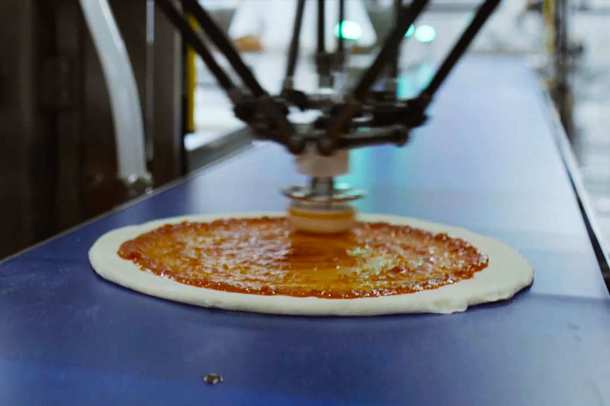
The future of pie delivery, argues Garden, is being pioneered by robots at his Zume Pizza, and Bloomberg got a look inside the new company. The process seems to involve a team of enormous and very expensive-looking robots preparing pies that then get baked by a giant bank of ovens en route to customers.

One of the robots (her name is Marta) expertly spreads sauce “perfectly but not too perfectly, so it looks just like an artisan product.” Another, named Bruno, then “gently, without disturbing it,” moves the pizza into an 850-degree oven to prebake. Traditional humans are still required for tasks like sprinkling cheese, driving the delivery truck, and walking sealed boxes to customers’ doors, but these seem like minor obstacles, really. After all, even Domino’s has robots that warm pies on the road and diligently hunt down customers using GPS.  Pizza seems the ripest for full automation within fast food, so it’s safe to assume the whole industry is steadily moving toward the all-robot business model.

Right now, Zume’s pies only appear to be available in Mountain View, but Garden warns his company is targeting massive chains like Domino’s and Pizza Hut, which he says he’ll be able to dethrone by offering “the best-tasting pizza in the country delivered in 15 minutes for the same price as any of the other chains.”As Bloomberg points out, there’s “a lot of profit in robot-made pizza.” Just envision one of the major pizza franchises but with “virtually no” humans, Garden calmly instructs everyone. “It would be like Domino’s without the labor component. You can start to see how incredibly profitable that can be.”

Brexit’s Impact on the Specialty Food Market

ba5403b65e43df0297aeba68d6c0ca1fc082559f.jpegThis weekend’s news was understandably dominated by Brexit, and the far-reaching implications of the vote. One unexpected result of Britain’s decision to leave the European Union falls on the English specialty food market, which has so far benefited from the EU’s Protected Designation of Origin status on many of it’s products.

This status, applied throughout the EU to products ranging from wines to olive oils to cheese and meat, allows specific regions to claim sole use of specific brand designations. Most famously, “champagne” is not champagne unless it is produced in the eponymous French province, using the méthode champenoise. Gorgonzola can only be gorgonzola if it comes from Italy. And in England, products like Cumberland sausage and Yorkshire-forced rhubarb are all protected by designated status.

England actually has more than 60 foods and beverages with protected designations. After the vote late last week to leave the EU, this status will disappear, and producers around the world can begin making products like Rutland bitter beer, Stilton cheese and pork from Gloucestershire Old Spot Pigs. While none of these have quite the cache of champagne, they still represent the food culture of the country – and the loss of PDO status could have a real impact on the farmers, brewers and craftsmen who make them.

To read more, click here.