8/31: RFP for a Restaurant and Banquet Facility

The NYC Parks Department has issued a request for proposals for a restaurant and banquet hall at 201-10 Cross Island Parkway, Queens. For full details of the RFP, see below:

In accordance with Section 1-13 of the Concession Rules of the City of New York, the New York City Department of Parks and Recreation (“Parks”) is issuing, as of the date of this notice, a significant Request for Proposals (“RFP”) for the operation, renovation, and maintenance of a restaurant and banquet facility at 201-10 Cross Island Parkway, Queens.

There will be a recommended site visit on July 27, 2016 at noon.  We will be meeting at 201-10 Cross Island Parkway, Bayside NY 11360, off the Cross Island Parkway between 201stand 202nd Streets in Queens.  If you are considering responding to this RFP, please make every effort to attend this recommended site visit.  All proposals submitted in response to this RFP must be submitted no later than August 31, 2016  at 3:00 p.m.

Hard copies of the RFP can be obtained, at no cost, commencing on July 1, 2016 through August 31, 2016, between the hours of 9:00 a.m. and 5:00 p.m., excluding weekends and holidays, at the Revenue Division of the New York City Department of Parks and Recreation, which is located at 830 Fifth Avenue, Room 407, New York, NY 10065.

The RFP is also available for download, commencing on June 30, 2016 through August 31, 2016, on Parks’ website.  To download the RFP, visit www.nyc.gov/parks/businessopportunities, click on the link for “Concessions Opportunities at Parks” and, after logging in, click on the “download” link that appears adjacent to the RFP’s description.

For more information or to request to receive a copy of the RFP by mail, prospective proposers may contact Alexander Han, Director of Concessions, at (212) 360-3452 or at Alexander.Han@parks.nyc.gov.

TELECOMMUNICATION DEVICE FOR THE DEAF (TDD) 212-504-4115

Do You Know Your Food Waste?

Did you know that the average restaurant in one year creates more than 50 tons of food waste?

Talk to any restaurant owner, and you will likely find that food waste is one of the top concerns when it comes to revenue loss.   A 2013 study conducted by Business for Social Responsibility (BSR), on behalf of the Food Waste Reduction Alliance, indicated that more than 84 percent of the food waste generated by surveyed U.S. restaurants ended up in the landfill.  Only 1.4 percent was donated, while 14.3 percent was recycled, and most of that was reclaimed as cooking oil.  On average, that translates to 15.7 percent food loss across the industry, or 3.3 pounds of food waste per $1,000 of company revenue.

Reducing waste makes good business sense for a restaurant.  The first step in reducing waste is to measure and track the amount, type, and source of the food and packaging waste.  Maintenance of a daily waste logbook can help food establishments (1) save money by reducing over-purchasing and disposal costs, (2) lessen environmental impacts, (3) support efforts to eliminate hunger, and (4) increase tax benefits by donating food.  It would be best to assemble a team of employees who prepare the meals (because they are familiar with the amounts of ingredients used in the dishes) and clean the dishes (because they are familiar with the type and quantity of food left over by guests).

Pre-consumer kitchen waste, which could be caused by incorrectly prepared food, spoiled food, trim waste, or simply overproduction, constitutes an estimated 4-10% of purchased food, and becomes waste before it ever reaches the table.  There are solutions for reducing this portion of food waste, such as donating to a food bank and creative re-use of certain foods (e.g., making day old bread into croutons).

Post-consumer waste after the meal relies heavily on consumer preference.  Some people take home a doggy bag and others send it back to the kitchen trash.  Garbage left over after dining represents the food not eaten, as well as disposable packaging such as plastic plates and cups.  Promotion of extra-large servings of food has been used as a marketing gimmick in the United States, and has backfired, leading to increased food waste.

In the kitchen, the easiest way to sort waste is by using different containers.  Categories may include meat, fresh fruit and vegetables, bread, glass, paper and plastic.  A large number of categories provides a clear picture of the type and quantity of waste and brings more recycling options.  The sorted waste should be measured at the end of each working shift, to compare how much food a restaurant sells and how much food is wasted.

Action items to reduce food waste

  • Identify the restaurant menu items that have the most leftovers, and consider reducing the portion size of these menu items to reduce waste and food cost. In addition, purchase ingredients in smaller packages if you are not using the inventory timely.
  • Conduct inventory in the restaurant on a regular basis so that you can identify the need for new purchases in due time – not too soon and not too late.
  • Purchase high-quality kitchen equipment such as specialized knives that can help to lower food waste when peeling fruits and vegetables, or cutting meat and filleting fish.
  • Invest in new dinner service; plates and glasses with smaller volumes will reduce portions.
  • Handle fruits and vegetables properly by cleaning them and storing them in a suitable container to extend their lives.
  • Rotate the food in the refrigerator and warehouse on a regular basis; set the foods that should be used first in front of the food that is newly stored.
  • Encourage your local restaurant to sell half portions of food if the serving size is too big.
SAMPLE WASTE LOGBOOK
Facility:
Date:
Special Events
TIME

NAME

FOOD TYPE LOSS REASON # OF PORTIONS # OF QUARTS # OF POUNDS
        PICK ONE

How to Use the Waste Logbook

Pre-Consumer Food Waste should be tracked every day.

  1. Track pre-consumer food waste at the time of discard. Record waste on the logbook immediately prior to placing it in the trash, compost or garbage disposer.
  2. If donating food to a food bank, record all food donations on the waste logbook immediately prior to donation.
  3. Record the type of food and the reason why it is being discarded on the logbook. These are the two most important pieces of information that will reveal opportunities for change.
  4. Record how much is being wasted according to weight or portions.
  5. Chefs and Managers should review the prior day’s waste logbook at the beginning of the following day’s shift.
  6. The Top 5 waste items should be discussed with the kitchen team at a pre-shift meeting. Ask the team for ideas to reduce those items.
  7. Review progress on the Top 5 items every week until the amounts drop.

 Post-Consumer Food Waste should be tracked once a month.

  1. Use a logbook to track the total weight of the trash (or another standardized metric such as number of trash cans or number of trash bags).
  2. Keep a record of total weight or count of post-consumer food waste in an Excel sheet or automated tracking system.
  3. When measuring post-consumer waste, always do so on a busy day and track subsequent measurements on the same day of the week. With this approach, you will have comparable data.
  4. Make sure to look at the food in the garbage and note any trends. There may be items that customers do not like which should be removed from the menu. In other cases, you may find portions need to be adjusted to avoid waste.


The Spritz: It’s All Built on Bubbles

Spritz culture is rooted in the cities and towns of Northern Italy.  The drink can be found at restaurants, cafes and even at the airport.

The Spritz is a wine-based cocktail commonly served as an aperitif (an alcoholic beverage served before the meal to stimulate appetite) in Northeast Italy. The drink is prepared with prosecco (Italian white) wine, a dash of some bitter liqueur such as Aperol, CampariCynar, or, especially in Venice, with Select. The glass is then topped off with sparkling mineral water. It is usually served over ice in a lowball glass and garnished with a slice of orange, or sometimes an olive, depending on the liqueur.

Thanks to the recent publication of a light-hearted book named “Spritz”, these drinks have become popular and American bars will serve them this summer.

American bartenders have taken the liberty of creating their own spritz concoctions.

At the Llama Inn in Williamsburg, Brooklyn, the bartender mixes gin, fino sherry, strawberry shrub, St. Germain elderflower liqueur, Peychaud’s bitters, Spanish sparkling wine and Perrier for the Señorita Spritz, a pretty pink concoction.

At Montana’s Trail House in Bushwick, Brooklyn, the owner piles Aperol, grapefruit juice and sparkling white wine atop a base of Mezcal with agave syrup.

Summertime is the perfect time for something light, refreshing and bubbly.  One bartender on the Lower East Side is quoted as saying, “Who doesn’t like something that feels like its dancing on your tongue?”

Please click here to read more…

Seeking Gold in Cuban Soil

According to the United States Chamber of Commerce, American exports could reap more than $1.2 billion a year in sales if the U.S. ends its trade restrictions against Cuba.  Cuba imports 60 percent to 80 percent of its food.  New trade lines would also provide a supply of sugar, coffee and tropical produce to America.

An alliance of organic industry leaders, chefs and investors travelled to Cuba this past May, with a mission of persuading the Cubans to protect and extend the small-scale, organic practices that have become a part of their lives.  These practices came into play during the rule of President Fidel Castro, when the communist Soviet Bloc fell apart, and Cuba was unable to trade for agricultural equipment, chemicals and gasoline.  Farmers were forced to replace tractors with oxen, and cooperative farms emerged.

The country has almost 400,000 urban farms, among them 10,000 small organic ones.  Organic supporters would like Cuba to continue employing a sustainable agriculture that rejects chemicals and genetic modification.  The incentive is that the American market is willing to pay a premium for organic produce.  Organic sales in the U.S. grew three times as fast as the overall food market last year.

Efforts to lift trade sanctions between the U.S. and Cuba are moving slowly, due in large part to the upcoming Presidential election.  In the meantime, Cuban officials are being encouraged to build on the country’s extensive research and the cultural desire for local food.

Please click here to read more…

Webinar Opportunity: Millennial Coffee Drinkers

S&D Coffee and Teas is hosting a webinar on Young Coffee Drinkers (YCD) Wednesday, July 13th 2016, 2pm ET.

The seminar focuses on how Coffee-drinking millennials—consumers ages 18 to 34—represent untapped opportunities and have the potential to make coffee an integral part of their lifelong consumption patterns.

In order to reach these consumers, food retailers need to understand the distinct ways in which they perceive and talk about coffee.

YCDs, for example, grew up in a “Starbucks world” and are more savvy about coffee. Their expectations are higher. At the same time, they are concerned about how the coffee got here and how it was made. Sustainability is therefore a very important value.

The webinar intends to address these issues and others so that views gain a new way to think about the coffee industry and insight into updated sales strategies.


To learn more and register, click here.

Why You Should Buy Produce in Chinatown?

28-chinatown-produce.w710.h473.2x

As anyone who’s spent an afternoon nibbling on roast pork while perusing the markets of Chinatown can attest, the neighborhood’s streets are home to an astounding variety of produce and vendors. In terms of fruits and vegetables, it’s an unparalleled shopping destination for the home cook in New York. This is in large part thanks to the remarkably cheap prices, but also the fact that you can consistently find new things to cook. The Wall Street Journal toured the neighborhood with economic botanist and From Farm to Canal Street author Valerie Imbruce, who filled the paper in on how the Chinatown produce economy works.

“You really can’t exaggerate this kind of variety”, says Imbruce. She counted 200 different fruits and vegetables, ranging from lots and lots of cherries to multiple varieties of choy and jackfruit, but also celtuce, long beans, bitter melon, dragon fruit, and all of the durian you would ever want. As far as their low pricing is concerned, Chinatown’s produce markets aren’t cheap because they’re peddling second-rate products, but because they’re actually kind of farm to vendor. Operators are linked to a network of small family farms, like home gardens in south Florida, and minor wholesalers that function independently of those that supply most supermarkets.

Furthermore, with low overheads — no credit cards, minimal staffing, and makeshift sidewalk stands — and collaboration among vendors to get bulk discounts means you’re paying as close to wholesale prices as you ever will. Chinatown’s markups typically run as low as 10 to 12 percent and don’t just beat Whole Foods (a.k.a Whole Paycheck), but also affordable chains like Key Foods.

Read more here.


8/15-8/17: CONNECT Mobile Innovation Summit

Registration is open now for the CONNECT Mobile Innovation Summit, to be held from August 15th to 17th in Chicago. In their own words, the event is an opportunity to explore the many opportunities that retailers, restaurants and other B2C enterprises have for leveraging mobile and digital channels to build their brands, increase sales and improve customer engagement, experience and loyalty.

Registration is limited to managers and executives of restaurants, retail and other business-to-consumer organizations.

To read more or register now, click here.

All Pizzas To Be Cooked By Robots?

24-robot-pizza.w710.h473.2x

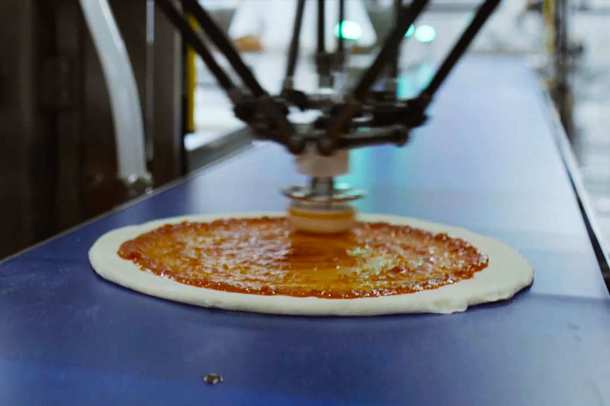
A former Silicon Valley executive with a love of pizza and robots is on a quest to make a better pie and deliver it faster than the big chains can. Alex Garden is making robots that make pizza and they are coming for Domino’s.

The future of pie delivery, argues Garden, is being pioneered by robots at his Zume Pizza, and Bloomberg got a look inside the new company. The process seems to involve a team of enormous and very expensive-looking robots preparing pies that then get baked by a giant bank of ovens en route to customers.

One of the robots (her name is Marta) expertly spreads sauce “perfectly but not too perfectly, so it looks just like an artisan product.” Another, named Bruno, then “gently, without disturbing it,” moves the pizza into an 850-degree oven to prebake. Traditional humans are still required for tasks like sprinkling cheese, driving the delivery truck, and walking sealed boxes to customers’ doors, but these seem like minor obstacles, really. After all, even Domino’s has robots that warm pies on the road and diligently hunt down customers using GPS.  Pizza seems the ripest for full automation within fast food, so it’s safe to assume the whole industry is steadily moving toward the all-robot business model.

Right now, Zume’s pies only appear to be available in Mountain View, but Garden warns his company is targeting massive chains like Domino’s and Pizza Hut, which he says he’ll be able to dethrone by offering “the best-tasting pizza in the country delivered in 15 minutes for the same price as any of the other chains.”As Bloomberg points out, there’s “a lot of profit in robot-made pizza.” Just envision one of the major pizza franchises but with “virtually no” humans, Garden calmly instructs everyone. “It would be like Domino’s without the labor component. You can start to see how incredibly profitable that can be.”

Manhattan Food and Bar Leasing Up Double Digits

Across the city, landlords want a seat at the table.  More specifically, they want the seats, and they want the tables inside their buildings.  Fast-casual restaurants, coffee shops, and juice bars are expanding across Manhattan, driven in part by a large millennial workforce and dense, wealthy demographic.

Also, though, as consumers behaviors have changed, opportunity has opened up for foodservice operators.  More and more retail and apparel is being purchased online, which has caused these companies to trim store sizes.  Now, with new inventory available, restaurants are building new locations even faster.  In 2015, the fast-casual segment grew to $44 billion nationwide–an 11.5% increase from 2014, according to Technomic.

Similarly, Manhattan lease transactions in the food and bar category increased 22% in 2015 over 2014, Cushman & Wakefield reports.  Meanwhile, drugstore leases were down 64% and apparel and accessories retails were down 22%.

Where banks and retailers once occupied large-footprint spaces, some landlords are building out food halls or dividing spaces into smaller units.  “You’re getting more [rent] than what a single tenant would pay,” said Brett Herschenfeld, SL Green Managing Director.

To read more, click here.


8/20 – 8/24: NY NOW at the Javitz Center

NYNOW2015-20151026023842968.jpgRegistration is now open for both exhibitors and attendees to the NY NOW Home, Lifestyle and Gift Exhibition at the Javitz Center. The event takes place over the course of 5 days, and will feature products from over 2,000 suppliers ranging from food and beverage to gifts and home goods. NY NOW is a unique opportunity to check out the latest in retail, often before it hits the shelves.

To learn more and register for the event, click here.