What’s Next for Retail?

Retail Customer Experience, the online publisher of current retail news and research, just released their latest Whitepaper on what’s next for retail (and how to navigate your business there). It includes research and advice on mobile POS, inventory management, and omnichannel brand representation, including warnings about some of the pitfalls retailers face navigating new technologies.

To download a copy, click here.

Reserve Goes after Instant Reservations

We’ve written a lot recently about the delivery wars currently being waged between competitors like Grubhub, Uber and Amazon, but less has been said about the battle to become the go-to reservation system. Current heavy hitters OpenTable and Yelp’s SeatMe have enjoyed a relatively open playing field for awhile, allowing each of them to acquire thousands of restaurant partners.

Reserve has been in the game since 2014, but has marketed its app as a restaurant “concierge” rather than a traditional reservation system. They partner with a much smaller list of restaurants (currently around 350), and users of the app provide a time window and a number of guests rather than making a reservation on the spot. Restaurants then confirm the time and Reserve alerts the user. Evidently with their eyes on a bigger prize, Reserve has now rolled out instant reservations at a subset of it’s current restaurant list. That subset may be small, but it includes impressive names like Russ & Daughter’s, Blue Hill at Stone Barns, and Mission Chinese. Reserve’s Head of Restaurant Product, Peter Esmond, says that their focus is largely on creating a product that works better for restaurants by offering more flexibility and greater customer support.

While Yelp and OpenTable continue to go head to head, Reserve may quietly sneak up on them through the high-end market. Or they may just add a delivery feature and take on the world.

To read more, click here.

Behind Chick-fil-A’s Success

cow-8.png

Political controversy aside, Chick-fil-A’s success is undeniable. In 2015, they averaged $3.2 million in per-store sales, which is 25% higher than McDonald’s, and double Burger King or Wendy’s. In 2014 they overtook KFC as America’s biggest Chicken chain. Analysts now predict that they are on track to become the 4th largest chain in America in terms of revenue by 2020, calling them the largest and least appreciated threat to McDonald’s. And if you think that this is largely irrelevant in New York, where Bill De Blasio has come out officially against the company for the CEO’s homophobic remarks, you might want to think again. 8 blocks from their first NYC location in midtown they are currently construction a second, and there are additional plans in the works to open a dozen more around the outer boroughs – bringing them close to the number of Panera breads in the city.

Needless to say, controversy does not seem to be slowing them down too much. Analysts credit their tight operations, and perhaps a certain amount of exclusivity: apparently only 0.7% of the 20,000 applicants who applied for franchises last year were given a spot – an acceptance rate lower than Harvard.

To read more, click here.

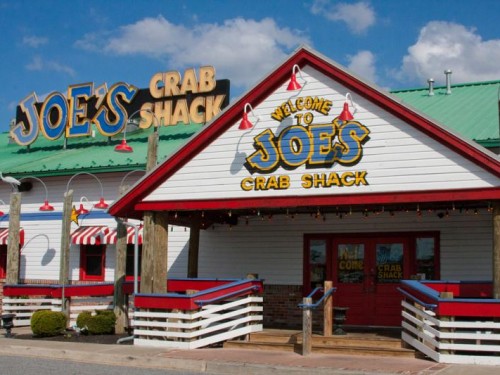
Joe’s Crab Shack Defects from Gratuity-Free

Joes-crab-shack.jpg

Several months after going the no-tipping route, Joe’s Crab Shack has now rolled back the model from 18 restaurants to just 4. CEO Bob Merritt tells investors that customers simply don’t like it, and foot count is down 8 to 10% on average among the locations.

The chain was originally praised for their efforts, which followed on the heels of higher-end restaurateurs like Danny Meyer, Gabriel Stulman and Andrew Tarlow. Overall they raised server wages to $14 an hour and menu prices by 12 to 15%. “We tried it for quite a while, tried communicating it different ways,” Merritt explained, but a large portion of guests were unswayed. Research indicates that about 60% of guests disliked the model, either because they didn’t trust management to pay the higher wages or they preferred being able to incentivize good service.

Joe’s will revert 14 locations back to their former tipped model, but the remaining 4 have apparently been working much better. Merritt says they plan to treat those stores as a rich source of research, and figure out what distinguishes them from locations where it doesn’t work.

To read more, click here.

6/17: Request for Proposals due for Snack Bar in Columbus Park

The NYC Parks Department has issued the following request for proposals (RFP) for a snack bar in Columbus park, due Friday June 17th.

In accordance with Section 1-13 of the Concession Rules of the City of New York, the New York City Department of Parks and Recreation (“Parks”) is issuing, as of the date of this notice, a significant Request for Proposals (“RFP”) for the renovation, operation, and maintenance of a snack bar at Columbus Park, Brooklyn.

All proposals submitted in response to this RFP must be submitted no later than Friday, June 17, 2016 at 2:00 PM. There will be a recommended site visit on Monday, May 23, 2016 at 11:00 AM.  We will be meeting in front of the snack bar on Joralemon Street, between Court Street and Adams Street, Brooklyn.  If you are considering responding to this RFP, please make every effort to attend this recommended site visit.

Hard copies of the RFP can be obtained, at no cost, commencing on May 6, 2016 through June 17, 2016, between the hours of 9:00 a.m. and 5:00 p.m., excluding weekends and holidays, at the Revenue Division of the New York City Department of Parks and Recreation, which is located at 830 Fifth Avenue, Room 407, New York, NY 10065.

The RFP is also available for download, commencing on May 6, 2016 through June 17, 2016, on Parks’ website.  To download the RFP, visit www.nyc.gov/parks/businessopportunities, click on the link for “Concessions Opportunities at Parks” and, after logging in, click on the “download” link that appears adjacent to the RFP’s description.

For more information or to request to receive a copy of the RFP by mail, prospective proposers may contact Zoe Piccolo, Project Manager, at (212) 360-3495 or at zoe.piccolo@parks.nyc.gov.

TELECOMMUNICATION DEVICE FOR THE DEAF (TDD) 212-504-4115


Café Henrie Launches Dinner

cafe-henrie-04.w600.h400.jpg

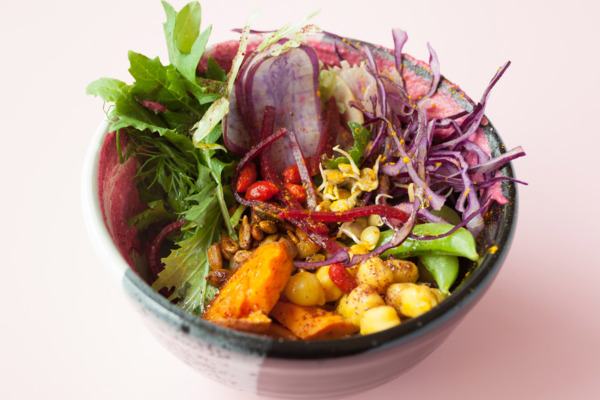
LES lunchtime favorite Cafe Henrie launched dinner service this week, with a beautiful menu of brightly colored, vegetable-heavy dishes like the Gypsy Salad (vegetables, chickpeas and beet tahini) and the tiger bowl (tuna, avocado and black sesame). The new menu is by Camille Becerra (formerly of Navy). Cafe Henrie is riding the wave of the (highly photographable) healthy-food-that-isn’t-health-food trend, as seen in spots like Dimes and El Rey. Their lunchtime success has allowed them to expand service to dinner.

To read more, click here.

Fairway Files for Bankruptcy

03-fairway.w529.h352

As of Monday (but predicted long before), Fairway Market has officially filed for bankruptcy after losing $300 million in five years and accumulating $267 million in debt. According to a statement released by the company, they have a plan underway to restructure debt while keeping all 15 stores in operation and continuing to pay wages, benefits and other obligations.

Fairway CEO Jack Murphy is publicly optimistic, stressing that the bankruptcy deal is the grocery chain’s best opportunity to continue operating and survive the recent turmoil more or less intact. Indeed, the news that all stores will remain open comes as some surprise, since initial reports predicted that at least the poorer performing branches would be forced to close.

To read more, click here.

The New Tech Changing the Guest Experience

In 2015, the foodservice industry saw some major technological changes—the introduction of EMV processing, Apple Pay and NFC adoption, and the continued rise of mobile POS terminals. But how can operators use this new tech to improve the guest experience? That’s what we will be discussing in this month’s Enterprise Insight.

Applying what’s new and hot in tech to your enterprise operations can be a double-edged sword. Thus, we advise our partners to focus on using new systems for the following key experiences: Loyalty, Mobile Ordering, and the Point of Sale.


Loyalty

 Tech-based loyalty programs are the best to engage repeat guests for two reasons: they provide insight and opportunity.

Systems like Square and LevelUp provide guest-specific metrics that a traditional punch card cannot. With these tech-based programs, operators can monitor, when your repeat guests are coming, what they’re purchasing, and how often.

This, then, allows you to more-personally and uniquely reward your best guests. Rather just the tenth cup free, you can reward birthdays, new guests, or stalled guests. This information and opportunity need to be handled appropriately, though; be wary of spending too much or not delivering.

It’s important to be mindful of perception, as well. Starbucks has been in hot water recently for the changes to their loyalty program. Originally, the coffee chain had been rewarding repeat guests with points, which were then redeemed for a product of the guests’ choice. However, when Starbucks changed the system to be based on dollar values rather than visits, guests were outraged. With a close look, though, the economics of the program actually benefit the most frequent guests—but the message wasn’t received as such.

Lastly, be mindful of your costs as you consider your strategy. We always run the numbers at different adoption rates to determine the good and potentially bad impact any program will have on your bottom line.


Mobile Ordering and Delivery

While Americans are dining out more than ever, at lunch they’re bringing that lunch in—or never even leaving. Mobile Ordering is imperative for your operation because it allows guests to place orders with security and comfort; they know that the order was received without anything lost in translation and, with the right technology in place, without even opening their wallets.

Seamless and Grub Hub are the industry titans, but newer start-ups like ChowNow, Brandibble, Olo, and OpenDining are bridging the gap between guest and enterprise: these services integrate directly with restaurants’ websites and apps to create a truly ‘seamless’ experience.

Within high-density areas, the rise of food delivery has evolved a segment of the restaurant industry to new extremes. Mobile Ordering connects diners and operators with a collection of middle-men: the IT team and the delivery team. Now, though, operators are developing their own ordering and delivery platforms with kitchens for a virtual restaurant—no seats, no servers, just delivery drivers and a website. In New York, Maple has seen huge growth and spawned a growing list of similar concepts.


Point of Sale

EMV, Apple Pay and NFC payments are important changes in the industry because they massively change the point-of-sale experience. While EMV actually increases friction—guests are using new equipment that increases the processing time—Apple Pay and NFC actually eliminate this, as well as traditional card swipes. And as with mobile ordering, these systems keep the credit card on file—guests never have to take out their wallet.

Similarly, start-ups like CheckMate are eliminating final step in the service cycle: dropping the bill. CheckMate is designed to make life for the service staff easier by allowing guests to pay for their bill from their phone. Via integrations with the existing POS, CheckMate allows restaurants to drop a “virtual bill,” which guests split, tip, and pay.

As with any new system you implement, you should carefully research, plan, and forecast the necessary components and implications. While these systems are all great individually, they don’t always communicate; for example, LevelUp and Square will not work together. Seamless won’t integrate directly with your point of sale. There are some systems, though, like Toast POS that offer a full suite of add-ons to create a complete ecosystem. And again, at TaraPaige, we ensure that the options we proceed with are the right fit financially, operationally, and experientially.

Retail Spotlight – Syndicated

657fa7862b12c5f91c449a4d83f058c5Their Success… Scrolling through the website for Syndicated, Brooklyn’s latest movie theater/restaurant mash-up, you might notice some curious contrasts. For example, there are the menus – half loaded tater tots/burgers/popcorn, half chatham mussels/smoked lamb ribs/fiddlehead ferns? Or click on their Instagram account, a mix of mouthwatering food photography and film stills that range from the artistic to the (literally) cartoonish. But move on to the calendar of movies and events for the clearest indication that Syndicated has embraced contrast to the fullest.
Syndicated’s monthly calendar is a grab bag of movies both classic and new. Each night features one or two films with up to 4 showtimes; some films run for a few nights, others are screened as one-offs or for special events. During the first week in May, each night is devoted to a single sci-fi flick, be it Mars Attacks or The Fifth Element. In mid April, the Coen Brothers had a week, as did Hitchcock later in the month. Sometimes an obvious theme ties together an entire week, other times guests may not even notice a connection, like the road-trip-week bookended by Fear and Loathing in Las Vegas and Dumb and Dumber.

Most of the movies listed on the calendar are screened in Syndicated’s single screening room, which comes equipped with a table for every two seats and a low-tech but easy ordering system. Theater-specific menus (think nachos, flavored popcorn and ice-cream sandwiches) are hung on clipboards at the tables, and guests can circle their orders. A server collects them and quietly brings the food around during the film, dropping the check shortly before it ends. Movie theaters have been making the majority of their money on concessions for decades, so it only makes sense to elevate that concession list and integrate the food and film experiences completely.

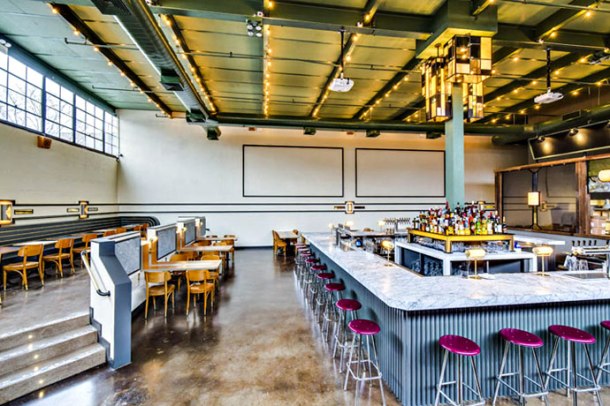
Outside the theater is the main bar/restaurant, a huge room with lofty ceilings and an art-deco aesthetic. There is a central bar with (almost) 360 degree seating, and generously-spaced tables along the edges of the room. Two large projectors on the far wall allow Syndicated to run additional programming (with closed captioning, of course) for guests who might not want to commit to a full movie, but still want the experience of dinner, drinks and a show. Sports bars may have been the first to figure out that guests will stay longer (and order more) if they can watch something while they do, but Syndicated is doing the same with the Oscars, presidential debates, and favorite TV show finales.

The thesis of this project is perhaps best summed up by their occasional “Hi / Low” movie pairings: two movies chosen because they express some underlying theme from very different rungs of the cultural ladder. (In May, for example, that means the dark and intense Shame alongside American Pie) “Hi/Low” is the best expression of what Syndicated aims to be – a  place you can eat great food that’s also junk food, catch up on classic film history or binge watch current tv, and have an extravagant date night that’s still just a casual dinner and a movie. Because sometimes a good night out looks like foreign films and a Spanish red, sometimes it looks like Bill & Ted’s Excellent adventure and a Narraganset, and sometimes it looks like all the above.

Take aways… Syndicated comfortably embraces contrast between the highbrow and the low, filling multiple needs in a playful way that keeps guests surprised and engaged.


7/26: The Four Seasons Auctions Off Its Entire Iconic Interior

fourseasons5.0.jpgDetails were released yesterday about the much-anticipated auction of the furniture and smallwares formerly used at the Four Seasons Park Avenue, and there are certainly more than a few New Yorkers out there already reaching for their pocketbooks.

The auction will be held by Wright Auctions, a Chicago-based company specializing in mid-century design. It will take place on-site on July 26th. The restaurant has long been iconic for it’s interior design and aesthetic; in fact, the architectural fittings and detailing have been landmarked (and as such are among the only items not available for sale). According to Richard Wright, founder and president of Wright Auctions, “[we] have always held a particular focus on modern architecture and design, and this interior so perfectly captures the modern spirit in heroic and elegant fashion.”

There will soon be a catalogue available of the full auction list, but New York collectors can already look forward to the Grill Room’s famous banquettes, the custom tulip tables, and bespoke small wares ranging from wine coolers to pots and pans.

To read more, click here.